When Behavior Becomes the Signal

How continuous behavioral understanding helps security AI recognize risk as it unfolds
The first wave of generative AI in security has been easy to recognize. Large language models are being given access to alerts and logs so analysts can ask questions in natural language, summarize incidents, explain detections, and determine what to investigate next. These capabilities are useful because they can help analysts work faster and make complex security systems easier to navigate. They also reflect a familiar pattern in how new technologies enter security, where the first step is often to improve the workflows teams already have.
The larger opportunity is to rethink where intelligence enters the security process. Today, much of security AI becomes useful only after an alert has fired or an analyst has started an investigation. By that point, the system is already reacting to something it has identified as noteworthy.
The next phase of security AI will move intelligence earlier in the process, toward systems that continuously understand enterprise behavior, preserve context over time, and recognize meaningful changes as they unfold. The goal is not simply to help analysts understand incidents faster. It is to help security systems understand behavior well enough to recognize risk before an incident fully takes shape.
Security telemetry is not language
Most generative AI architectures were designed around language, which makes it tempting to apply the same approach to security telemetry by retrieving relevant logs, placing them into a model’s context, and asking an LLM to reason about the activity. Enterprise behavior does not exist as a collection of documents, and a single event is rarely meaningful on its own. A user opening an application, authenticating to a service, executing a command, or accessing a file may all be completely legitimate.
The meaning comes from the context around those actions, including whether the behavior is normal for that user, whether the device has behaved this way before, what happened immediately beforehand, which applications, identities, and policies are involved, and how the activity compares with historical patterns.
Security is inherently longitudinal, which means understanding it requires models that can preserve relationships across users, devices, applications, identities, policies, and time. That is fundamentally different from asking a language model to summarize text.
From alert intelligence to behavioral intelligence
Much of today’s security AI begins once something has already been identified as interesting. An alert fires, an analyst investigates it, and AI helps summarize the relevant information and determine what to do next.
The more significant opportunity is to move intelligence earlier in that process by continuously building an understanding of enterprise behavior. Instead of asking AI only to interpret alerts, security systems can learn how users normally behave, how systems typically interact, which patterns are expected, and which changes may be meaningful.
Rather than waiting for isolated events to become alerts, security intelligence can evaluate a continuous stream of actions in context as work unfolds. This shifts the role of AI from helping analysts investigate known events to helping identify unusual behavior before an analyst knows which question to ask.
Context matters more than model size
Raw model intelligence is not enough in security. A model also needs to understand the environment in which activity is taking place. A highly capable general-purpose model without that context may be less useful than a smaller system that understands what normal behavior looks like inside that organization.
That understanding starts at the endpoint, where user activity is continuously unfolding. Individual actions may look harmless on their own. Their meaning becomes clearer when they are understood alongside behavioral history, organizational context, and policy. Security intelligence emerges when telemetry is connected to that broader understanding of how people, applications, and systems normally behave.
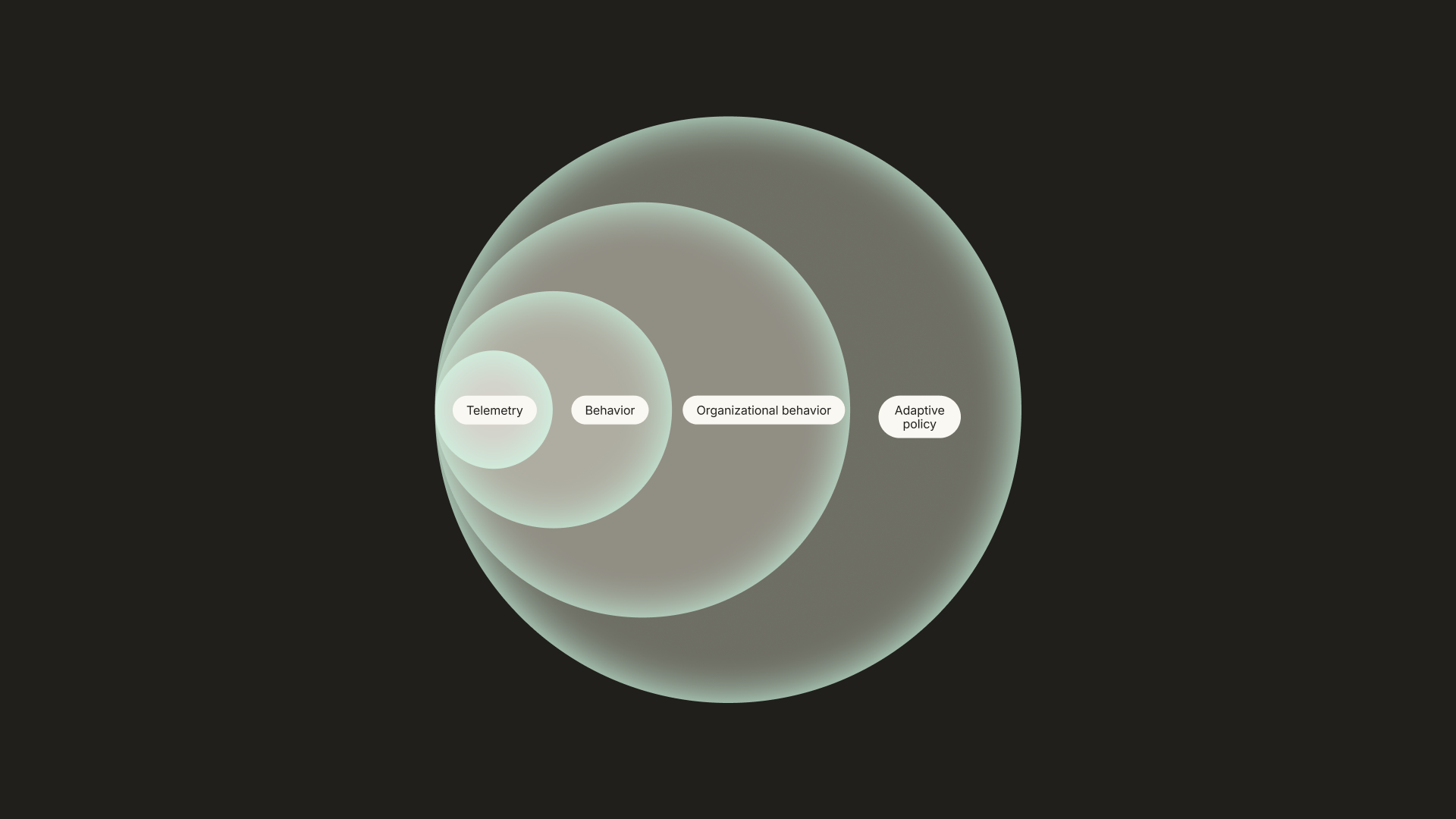
At Ent, we are building AI models that turn endpoint telemetry and user activity into behavioral representations informed by organizational context and policy. This gives security systems a continuously updated understanding of what normal looks like, providing richer context for both real-time decisions at the endpoint and deeper reasoning when additional analysis is needed.
Security intelligence has to be continuous
Security decisions often need to happen in real time, especially when important activity is unfolding continuously on the endpoint. In those moments, milliseconds matter. Continuous security requires intelligence that can keep pace with the stream of actions as they occur, interpreting those actions in context rather than waiting for individual events to become alerts.
Continuous endpoint intelligence operates differently from slower agent workflows that investigate activity after something has already surfaced. Those agents remain valuable for deeper reasoning, investigation, and orchestration, but prevention operates on a different timescale.
That points toward a hierarchical architecture in which smaller models perform continuous behavioral inference with low latency at the endpoint, while larger reasoning systems provide deeper analysis, correlate activity across the environment, and orchestrate more complex response workflows. The two layers serve different purposes. Endpoint intelligence supports immediate understanding and prevention, while larger agents provide deeper investigation when additional analysis is required.
At the endpoint, the UI becomes part of that response layer, enabling direct interaction with end users and supporting interventions as risky activity occurs.
Figure 2 shows how the system combines activity happening now with context learned over time. At the endpoint, inference evaluates the live stream of actions alongside context embeddings that represent previously learned normal behavior.
Separately, context capture supplies new endpoint context to the broader learning system, which builds and updates behavioral baselines across users, departments, and the enterprise.
Those updated baselines are periodically returned to endpoints, helping inference support an immediate UI intervention or trigger an investigation agent when deeper analysis is required.
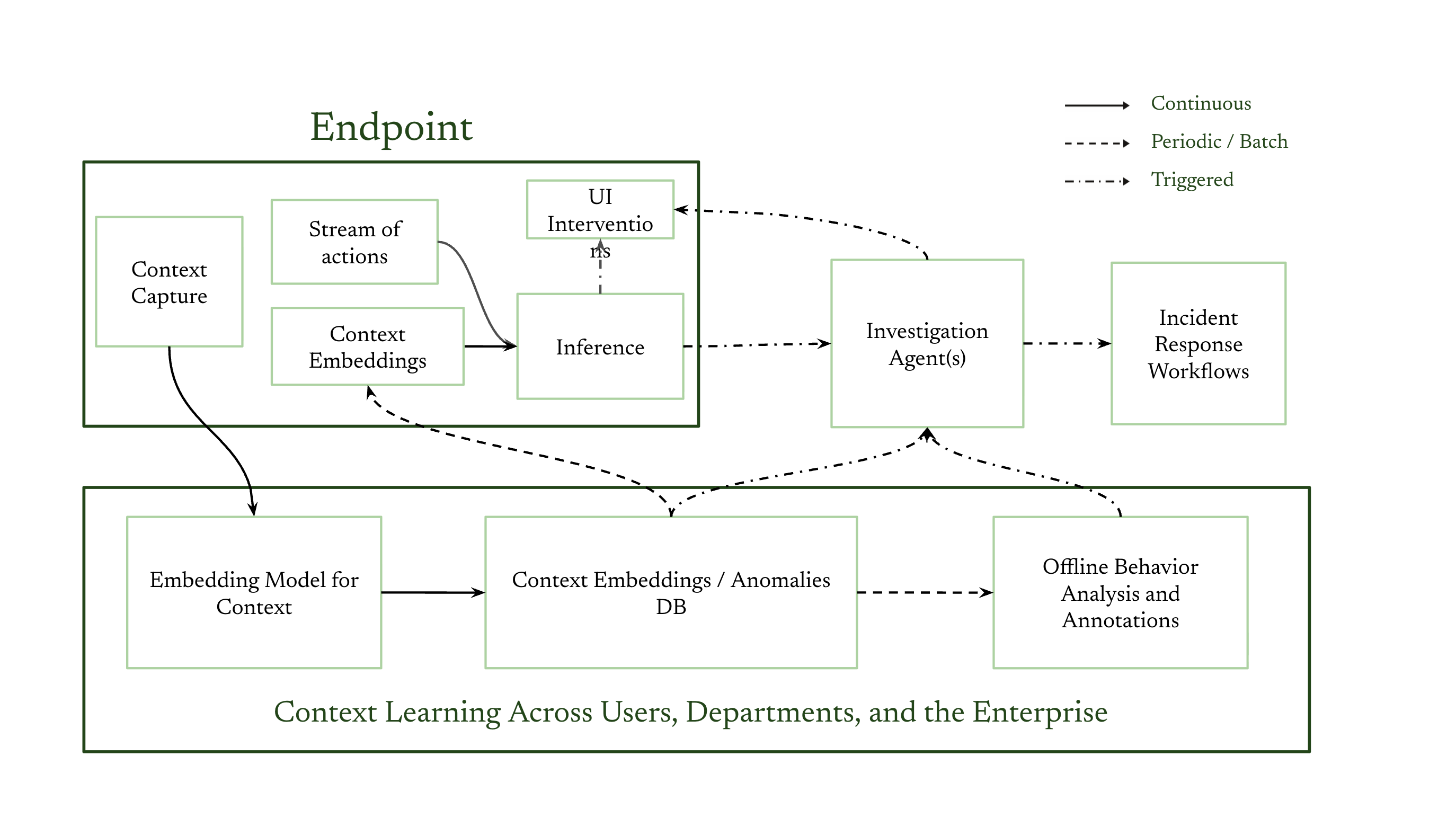
The goal is not to replace large language models, which remain valuable for reasoning, investigation, and orchestration, but to use them as one layer within a broader system. In this architecture, inference at the endpoint supports continuous, time-sensitive decisions, while larger models and agents handle more complex analysis and response. Together, these layers move security AI beyond explaining what has already happened and toward recognizing and preventing risk as it unfolds.
Building for continuous understanding
The opportunity for security AI is to move from helping teams make sense of alerts to recognizing meaningful behavior as it happens. Getting there requires systems that can maintain an understanding of what is normal for an organization and use that understanding to identify risk earlier. It also requires security intelligence that can operate at the speed of the activity it is protecting, rather than waiting for a slower investigative workflow to determine what happened.
That is the direction we are building toward at Ent, creating security that continuously understands behavior and helps teams act before risky activity becomes an incident.