What’s Old Is New, Fast, & Everywhere: Artex, Cairn, and The Impact of AI Enabled Attacks

Recently, I was reading some news and came across a significant warning:
“A recent report by market research firm Forrester into software security threats found that attacks “explode after unscrupulous hackers build scripted versions.” Many critics agree, saying such exploit-testing scripts–which turn a highly technical vulnerability into code that can be run with a few commands–allow far too many people to become online attackers. ‘There will be about 10 academics and serious researchers who may find this interesting and about 10,000 kiddies who will blow each other’s virtual brains out, with enterprise security folks caught in the middle,’ said Peter Lindstrom, the director of research for security consultancy Spire Security.”
It would be easy to assume I was reading about the recent rash of attacks where adversaries use tools like Artex, Cairn, HexStrike, or PentAGI (among many others, with hundreds of available forks). But that quote was actually from 2004 (my news backlog is really getting the better of me) and wasn’t about a new AI red-teaming framework being used by bad guys, but instead about the original red-teaming framework: Metasploit, from a CNET article titled Security tool more harmful than helpful? by Robert Lemos.
While it’s easy to be tongue-in-cheek, two things can be true: while this new breed of AI tools isn’t unprecedented, nor are they doing anything entirely novel, much like the release of tools such as Metasploit Framework, Cobalt Strike, and Mimikatz, they are having and will continue to have a significant impact on the threat landscape.
Ultimately, AI-driven attack tools do three things:
- Lowering the Skill Floor: Just as coding agents give inexperienced users access to software development capabilities they didn’t have before, these offensive tools are enabling individuals with intent, but not skill, to execute cyberattacks. Cobalt Strike had a similar impact, perhaps even more so than Metasploit.
- Raising the Operator Ceiling: At the same time, these tools allow experienced attackers to scale based on the amount of compute rather than the number of operators, deploying their techniques and malware widely after minimal setup. Metasploit did the exact same thing, standardizing the industry and replacing bespoke solutions.
- Giving Noise to Hide In: The last change, and perhaps the least discussed, is how capabilities like this provide plausible deniability to adversaries by letting experienced operators use a publicly available tool rather than bespoke (and attributable) capabilities. This signal reduction makes it harder for defenders to understand what they’re facing. Mimikatz had a similar impact.
This represents a democratization of capabilities rather than entirely novel capabilities. As defenders, we need to respond, and we need to respond thoughtfully. So what can and should we do?
A Closer Look
The quintessential example of these tools in action is attackers using ARTEX in October of 2026. STORM-0940 has been an active threat group since 2021 and, according to Microsoft, started using ARTEX in September 2026.

From October 10-14 the adversary started an automated, cross-tenet password spraying against 327 accounts across 8 organizations (from 144.172.64[.]99 which aligns with ConnectWise’s own advisory) according to Microsoft and Huntress. The result? No successes but 151,000 (!!!) failed logins. Also on the 14th, according to Huntress, the adversary accessed ConnectWise’s Cloud Backup (formerly SkyKick), acquired through unknown means.
The next day, October 15 starting at 01:58, Huntress observed ConnectWise Cloud Management service principles (Exchange Online, Teams, Graph) gave themselves directory roles, primarily Exchange Administrator roles, on 50 ConnectWise customers. By around 03:45 the adversary started scripted post-compromise activity against ConnectWise Cloud customers. Later that morning, between 06:13-08:33 the Cloud Backup app signed into customer tenants and gets Microsoft Graph tokens and logged into 173 tenants.
Once detected ConnectWise undertook a two week comprehensive incident response, publishing their own advisory, revoking certificates, credentials, and applications, evaluating other services, and restoring service, fully restoring service on November 4.
What makes this intrusion unique is not the actions taken or the techniques used, but the scale and speed. In under a day, perhaps under 12 hours, the adversary went from one credential to compromising 173 tenants. They tested 151,000 compromised credentials, escalated privilege against 50 tenants, scripted post-compromise activity, etc. The individual actions are common, the scale and speed is what’s unique. At the same time it was loud, not stealthy. Offensive LLM tools are trained to achieve objectives, and often do so aggressively.
Near, Far, and Forever
So what can we learn from the STORM-0490 campaign:
In the short term, take advantage of the fact that these tools are loud. Much like a coding harness such as Codex or Pi, a lot of what happens is driven by how they’re prompted, which means less-skilled attackers will get less-than-ideal results. Their actions can be sloppy, loud, and generic enough that solid detection fundamentals should pick them up.
Longer term, it’s clear that if offense scales with AI, defense must scale similarly. This applies to all aspects of security, including offensive testing, vulnerability management, incident response, and intrusion detection.
One thing we saw ConnectWise did really well, based on the speed of their response, is once they became aware they had a rapid and comprehensive response. This included sharing a huge amount of intelligence useful to other defenders. Defenders cannot decide when or where they get attacked, but can define how they respond to it. Building tools and automation (AI tool development works for defenders too), building processes and procedures, running table tops, all of these things mean when an incident happens you can respond well the way ConnectWise did.
Lastly, we have to acknowledge that IOCs, while still useful for investigation and cyber threat intelligence, are by and large dead for pure detection. Malware can be written and rewritten constantly, making hashes unusable and minimizing the effectiveness of signatures. IPs and domains face similar challenges, just look at Lumen’s Silent Train reporting. Yet adversaries still need to perform most of the same core actions as always: establish persistence, communicate, collect data, and exfiltrate it.
The View from the Top of the Pyramid
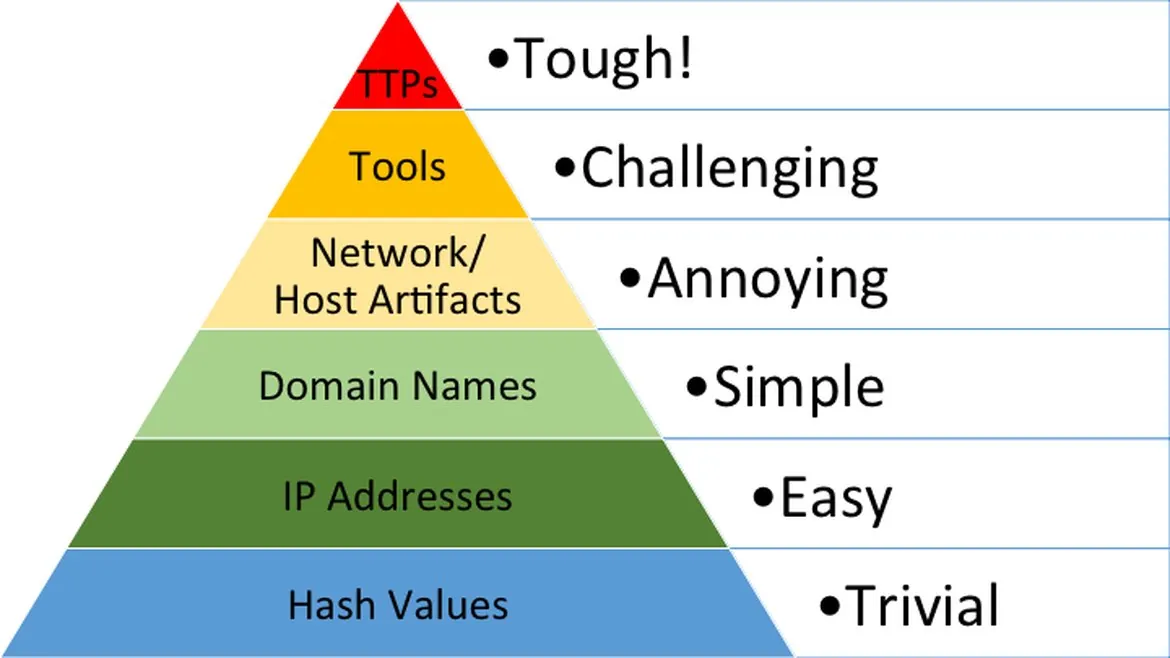
If we look back at David Bianco’s Pyramid of Pain, we have to admit that things have changed. The Pyramid, fundamentally, is based on how much pain an adversary faces when changing things we can detect. Hash values were always just a recompilation away from changing. Near the bottom, we saw IP addresses and domains become less useful with the rise of FastFlux DNS. Now, with LLM-based tools and the ability to rapidly rebuild platforms, malware families, and communication protocols, as well as automate infrastructure development (including compromised infrastructure like Operational Relay Boxes), we must acknowledge that even Network/Host Artifacts and Tools have shifted from "Annoying & Challenging" to "Trivial."
The one approach that transcends all adversary activity, whether driven by new tools, experienced operators hands-on-keyboard, or whatever comes next, is to understand what's happening on our systems foundationally. We achieve this by detecting and responding to adversary tactics, techniques, and procedures (TTPs) based on the intent of the activity rather than its transient artifacts.
See the platform in action and schedule a demo with the team.