12 Best UEBA Tools For Insider Threat Detection (2026)

Insider threats rarely look like attacks. A finance analyst saves the monthly report to a personal drive, or a service account signs in from a host it has never touched. User and entity behavior analytics (UEBA) tools exist to catch that kind of activity.
They learn the baseline activities of users and entities (devices, service accounts, and applications) from logs, identity data, and network telemetry. Then, they risk-score deviations that could signal an insider threat, compromised credentials, or lateral movement. Some UEBA tools ship as standalone products, but most live inside a security information and event management (SIEM) or extended detection and response (XDR) platform.
The cost of missing insider activity keeps climbing. The 2026 Cost of Insider Risks report from Ponemon Institute and DTEX puts the average annual cost of insider risk at $19.5 million per organization. That’s up from $17.4 million in 2024.
This guide sorts 12 UEBA tools into four categories that match how security stacks are built, starting with intent-aware AI endpoint security. Each entry covers who the tool is for, one notable feature, one limitation, and pricing (when available). Use it to build a shortlist before you sit through a dozen demos.
TL;DR
- Most UEBA tools learn a baseline of normal behavior, then alert on deviations after they happen. Very few can step in while a risky action is still in progress.
- SIEM-native UEBA fits teams that want behavioral analytics inside the console they already run. Dedicated and data-centric platforms go deeper on insider, identity, or data-access risk.
- AI agents are the new blind spot. Only a handful of vendors treat them as first-class entities so far.
- Intent-aware AI endpoint security reads human and AI agent activity in sequence and can intervene before risky work completes. It works alongside your SIEM.
- Most vendors in this space do not publish any pricing details. Expect a sales conversation before you can compare costs.
What To Look For In A UEBA Tool
On paper, most UEBA tools promise the same baselines, risk scores, and alerts. Weigh these six factors to separate tools that fit your environment from platforms that just add another console.
Baselining method and time to value
Most tools use unsupervised machine learning (ML) to learn each user’s normal pattern and compare it with a peer group of similar roles. Ask how the baseline is built and how long it takes. Documented training periods run from about a day to roughly three months.
Breadth of entities covered
Early UEBA products only watched human users. Modern environments also run service accounts, Internet of Things (IoT) and operational technology (OT) devices, and AI agents acting with a user’s access. Machine identities, including AI agents, now outnumber human identities 109 to 1, according to Palo Alto Networks.
Data source integration
UEBA is only as good as the data it sees. Count how many sources connect natively, including your identity provider (IdP), endpoint detection and response (EDR), cloud, and data loss prevention (DLP) tools. Every custom connector is one more parser your team has to maintain.
Alert quality and investigation tooling
Look for risk scoring that rolls many weak signals into one prioritized case. Automated incident timelines and peer-group context shorten triage. The simplest test is whether the tool cuts the number of alerts your analysts touch or adds to it.
Response model
Most UEBA tools raise an alert and wait for an analyst. A few can act in the moment by warning a user, pausing an action, or blocking it. Decide which model you need before you build a shortlist.
Deployment and pricing model
UEBA comes either as a module on an existing SIEM or as a separate platform with its own agent and console. Few vendors in this space publish per-seat pricing.
Best For Intent-Aware AI Endpoint Security
This newer category takes a different approach to insider risk than baseline-and-anomaly UEBA. It evaluates the intent behind human and AI agent actions as they happen. It can also step in before risky work completes.
Ent
Ent runs one lightweight agent across Windows, macOS, Linux, and modern browsers. It connects user activity, AI agent actions, applications, data, and process execution into a single sequence. Local AI reasoning and deterministic policy then decide whether each action should continue.
Best for: Security teams whose insider-risk surface now includes AI agents and coding assistants acting with a user’s access.
Notable feature: Inline prevention. Ent can warn a user, require a justification, constrain or redact an action, escalate it, or block it before it completes.
Limitation: Ent isn’t built for SIEM-style log retention or compliance reporting.
Pricing: Quote-only.
Best For SIEM-Native And SIEM-Augmenting UEBA
These UEBA tools are built into or layered onto a SIEM. They fit teams that want behavioral analytics without adding a fully separate console.
Exabeam
Exabeam builds statistical, histogram-based profiles for each user and entity. It compares anomalies against a peer group of people in similar roles, then opens an incident automatically once a risk crosses a threshold. Its UEBA runs inside New-Scale SIEM or as an analytics layer on a SIEM you already own.
Best for: Teams that want deep UEBA on top of an existing SIEM, or a behavior-first SIEM replacement.
Notable feature: Agent Behavior Analytics. In January 2026, Exabeam extended UEBA to AI agents, a move it calls an industry first.
Limitation: After its July 2024 merger with LogRhythm, Exabeam runs two lines: cloud-native New-Scale and self-hosted LogRhythm SIEM. Buyers have to sort out which product fits before they can compare prices.
Pricing: Quote-only. Vendr’s buyer data shows a median price of $210,252 a year.
Splunk Enterprise Security (UEBA)
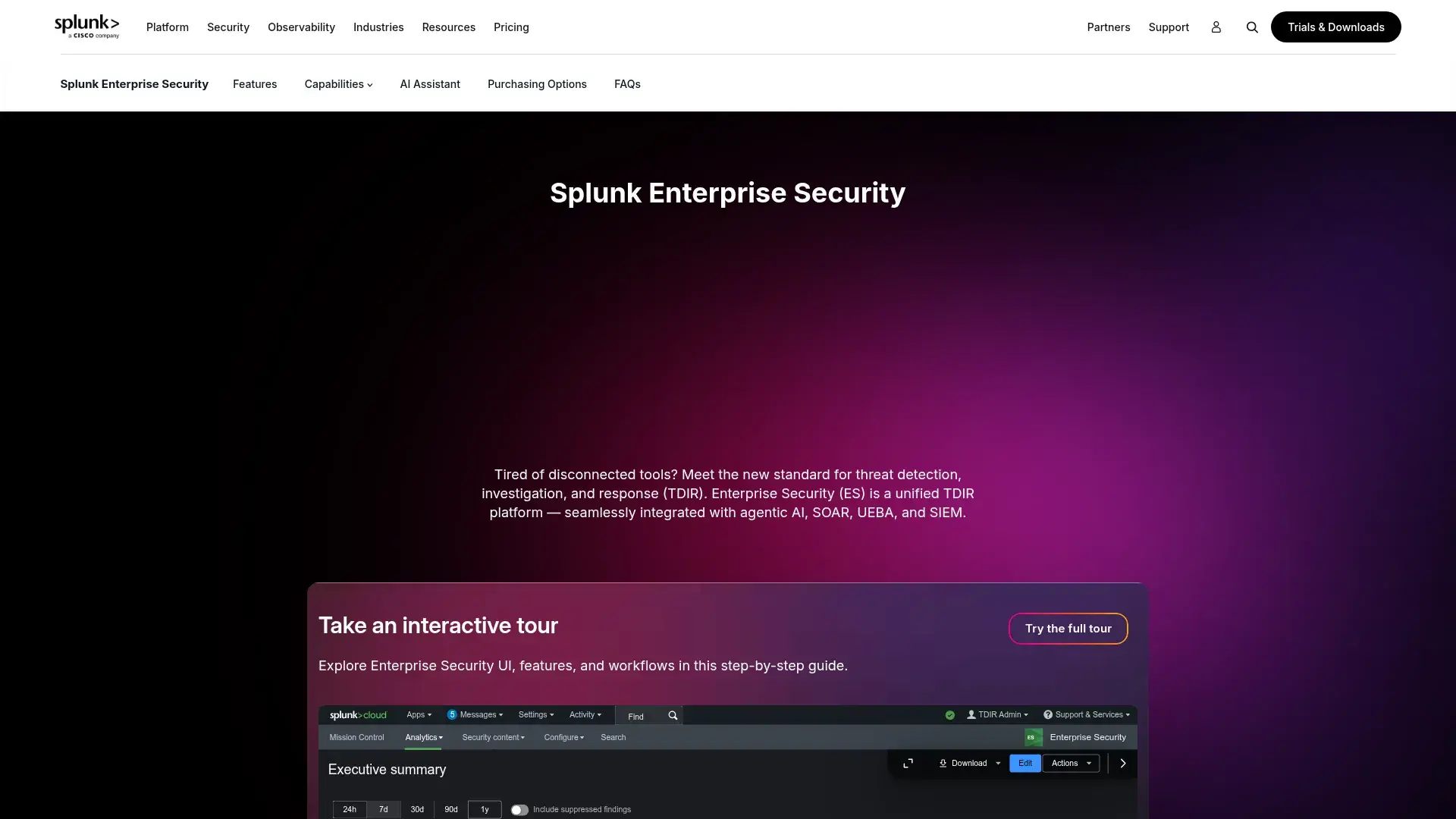
Splunk Enterprise Security (ES) continuously baselines users, devices, endpoints, and cloud applications with multiple ML models. Analysts get peer-group comparisons as context for each anomaly.
With Cisco completing its acquisition of Splunk in March 2024, Splunk User Behavior Analytics (UBA) is no longer sold as a separate product. Splunk stopped selling it in December 2025 and ends support on January 31, 2027, per its end-of-sale FAQ. UEBA now ships only inside ES Premier, and there’s no migration path from UBA.
Best for: Organizations already standardized on Splunk that want behavioral analytics without another platform.
Notable feature: Scale. A single cloud tenant supports up to 3 million users and 3 million devices.
Limitation: UEBA requires the top Premier tier, and costs climb with data volume. One IT analyst wrote, “One of the biggest challenges is its licensing cost, especially for organizations that ingest large volumes of data.”
Pricing: Quote-only. Splunk offers activity-based, workload, or ingest pricing. Vendr estimates ES list pricing at $250 to $400 per gigabyte (GB) of daily ingest.
IBM QRadar SIEM
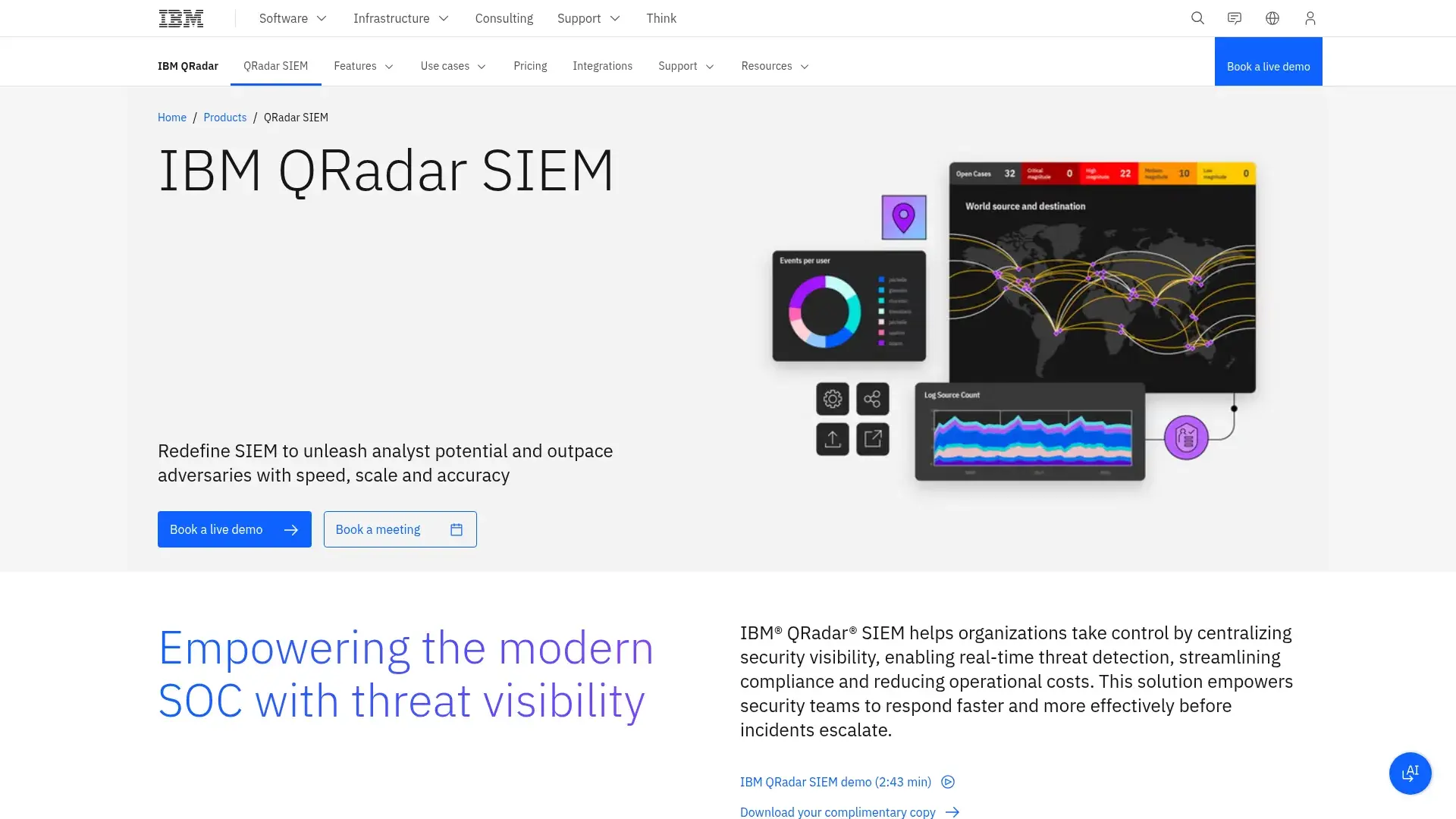
IBM QRadar SIEM adds UEBA through an app that profiles users with time-series analysis and clustering. Baselines draw on each user’s events and those of similar peers, using more than four weeks of history. Risk scores also decay over time, letting stale anomalies fade.
IBM sold its QRadar SaaS business to Palo Alto Networks in 2024, and cloud customers now move to Cortex XSIAM. On-premises QRadar is still in development, and version 7.6.0 shipped in June 2026.
Best for: Existing on-premises QRadar shops that want UEBA without new licensing.
Notable feature: Cost. IBM offers the UEBA app to QRadar clients at no additional cost.
Limitation: The app needs 64 to 128 GB of memory on the console and tops out at 400,000 users. Its last release shipped in May 2024.
Pricing: Quote-only for QRadar SIEM. The UEBA app itself is free for QRadar clients.
Microsoft Sentinel
Microsoft Sentinel builds dynamic behavioral profiles for users, hosts, IP addresses, and applications. It ranks each user’s top 20 peers from shared security groups and mailing lists, then scores anomalies against both. You turn UEBA on in settings and choose Active Directory, Entra ID, or both as user sources.
Best for: Microsoft-centric organizations that want UEBA at no extra license cost.
Notable feature: The UEBA behaviors layer. It turns raw logs into plain-language “who did what to whom” summaries mapped to MITRE ATT&CK.
Limitation: UEBA works best on Microsoft identity data, and several third-party sources only work in the Defender portal. Costs can also drift. A cybersecurity consultant called cost management “still one of the biggest pain points.”
Pricing: Published. The analytics tier lists at $4.30 per GB pay-as-you-go in East US, and a 100 GB-per-day commitment costs $296 a day. UEBA adds no license cost, but its tables incur storage charges.
Securonix
Securonix Unified Defense SIEM bundles SIEM, UEBA, security orchestration, automation, and response (SOAR), and threat intelligence in one cloud-native platform. Its UEBA engine flags deviations from individual or peer-group patterns, such as rare access, abnormal volume, or unusual tool use. Users, service accounts, and AI agents are all named entities.
Best for: Teams that want a consolidated cloud SIEM, or deeper UEBA on top of Microsoft Sentinel. Securonix’s Threat Analytics for Microsoft Sentinel adds UEBA to existing Sentinel data without a SIEM replacement.
Notable feature: The Insider Intent Agent. It correlates behavioral, linguistic, and AI-interaction signals, and privacy controls support approval-based unmasking of user identities.
Limitation: Behavioral rules can get noisy. One user noted that behavioral analytics “sometimes triggers due to legitimate actions.” Current product pages also list no on-premises option.
Pricing: Consumption-based. Securonix charges no separate fees for SOAR, UEBA, or analytics. Vendr reports a median of $67,750 a year.
ManageEngine Log360
ManageEngine Log360 offers UEBA as an add-on that baselines expected activity for each user and host. Dynamic peer grouping lowers a risk score when an anomaly matches peer behavior. Scores roll up into five categories, including insider threats, data exfiltration, and compromised accounts.
Best for: Small and midsize IT teams that want SIEM and UEBA at a lower entry price.
Notable feature: Fast training on Log360 Cloud. Time-based models need one day of data, and pattern-based models need about seven days.
Limitation: On-premises UEBA is a separately licensed add-on, and Log360 updates don’t update it. ManageEngine also doesn’t publish its risk-score scale or algorithms.
Pricing: Quote-only for on-premises Log360. Capterra lists Log360 Cloud from $300 a year, though UEBA inclusion at that tier isn’t confirmed.
Rapid7 Incident Command
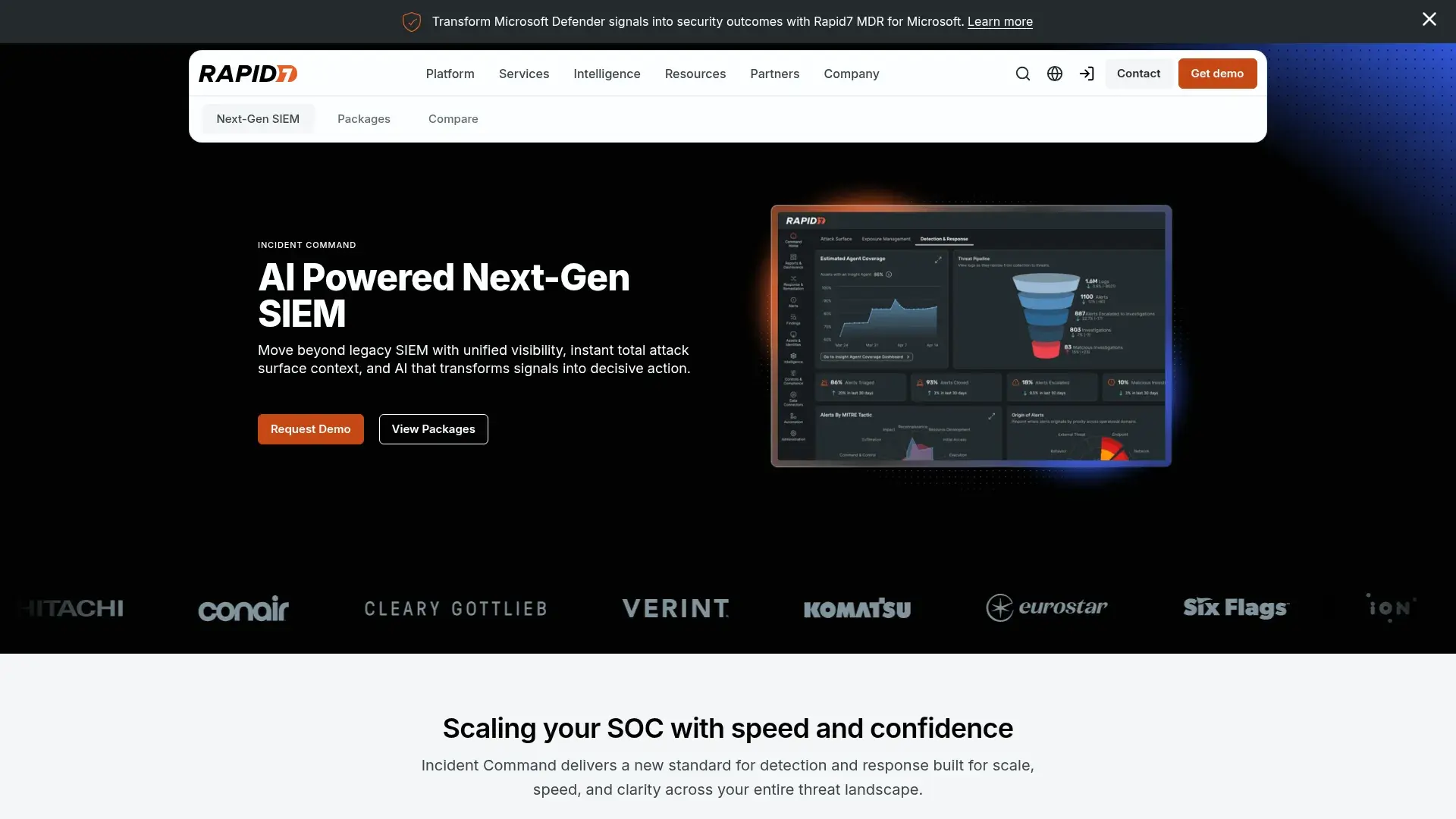
Rapid7 now markets InsightIDR as Incident Command, an AI-powered next-gen SIEM for hybrid environments. Its UEBA watches for lateral movement, privilege abuse, and anomalous access. Baselines take 21 days for new users and 14 days for new assets.
Best for: Midsize teams that want UEBA and deception tools in one cloud SIEM.
Notable feature: Deception technology. Honeypots, honey users, honey files, and honey credentials run from the Rapid7 agent with no extra setup.
Limitation: Rapid7 relabeled its UBA rules as “Legacy UBA Detection Rules” and is moving them into a new detection library. No end-of-life date is stated. Ask about the roadmap before you commit.
Pricing: Asset-based. The vendor’s pricing page shows tiers but no figures. TrustRadius relays a historical list price of $5.89 per asset per month for the Advanced tier, and the minimum is 500 assets.
Best For Dedicated Identity And Insider-Risk UEBA Platforms
These products focus on user, identity, and insider behavior, and some bundle UEBA into a broader security suite. Most teams buy them alongside a SIEM.
Gurucul
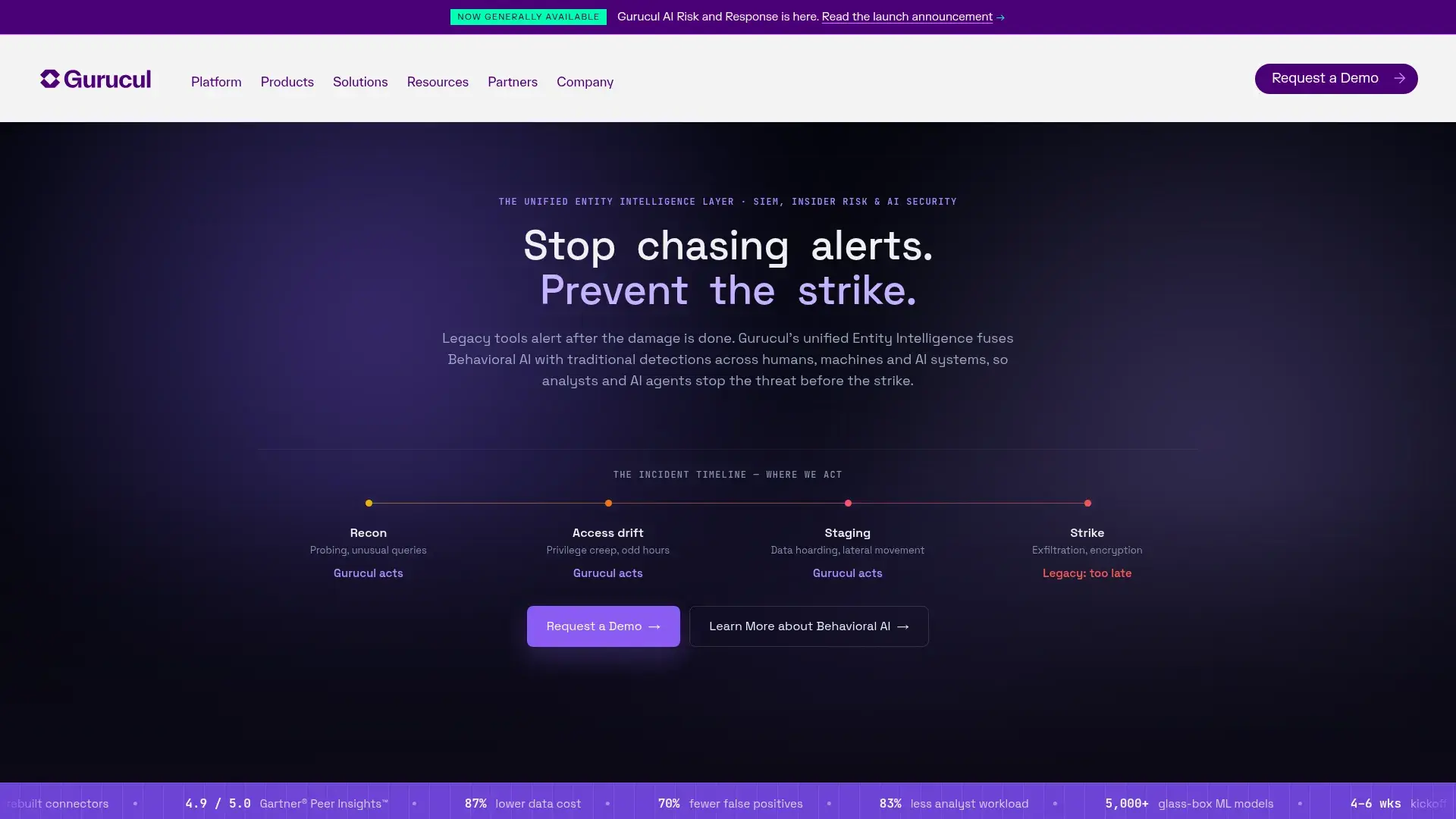
Gurucul runs UEBA on its REVEAL platform with a library of more than 5,000 ML models. It scores risk from 0 to 100 and links evidence into cases with its patented Link Chain Analysis. Built-in models start detecting on day one, and baselines refine as data arrives.
Best for: Large enterprises that want one analytics layer across insiders, machines, service accounts, and AI agents.
Notable feature: Breadth. Gurucul lists 450+ data source integrations and supports agentless or agent-based collection.
Limitation: It’s a heavy enterprise platform with a learning curve. Gurucul doesn’t document how it builds peer groups, and its accuracy claims are vendor figures.
Pricing: AWS Marketplace lists Gurucul SaaS UEBA at $46,986 for 12 months and 1,000 units. The listing doesn’t define a unit. Confirm scope with sales.
Teramind
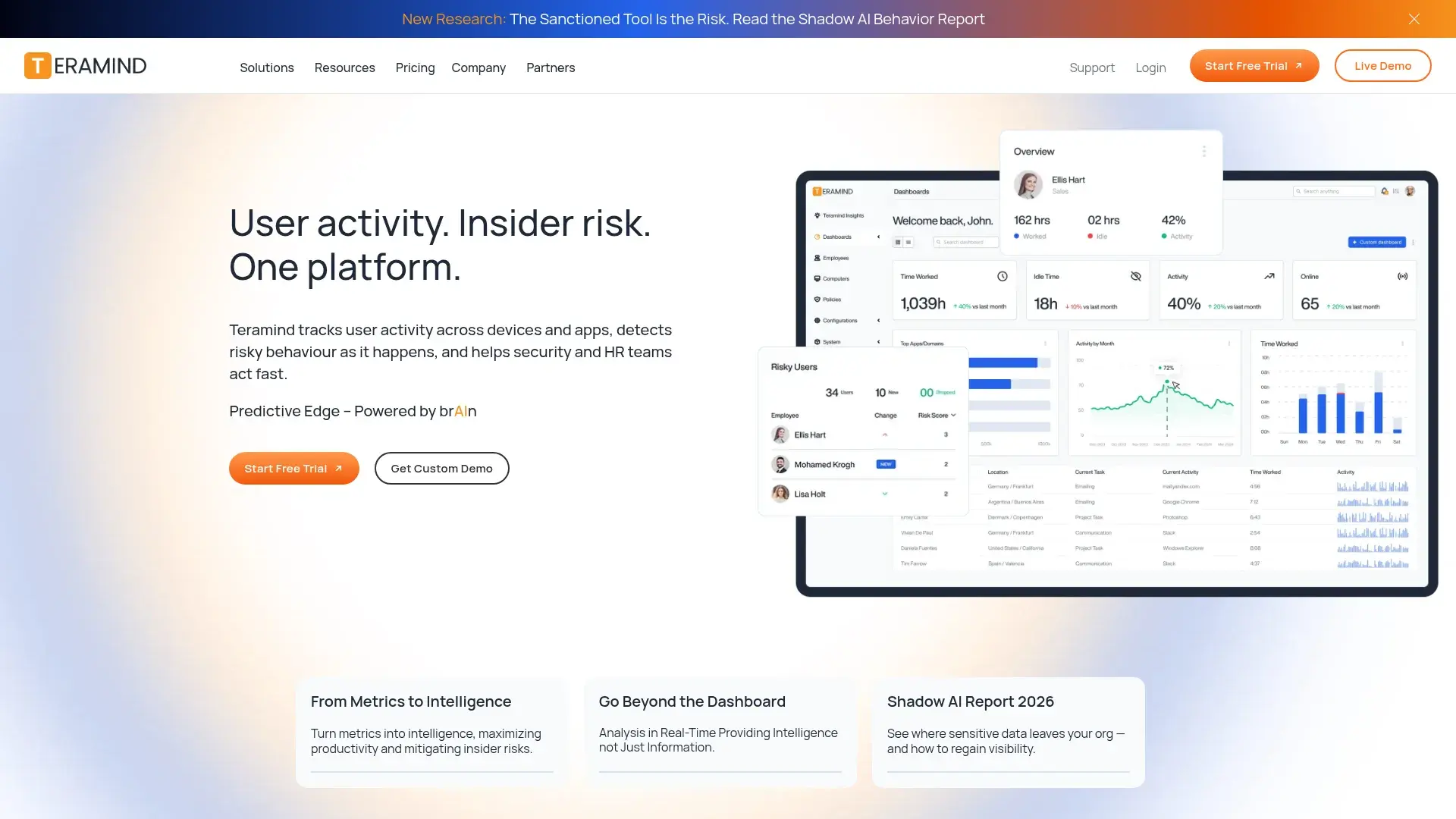
Teramind records user activity on endpoints and uses ML to establish baseline behavior and flag anomalies. It captures live and historical screen recordings and reads on-screen text with optical character recognition (OCR). Custom rules alert on activity like large file transfers or unauthorized app use.
Best for: Organizations that need detailed user-activity evidence for insider investigations.
Notable feature: Session-level evidence. Screen recordings and OCR give investigators a replay of exactly what a user did.
Limitation: Screen and keystroke-level capture is invasive. Expect legal and HR review in privacy-regulated regions, even with built-in blurring and exclusion controls.
Pricing: Per seat, according to a third-party listing. G2 lists the monthly costs of the Starter tier at $15, user activity monitoring (UAM) at $30, and DLP at $35. The minimum is five users, and Enterprise pricing is custom.
Cynet
Cynet sells three packages (Protect, Elite, and All-in-One), and all of them include user behavior analytics. It pulls data from identity systems like Active Directory and network telemetry to flag unusual sign-ins, impossible travel, and session hijacking. Identity threat detection and response (ITDR) is an add-on in Elite and included in All-in-One.
Best for: Lean security teams that want UEBA, endpoint protection, and managed detection and response (MDR) from one agent.
Notable feature: Included MDR. Cynet’s 24x7 CyOps team comes with the Elite and All-in-One packages.
Limitation: UEBA is one module of a broader suite. Cynet publishes little detail on how its baselines work, and MDR requires Elite or above.
Pricing: Quote-only, based on package, environment size, and add-ons. A 14-day free trial is available.
Best For Data-Centric UEBA
This category applies behavioral analytics specifically to how people access and move data.
Varonis Data Security Platform
Varonis uses ML to build behavior profiles and baselines for every user and device. It alerts on unusual file access, email activity, permission changes, and geo-hopping. Coverage spans on-premises file shares, Microsoft 365, the major clouds, and popular SaaS apps.
Best for: Teams whose biggest insider risk is sensitive data in file shares, Microsoft 365, and SaaS.
Notable feature: Copilot monitoring. Varonis collects and enriches Microsoft 365 Copilot events and flags suspicious Copilot interactions with sensitive data.
Limitation: The focus is data and identity. There’s no endpoint screen or keystroke visibility. Initial setup and customization can take time.
Pricing: Quote-only, priced per user per year. Vendr reports a median of $88,044 a year.
At-A-Glance Comparison
The table compares all 12 tools on category, entity coverage, deployment, and pricing model. Of note, eight of the 12 tools only provide pricing as part of a quote, with only Microsoft Sentinel and Gurucul widely publishing those figures.
Tool Category Entities covered Deployment Pricing model Ent Intent-aware AI endpoint Users + AI agents + apps SaaS or customer-controlled Quote-only Exabeam SIEM-native Users + devices + NHIs + AI agents Cloud or self-hosted Quote-only Splunk ES SIEM-native Users + devices + cloud apps Cloud or on-prem Quote-only IBM QRadar SIEM SIEM-native Users + assets On-prem Quote-only (UEBA app free) Microsoft Sentinel SIEM-native Users + hosts + apps + service principals Cloud Published (per GB) Securonix SIEM-native Users + service accounts + AI agents Cloud Quote-only ManageEngine Log360 SIEM-native (add-on) Users + hosts On-prem or cloud Quote-only (cloud starting price listed) Rapid7 Incident Command SIEM-native Users + assets + service accounts Cloud Asset-based (no published figures) Gurucul Dedicated Users + devices + service accounts + AI agents Cloud, on-prem, or hybrid Listed on AWS Marketplace Teramind Dedicated Endpoint users Cloud or self-hosted Per seat (third-party listing) Cynet Dedicated (XDR module) Users + endpoints + cloud accounts SaaS Quote-only Varonis Data-centric Users + devices Cloud SaaS with on-prem coverage Quote-only
(NHI stands for non-human identity, such as a service principal, API key, or AI agent.)
What UEBA Tools Still Miss
Nearly every tool above works the same way at its core. It learns a baseline, spots a deviation, and raises an alert. But by the time an analyst opens that alert, the file has usually moved, or the credential has been used.
That delay is expensive. Insider incidents take an average of 67 days to contain. A detection-only model can shorten that window, but it can’t close the gap between the risky action and the response.
The second blind spot is AI agents. Most UEBA engines were designed around human users, and agent coverage is usually bolted on.
In the 2026 Ponemon and DTEX study, only 19% of organizations classify AI agents as equivalent to human insiders. Nearly half have minimal or no visibility into agent activity.
AI use is already part of the insider picture. Verizon’s 2026 Data Breach Investigations Report found that shadow AI is now the third most common non-malicious insider action in its DLP dataset. Exabeam, Securonix, and Gurucul now name AI agents as entities, while Splunk, QRadar, and Sentinel documentation doesn’t mention them yet.
Where Ent Fits
Ent is an AI endpoint security platform for both human and agentic work. It isn’t a baseline-and-anomaly UEBA product, but rather reads activity on the endpoint in sequence and asks three questions: what is happening, why is it happening, and should it continue?
That sequence matters because individual actions often look legitimate. A process runs, a file opens, or an agent calls a tool, and none of it stands out alone. Ent connects user activity, agent actions, applications, data, scripts, and process execution so the risk shows up when the steps are read together.
Andrew Cal, CISO at WestCap, described the problem this way. “Modern work creates signals that can look identical on the surface, even when the intent is completely different.”
How Ent decides and intervenes
Ent combines deterministic policy, behavioral intelligence, and local AI reasoning on the device. A custom small language model classifies sensitive data where it’s used and tracks how it moves. Because the reasoning runs locally, Ent can respond before an action completes, from a warning or justification prompt to redaction or a block.
Ent also controls execution. It sets which applications, scripts, and tools can run and what they’re allowed to do. That shrinks the room for living-off-the-land abuse, unauthorized tooling, and risky agent actions.
Because activity arrives as one connected sequence, analysts spend less time stitching logs together and chasing isolated alerts. Ent also preserves that sequence for investigation after an intervention.
One policy for people and AI agents
Ent applies one programmable policy to human and AI agent behavior. That matters as more of the insider-risk surface shifts to tools like Claude Code, Cursor, GitHub Copilot, and OpenAI Codex acting on a user’s behalf. The same policy can steer people to sanctioned AI tools and stop sensitive content before it reaches an unapproved one.
Deployment is flexible, too. Ent supports SaaS or customer-controlled deployment in users’ own cloud. That keeps sensitive telemetry and processing inside your environment where data sovereignty requires it.
How Ent fits with your SIEM
Ent can consolidate several point tools under one context and enforcement layer. That includes endpoint insider-risk and UEBA-style user monitoring, legacy DLP, and application control. It doesn’t replace the log correlation, retention, and compliance reporting your SIEM provides.
Most teams will run Ent next to their SIEM. It’s the right fit when your emerging risk is AI agent and insider activity that looks legitimate on the surface.
Read how Ent approaches security telemetry for intent, or schedule a demo to see how it protects work as it happens on your own endpoints.
Frequently Asked Questions
What’s the difference between UBA and UEBA?
User behavior analytics (UBA) watches people. UEBA adds entities such as devices, servers, service accounts, and applications. Gartner coined the UEBA term in 2015 to reflect that broader scope.
What’s the difference between UEBA and SIEM, and do you need both?
A SIEM collects, stores, and correlates logs for detection, investigation, and compliance. UEBA analyzes behavior in that data to surface threats that static rules miss, like a valid account acting out of character.
Most teams benefit from both. That’s why so many SIEMs now ship UEBA as a built-in feature.
How much do UEBA tools typically cost?
Microsoft Sentinel and IBM QRadar include UEBA at no extra license cost, though you still pay for the SIEM underneath. Vendr medians for quote-only platforms run from $67,750 a year (Securonix) to $210,252 (Exabeam). Per-seat tools like Teramind start at $15 per user per month.
Can UEBA tools replace a SIEM entirely?
Usually not. Standalone UEBA tools typically rely on a SIEM or data lake for log collection, long-term retention, and compliance reporting. Platforms that bundle both, like Exabeam New-Scale Fusion or Securonix Unified Defense SIEM, are the main exception.
Do UEBA tools monitor AI agents and non-human identities yet?
Some do. Exabeam, Securonix, and Gurucul name AI agents as monitored entities, and Sentinel ingests service principal and managed identity sign-ins. Many others still focus on human users, service accounts, and devices.
Intent-aware tools like Ent take a different route. They apply the same policy to human and AI agent activity on the endpoint.
How long does it take to get useful baselines after deploying a UEBA tool?
Training periods run from about a day to three months. Log360 Cloud trains time-based models on one day of data. Rapid7 sets 21 days for new users, and Exabeam examines 60 to 90 days of logs before scoring.
Sentinel works differently. Each of its signals compares against a lookback window of 5 to 180 days.