The OAuth Consent that Wasn’t

Three seconds from email to website
We recently observed a phishing attempt in a customer environment that started with a familiar request: review the updated employee handbook. The organization had already been warned about the campaign and had blocked the messages based on the subject line. Several still got through.
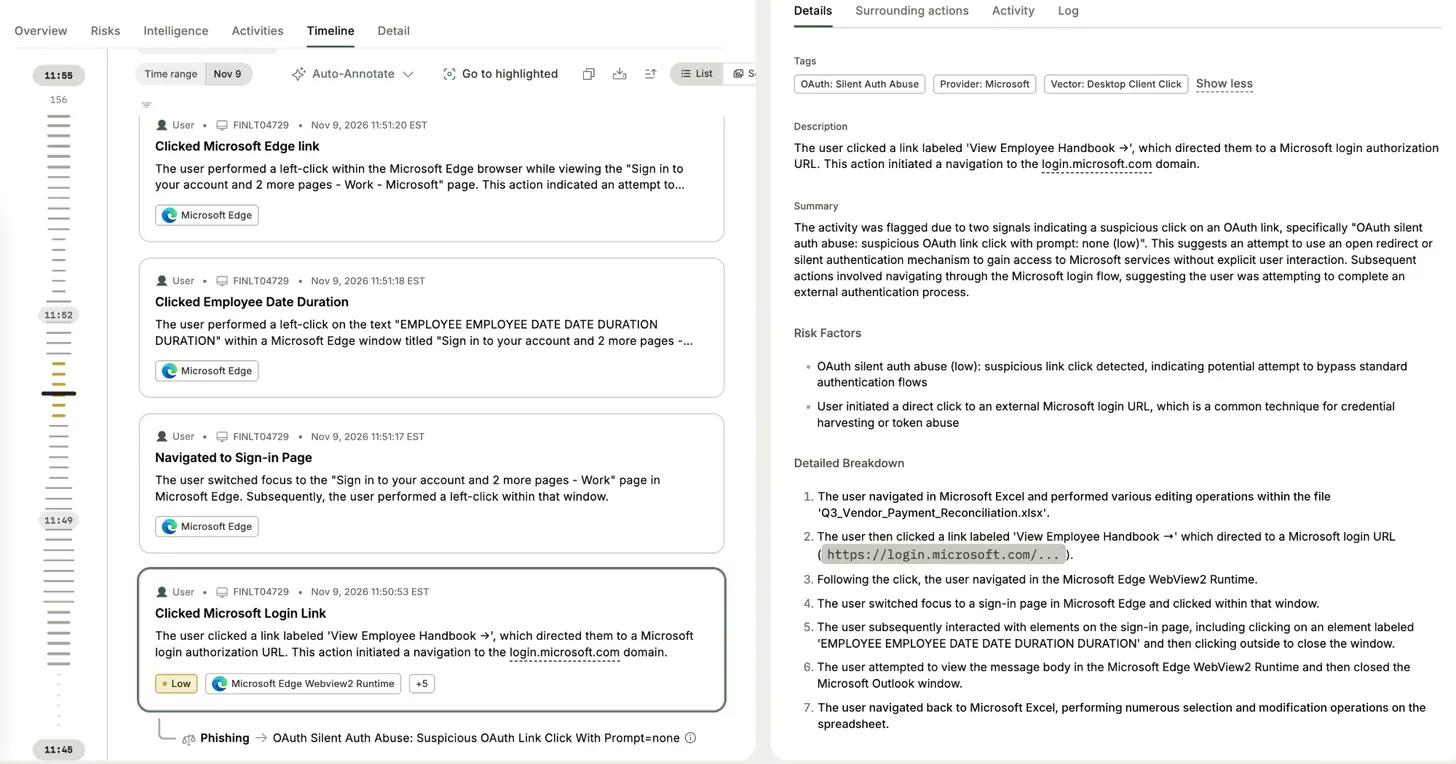
Within three seconds of receiving the email, the user opened it in Outlook and clicked the link. The website opened inside an embedded browser window launched by Outlook, outside the fully instrumented browser path where additional controls could have intervened.
Ent observed this in real time as the behavior unfolded. The user clicked around the page but never entered anything or pressed a button to continue. Within a minute, they closed the window.
Legitimate software, malicious intent
These attacks are going to keep happening because they take advantage of the software and workflows people already trust. In this case, the email protection failed to stop the message, and the network controls allowed the destination to load. The attempt also involved a Microsoft OAuth flow, bringing legitimate infrastructure into the attack.
The link itself was built to get past exactly these controls. Silent OAuth redirect phishing has typically used links to login.microsoftonline.com. The link in this case pointed to login.microsoft.com instead, which forwards to login.microsoftonline.com, keeping the parameters, before the redirect fires. The likely goal is to get past email and URL rules that flag prompt=none links to login.microsoftonline.com. The links also pad the path with extra slashes (login.microsoft.com///////////////common/oauth2/...), which Microsoft drops during the forward, likely to defeat rules that match the standard /common/oauth2/ path.
The links also carry a heavily encoded uri parameter that looks like a destination. In some links it decodes to a login.microsoftonline.com URL, and in others to legitimate sites the attacker doesn't control. Microsoft ignores uri entirely. The victim is actually sent to the redirect address registered to the attacker's app. The link contains that app's client_id, but not the final domain, so the uri value is just a decoy to make the link look legitimate to anyone who decodes it.
An EDR product may see Outlook launch a browser process, but that alone doesn’t explain what the user is being asked to do. Opening an employee handbook and authorizing an unfamiliar application can start with the same email and involve the same legitimate software.
Ent connected the email interaction, the link opening, and the silent OAuth redirect to a website the user hadn’t previously visited. Seeing the user’s actual interaction allowed Ent to put together context that process and network activity alone may not provide. The same applies to living-off-the-land techniques, where understanding how legitimate software is being used is necessary to identify the risk.
Visibility creates an opportunity to intervene
Ent wasn’t configured to fire an intervention in this case. It could have intervened at the click, when it observed the unfamiliar destination and OAuth consent flow, to warn the user or stop the interaction before they proceeded.
Blocking every message or domain is difficult. Understanding what someone is about to do creates another opportunity to stop an attack, even after earlier controls have let it through. In this case, the user stopped on their own, and Ent gave the customer visibility into that decision.
Knowing when there is nothing to remediate
Ent’s deep investigation agentic harness then investigated the activity and wrote up the incident on the customer’s behalf. The team received an account of how the email led to the OAuth flow and what the user actually did, without having to manually reconstruct the sequence.
The customer could see that the user reached the page but closed it without interacting with the fields or clicking any buttons to advance the flow. That evidence helped them resolve the event without launching an unnecessary remediation effort.
We spend a lot of time talking about what security products detect and block. We should spend more time talking about the work they eliminate. Here, Ent observed the behavior in real time and automated the investigation and write-up afterward, reducing the work required to understand and close out the attempt.
These attempts will continue. Ent gives customers more opportunities to intervene and the context to understand what happened. When an attempt ends without compromise, remediation, or additional analyst effort, that is time the team can spend elsewhere.
References
https://labs.eye.security/microsoft-login-page-abused-as-phishing-redirector/
https://abnormal.ai/threat-intelligence/digest/oauth-error-handling-phishing-silent-redirect
https://www.levelblue.com/blogs/spiderlabs-blog/phishing-with-oauth-redirect