The 11 Best SentinelOne Alternatives In 2026

The usual reasons are cost, noise, and effort. Prices climb as you add modules. Alert volume eats analyst hours. Tuning the platform takes more time than a lean team can spare.
A newer pressure adds to those. Attackers now work inside trusted tools like browsers, Office, and remote access software, and AI agents acting on a user's behalf operate in exactly the same places. Classic EDR is tuned to spot malicious files and behaviors. It has far less to say when the activity is a trusted tool doing something it's allowed to do, just for the wrong reason. Each step can look legitimate on its own, and the risk often shows only when the steps are read as a sequence.
This guide isn't a case against SentinelOne. It covers when a switch makes sense and what each of these 11 alternatives does well. We’ll also cover where each one falls short, so you can build a shortlist that fits your environment.
TL;DR
- Teams usually leave SentinelOne over module-based pricing, alert tuning, or gaps around attacks that hide inside legitimate tools.
- Enterprises with an in-house SOC tend to compare CrowdStrike Falcon, Cortex XDR, and TrendAI Vision One.
- Microsoft 365 E3 and E5 shops already pay for Microsoft Defender for Endpoint, so it often offers the best value.
- Lean IT teams and managed service providers (MSPs) usually do better with managed options like Huntress, Field Effect, Cynet, or Acronis.
- Ent is the AI endpoint security platform to look at if you need to protect both human and AI-agent work. It connects actions into a sequence and judges intent before an action completes. For example, it can flag customer data before it's pasted into an AI app, or block a risky agent action before it runs. Ent runs alongside your existing EDR and doesn't replace it.
Why People Look For A SentinelOne Alternative
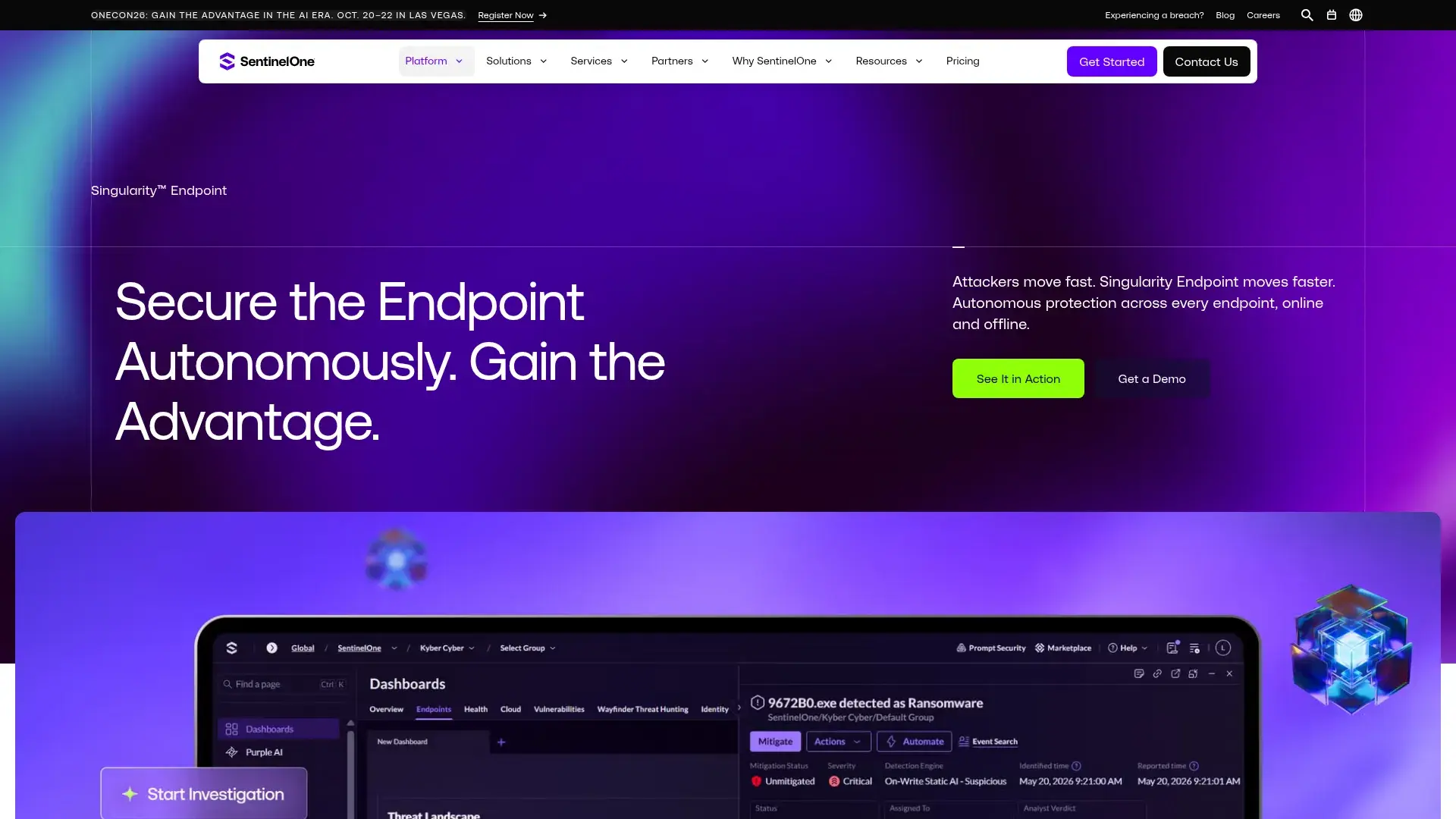
Here's how it stacks up against the tools buyers compare it to most:
- On Gartner Peer Insights, Singularity Endpoint scores 4.6 out of 5 from 3,134 ratings, as of September 2026.
- Buyers most often weigh it against CrowdStrike Falcon (4.7 from 3,259 ratings), Sophos Endpoint (4.8 from 2,068), and Microsoft Defender for Endpoint (4.4 from 1,955).
- SentinelOne, Microsoft, and Palo Alto Networks all sat out the 2025 MITRE ATT&CK Enterprise Evaluations. SentinelOne said it skipped the round to focus engineering on its product roadmap, so the absence isn't evidence of weaker detection. CrowdStrike, Sophos, Trend Micro, Cynet, and Acronis did take part, so those alternatives have recent public results.
Pricing that grows with each module
Singularity Complete runs $179.99 per endpoint per year. Commercial runs $229.99 and adds identity detection, 90-day retention, and managed threat hunting. Managed detection and response (MDR), sold as Vigilance, is an add-on on every tier.
But costs get harder to predict from there. Enterprise is quote-only, and the MDR add-on has no publicly listed price. The list rates only apply to 5 to 100 workstations. Final pricing goes through partners.
A senior information security analyst wrote on G2 that it's "well-priced for the value and benefits it provides, but startups and small teams might still find it expensive."
Alert volume and tuning time
Behavioral AI is SentinelOne's core strength. Like every behavioral EDR, it needs tuning before the alerts settle down. SentinelOne's Static and Behavioral AI engines can make the first weeks especially loud.
One penetration tester on G2 noted that "alert volume before tuning is high enough that early days feel noisier than expected."
For a team without a dedicated SOC, that noise turns straight into triage hours.
Deployment and the learning curve
A typical SentinelOne rollout starts with a pilot of 5% to 10% of endpoints in Detect mode. One partner's deployment checklist explains that in this mode "nothing is blocked or killed." Teams then triage alerts and tune exclusions before moving policies to Protect mode.
That tuning is skilled work. Good exclusions use a signing certificate or an exact path, with file hashes saved for one-off binaries because a hash changes with every app update. The same checklist warns against broad folder and wildcard exclusions and asks for a documented reason and review date on each one.
Help is available, but mostly at a higher tier. Expert-led onboarding and training appear only in the quote-only Enterprise tier. Other teams can book SentinelOne GO, a fixed-scope onboarding engagement, or pay for Premium SentinelOne University courses.
A security team with a dedicated engineer can manage this work. A two-person IT team juggling help desk tickets can't. SentinelOne's Vigilance MDR is built to take this work off your plate, but it's a quote-only add-on.
Attacks that hide inside trusted tools
CrowdStrike's 2026 Global Threat Report found that 82% of detections in 2025 were malware-free. EDR still flagged that activity. But it often did so after hands-on-keyboard work had started, and without knowing whether the action was legitimate.
AI is speeding this up. Average eCrime breakout time fell to 29 minutes, AI-enabled adversary activity rose 89% year over year, and IBM's Cost of a Data Breach Report 2026 found one in four malicious breaches were AI-enabled (averaging $6 million each).
Traditional EDR sees processes, files, and network calls. It struggles to tell whether a trusted tool is being used for a trusted reason. That blind spot is where AI agents and "living off the land" attacks operate.
Comparison Table: SentinelOne Vs. 11 Alternatives At A Glance
Use this table as a quick filter. The full entries below cover each tool's tradeoffs in more depth.
Tool Category Best for Notable feature Pricing SentinelOne Singularity EDR / XDR Teams wanting autonomous endpoint protection One-click rollback and on-agent behavioral AI From $179.99/endpoint/year Ent AI endpoint security Teams securing human and AI-agent work on the endpoint On-device AI that reads actions in sequence and judges intent Not publicly listed CrowdStrike Falcon Enterprise EDR / XDR Large, SOC-led security teams Falcon Guardian for AI agents on endpoints $59.99 to $184.99/device/year Microsoft Defender for Endpoint EDR for Microsoft environments Microsoft 365 E3 and E5 customers Included in existing licenses In E3/E5; Business plan $3/user/month Palo Alto Networks Cortex XDR Enterprise XDR Palo Alto firewall customers Endpoint and network data correlation Not publicly listed Sophos Intercept X EDR with optional MDR Mid-market teams using Sophos Firewall CryptoGuard ransomware rollback Not publicly listed TrendAI Vision One Enterprise XDR platform Teams consolidating many security tools ZDI-backed virtual patching Not publicly listed Cynet All-in-one XDR with MDR Mid-sized companies without a SOC 24/7 MDR included Not publicly listed Bitdefender GravityZone Endpoint protection and EDR Lean IT teams Top results in independent prevention testing ~$57 to $96/device/year (third-party) Acronis Cyber Protect Cloud MSP backup and security platform MSPs selling backup and security together Backup, RMM, and EDR in one console Per workload, through providers Field Effect MDR MDR Small and mid-sized businesses Plain-language, prioritized alerts $5 to $25/user/month Huntress MSP-focused managed EDR MSPs and small businesses 24/7 SOC included, flat pricing $7.99/endpoint/month
SentinelOne Alternatives, Compared One By One
The list starts with AI endpoint security. It then moves to the established enterprise extended detection and response (XDR) and EDR leaders. It ends with MSP and mid-market MDR providers, so you can jump to the segment that matches your environment.
Ent
Ent is an AI endpoint security platform for human and agentic work. A lightweight agent and browser extension connect activity across apps, browsers, files, scripts, and AI tools into one sequence on Windows, macOS, and Linux. Deterministic policy, behavioral intelligence, and local AI reasoning then judge what is happening, why, and whether it should continue. When it shouldn't, Ent can warn, require justification, constrain, escalate, or block it before it completes.
That intent layer applies one policy to people and AI agents alike. Security teams can see who uses OpenAI Codex, Claude Code, GitHub Copilot, Cursor, and similar tools, and what data those tools touch. Ent can also steer users to sanctioned tools, flag sensitive content before it reaches an AI app, and block risky agent behavior.
On the data side, a custom small language model (SLM) classifies sensitive data at the point of use. It tracks where that data came from and where it moves across apps and AI tools. Ent runs as SaaS or in a customer-controlled deployment, so sensitive telemetry and processing can stay in your environment where required.
Best for: Security teams that need to stop risky human and agent activity that looks legitimate, including work in AI tools like Claude Code, Cursor, and GitHub Copilot, alongside their existing endpoint protection.
Notable feature: Threat-aware application control covers shadow AI, remote monitoring and management (RMM) tools, living-off-the-land binaries (LOLBins), and vulnerable drivers. That last one targets bring-your-own-vulnerable-driver (BYOVD) attacks, a common way to disable EDR.
Limitation: Ent isn't a like-for-like replacement for EDR malware detection, forensics, and response tooling, so most teams run it alongside their current EDR or MDR. In the proof of concept, set mutual exclusions between Ent and your EDR, and check performance, offline behavior, and tamper protection.
Pricing: Not publicly listed.
CrowdStrike Falcon
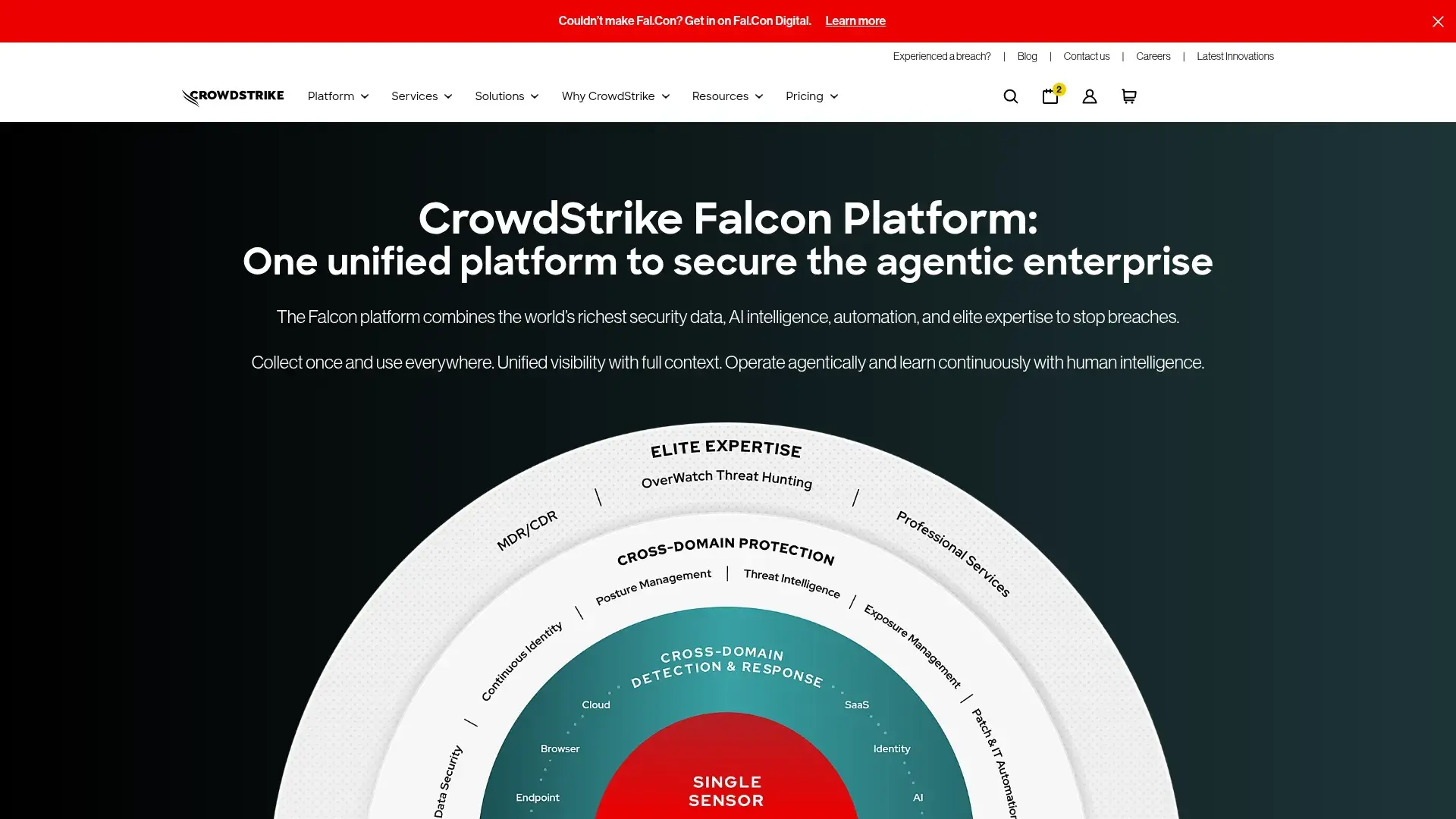
CrowdStrike is SentinelOne's most common head-to-head rival. Falcon is built around a single sensor that feeds a cloud platform. That platform spans endpoint, identity, cloud, threat intelligence, and managed hunting.
Best for: Enterprises with an in-house SOC that want deep threat intel and hunting.
Notable feature: Falcon Guardian, announced September 1, 2026, discovers known and shadow AI agents on Windows and macOS, controls which agents can run, and detects attacks on them at runtime. Ent overlaps on agent visibility and control. It differs by putting people and agents under one policy, classifying data at the point of use, and offering a self-hosted option.
Limitation: Costs add up as modules stack. One small-business user on G2 pointed out that "pricing can be relatively high for smaller organizations, especially when additional modules are required."
Pricing: Falcon Go is $59.99, Pro is $99.99, and Enterprise is $184.99 per device per year. Falcon Complete Next-Gen MDR is quote-only.
Microsoft Defender for Endpoint
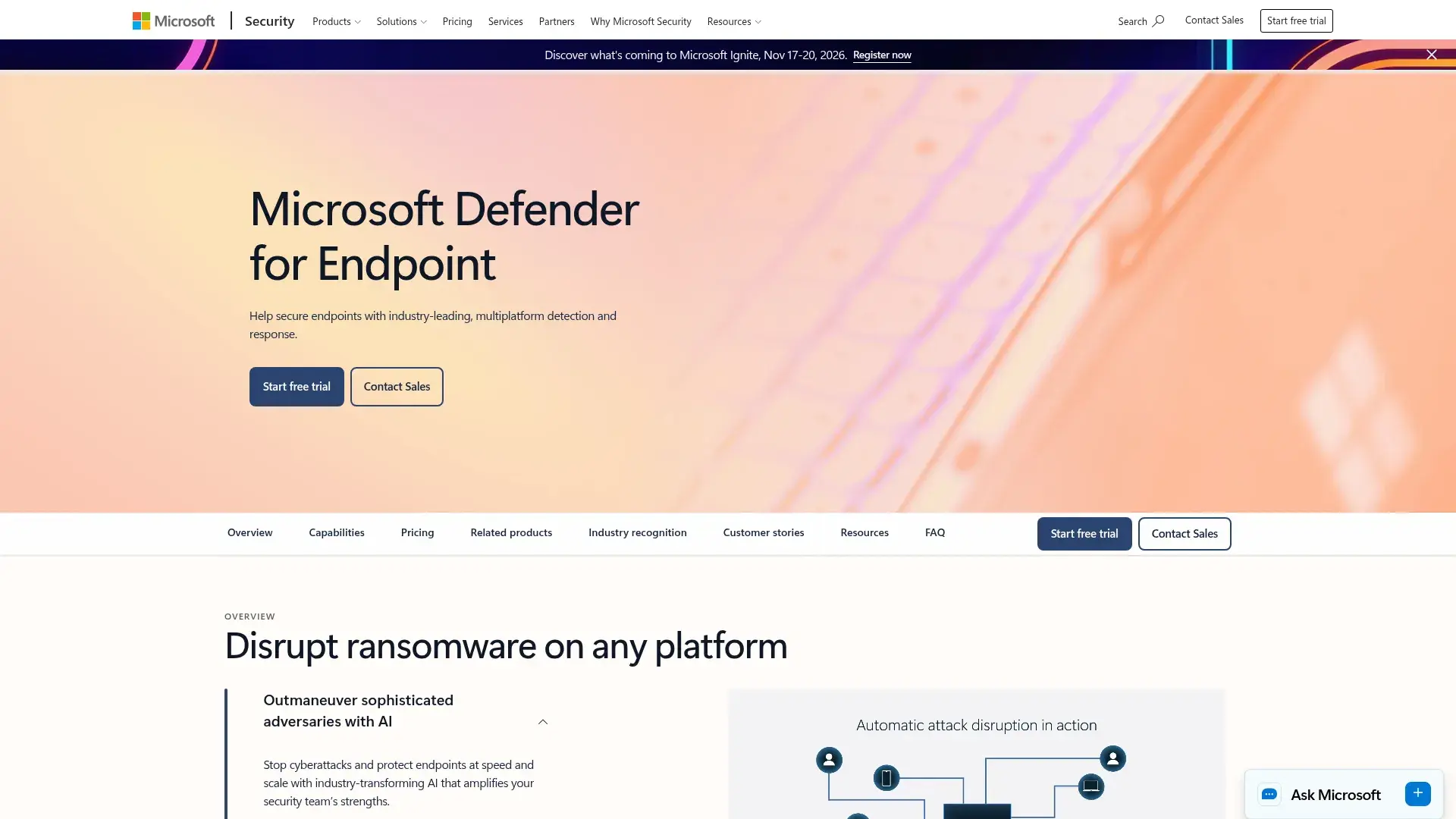
Defender for Endpoint is part of Microsoft's broader security stack. It sits alongside Intune, Entra, and Purview. For a Windows-heavy shop, that means device policy, identity, and endpoint detection share one ecosystem.
Best for: Organizations already licensed for Microsoft 365 E3 or E5.
Notable feature: Licensing. Plan 1 is included in E3 and Plan 2 in E5, so many teams already own it.
Limitation: Licensing gets complex fast. Plan 2 features need E5 or the E5 Security add-on, and Microsoft's managed hunting service, Defender Experts, is a separate purchase. It's most compelling for teams already deep in Intune and Entra.
Pricing: Included in Microsoft 365 E3 (Plan 1) and E5 (Plan 2). Defender for Business lists at $3 per user per month, for up to 300 users.
Palo Alto Networks Cortex XDR
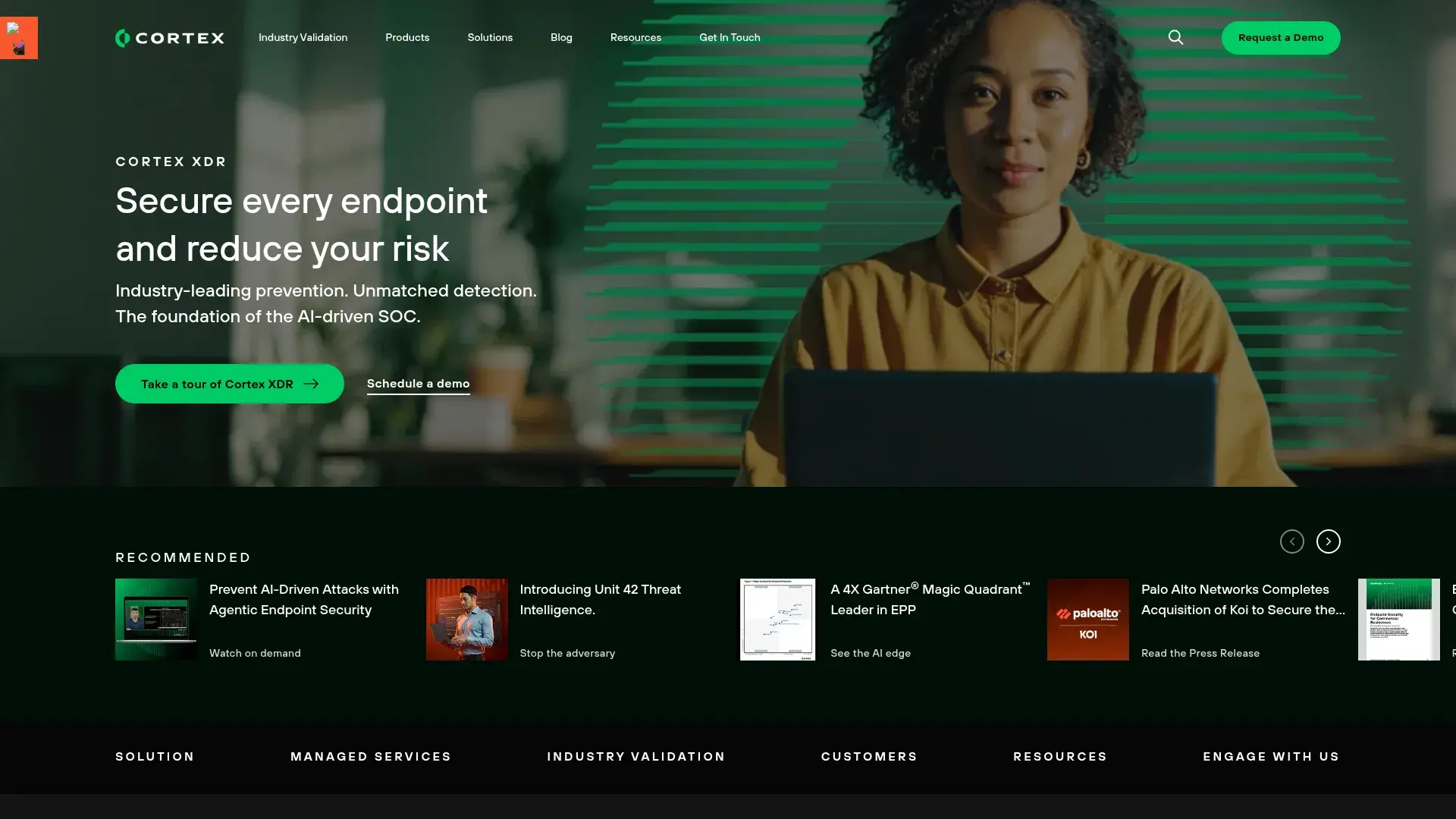
Cortex XDR pulls endpoint, network, and cloud data into one detection layer. Palo Alto calls it "the foundation of the AI-driven SOC." It sits in a larger Cortex family that includes XSIAM, XSOAR, and Cortex Cloud.
Best for: Teams already running Palo Alto firewalls that want endpoint and network signals correlated.
Notable feature: Cross-source correlation. Dev, a mid-market user, wrote that "XDR correlates endpoint and network data, cutting investigation time."
Limitation: Much of its value comes from correlating Palo Alto network data, so it's a weaker fit without Palo Alto firewalls. Cortex XDR Prevent excludes EDR data collection, so compare SentinelOne against the Pro tier. Neither tier has a published price.
Pricing: Not publicly listed.
Sophos Intercept X
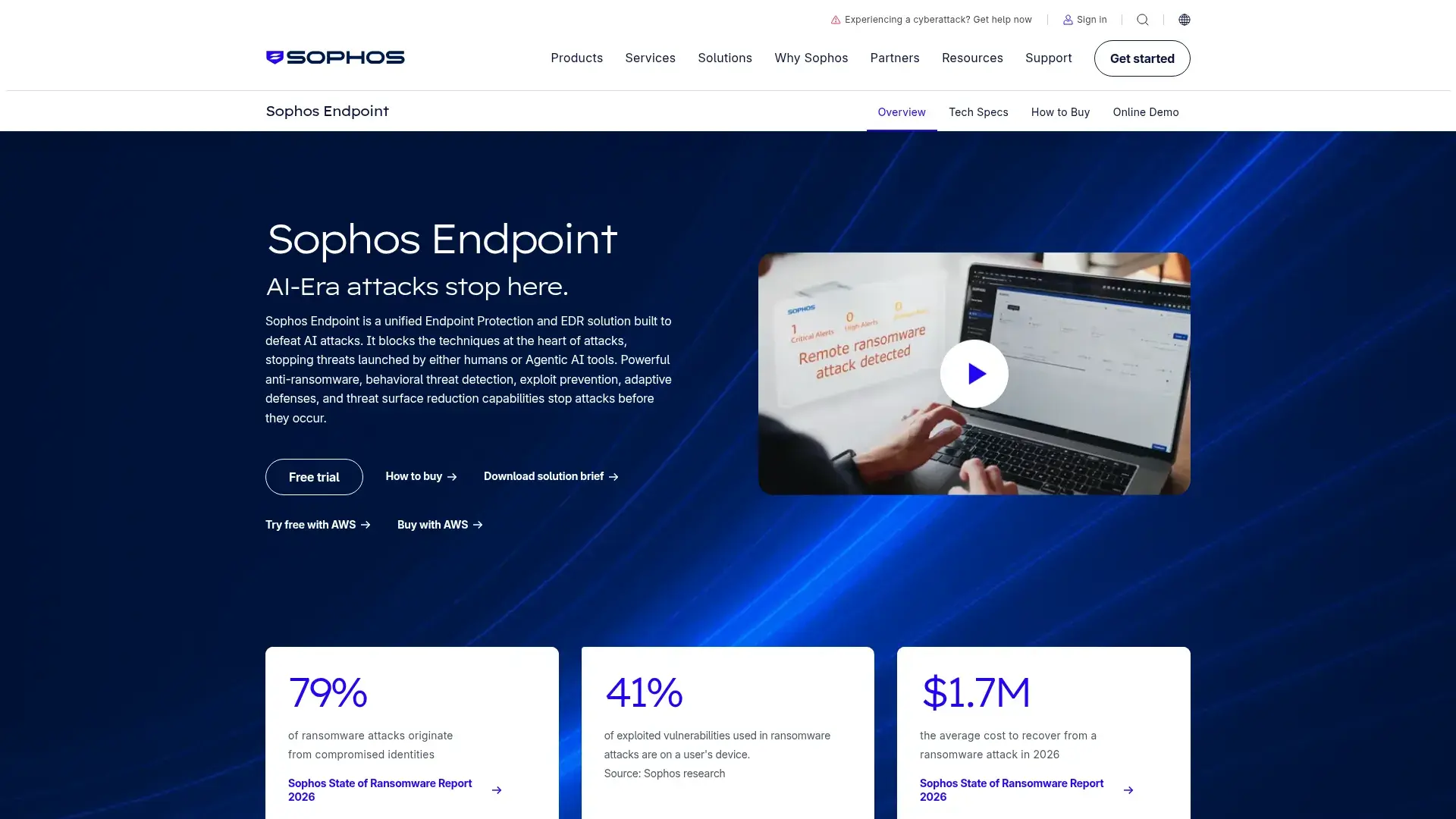
Sophos now markets Intercept X as Sophos Endpoint. It focuses on stopping ransomware and exploits early. More than 60 exploit mitigations are on by default, along with Adaptive Attack Protection.
Best for: Mid-market teams, especially those already running Sophos Firewall for its Synchronized Security integration.
Notable feature: CryptoGuard reverts files that ransomware has encrypted. Sophos MDR is the other big draw. It's trusted by 40,000+ organizations and integrates with 500+ third-party tools, so it can monitor environments that run CrowdStrike or SentinelOne.
Limitation: Detection and response aren't in the base product. Sophos Endpoint covers protection, while EDR moved to a separate Sophos EDR tier for term licenses starting November 2025.
Pricing: Not publicly listed. Sophos sells through partners.
TrendAI Vision One
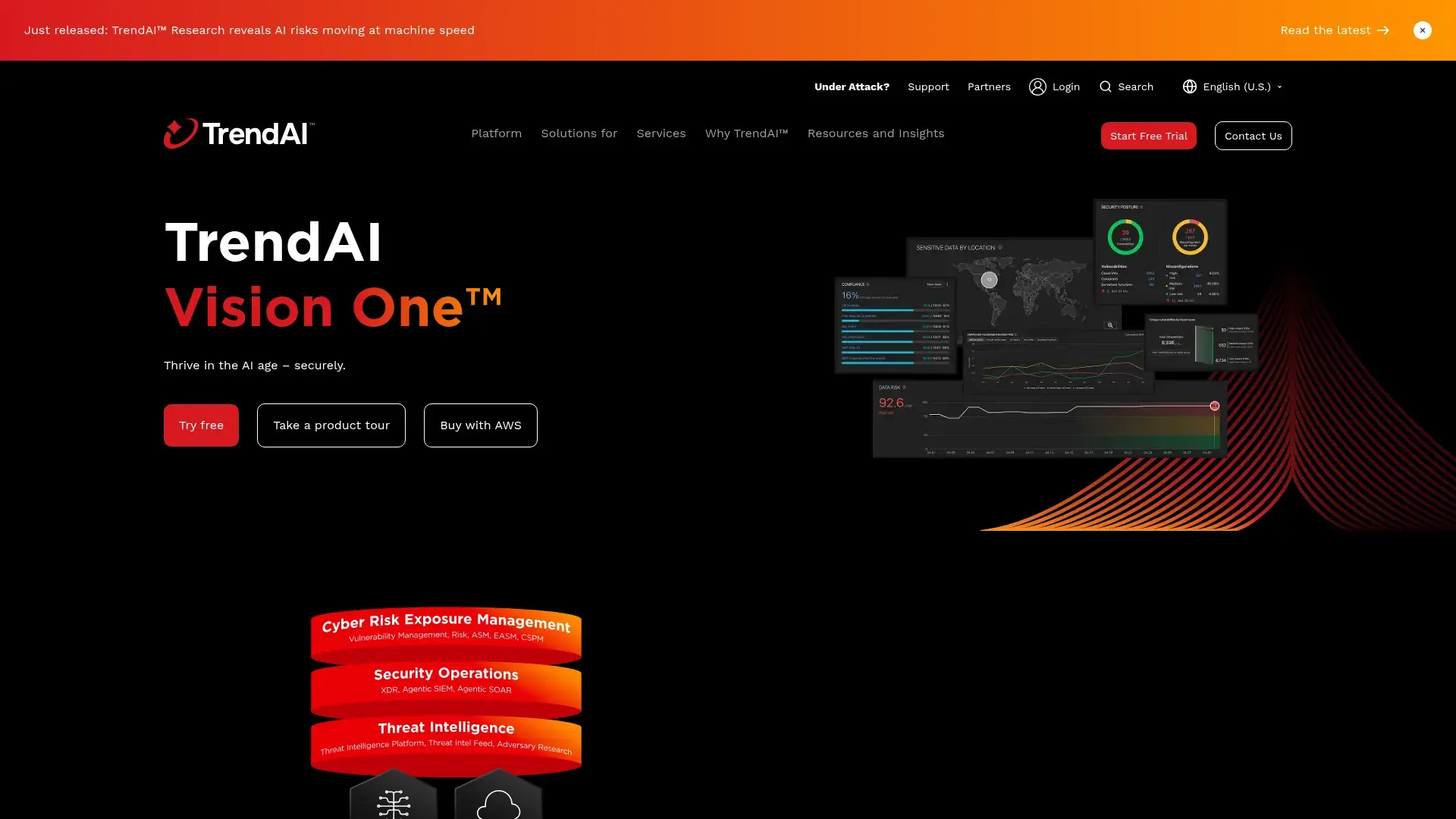
Trend Micro's enterprise business became TrendAI in March 2026. Vision One now covers endpoint, email, cloud, identity, network, and data security. It also adds agentic SIEM and SOAR for the SOC.
Best for: Large teams consolidating several security tools into one console.
Notable feature: Pre-patch protection fed by Trend's Zero Day Initiative (ZDI) research. Vision One can virtually patch network-exploitable flaws through TippingPoint IPS rules and block vulnerable app versions from launching on endpoints.
Limitation: Costs are hard to forecast. TrendAI Flex lets you move credits across 30+ solutions, but the platform page doesn't publish how many credits each module consumes.
Pricing: Not publicly listed. A free trial is available.
Cynet
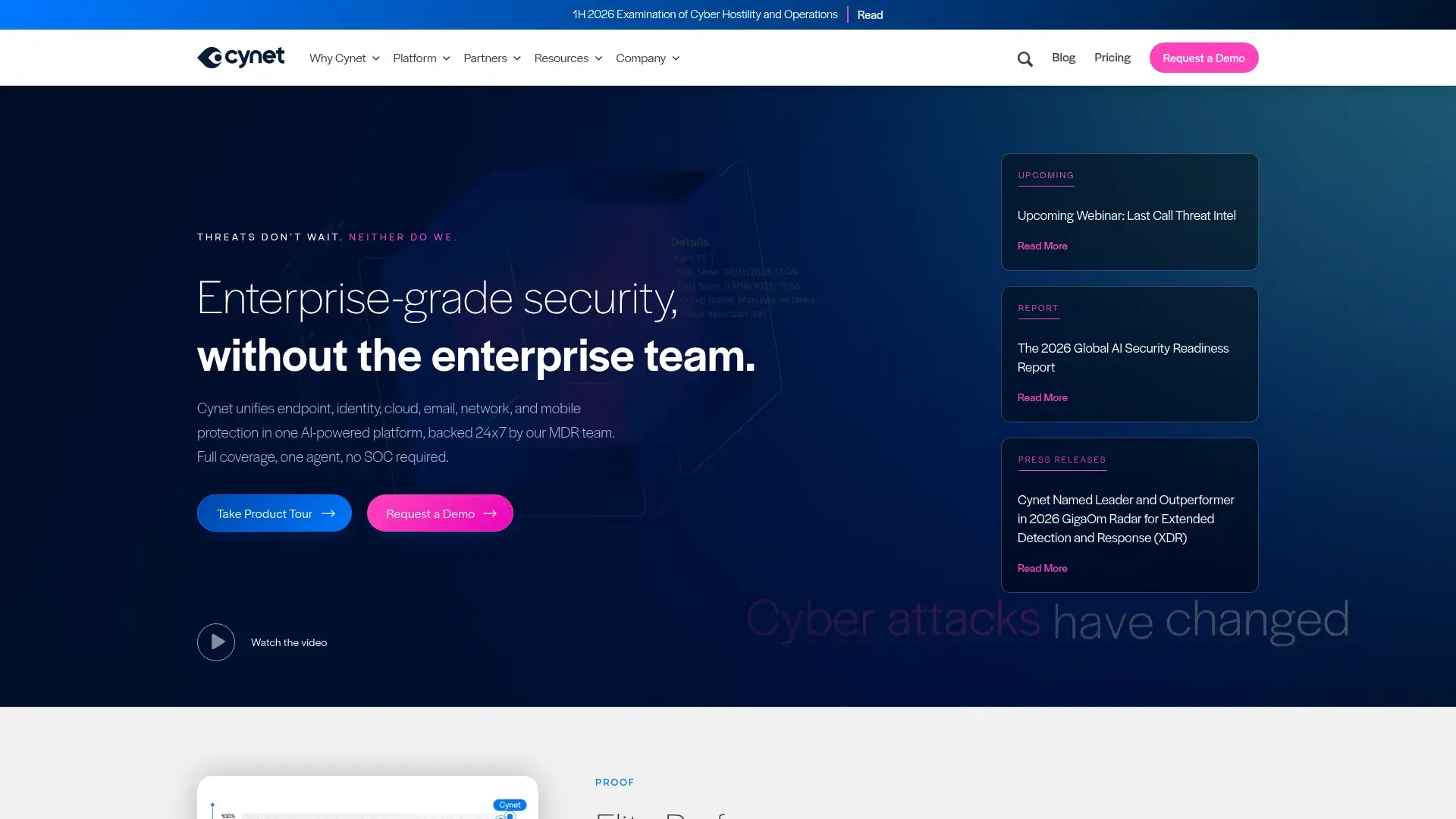
Cynet combines EDR, network, email, identity, SaaS and cloud security posture management (SSPM and CSPM), and SOAR in one platform. Its CyOps team provides 24/7 MDR as part of the package. The pitch is "enterprise-grade security, without the enterprise team."
Best for: Mid-sized companies and MSPs without an internal SOC.
Notable feature: 24/7 MDR from the CyOps team is part of the platform.
Limitation: The console takes time to learn. One system administrator wrote that "without hours of training on its use, it is difficult to understand everything."
Pricing: Not publicly listed.
Bitdefender GravityZone
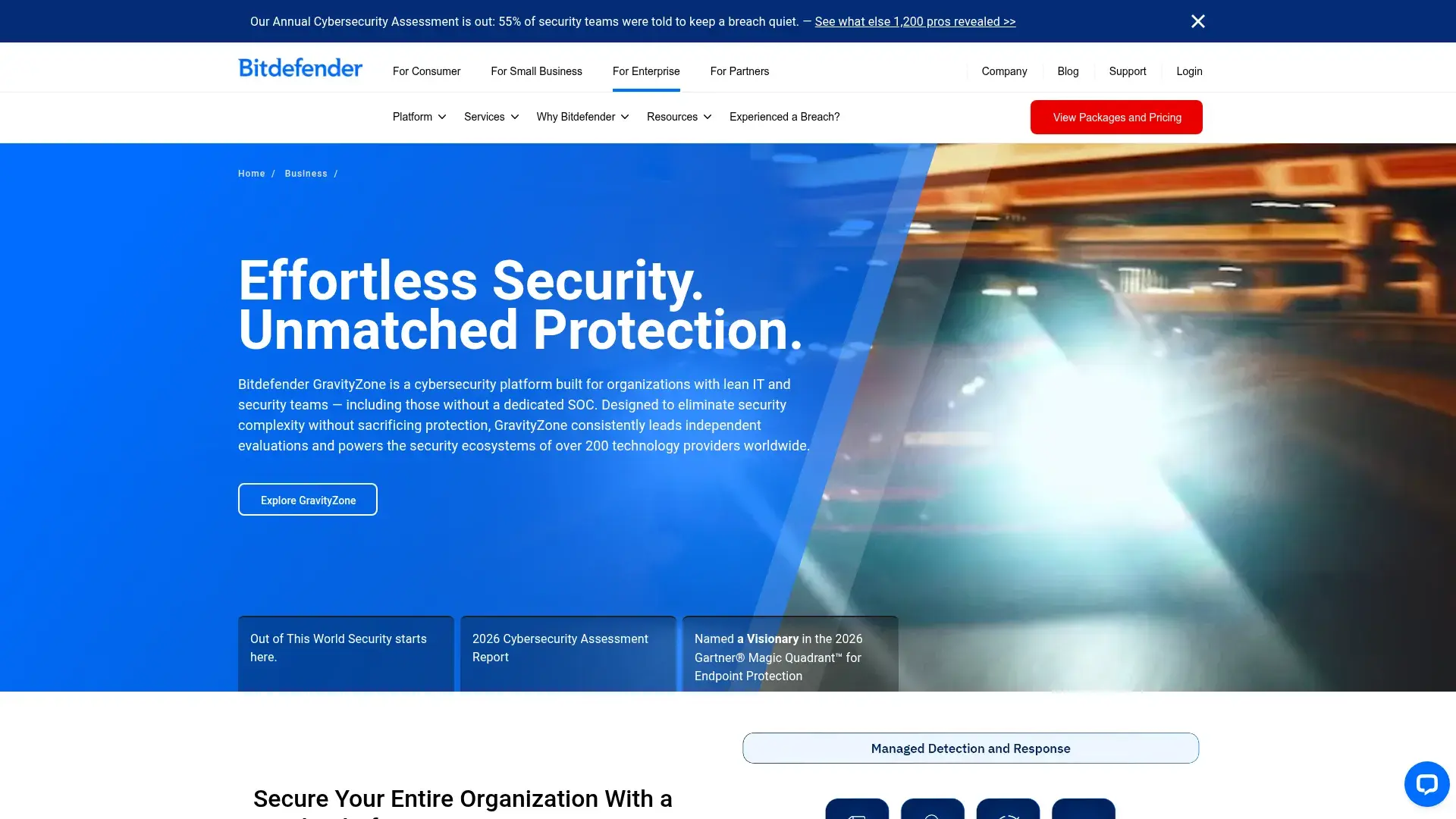
Bitdefender GravityZone is a single platform for endpoint prevention, detection, and response. The same console adds Endpoint Risk Analytics, full disk encryption, and cloud security posture management, with 200+ technology integrations.
Best for: Small and mid-sized IT teams that want strong prevention at a moderate price.
Notable feature: Prevention efficacy. GravityZone Business Security Enterprise was named a Certified Leader in AV-Comparatives' 2026 Endpoint Prevention and Response Test, blocking all 50 attack scenarios. Premium and Enterprise also add HyperDetect, tunable pre-execution machine learning.
Limitation: EDR isn't in the lower tiers. Bitdefender's package comparison lists Business Security Enterprise as the entry point for EDR, and full XDR requires GravityZone Defense XDR. MDR is a separate service on top.
Pricing: Not publicly listed. Vendr data shows a median contract of $8,121 per year. Negotiated rates run roughly $35 to $70 per endpoint per year, depending on deployment size.
Acronis Cyber Protect Cloud
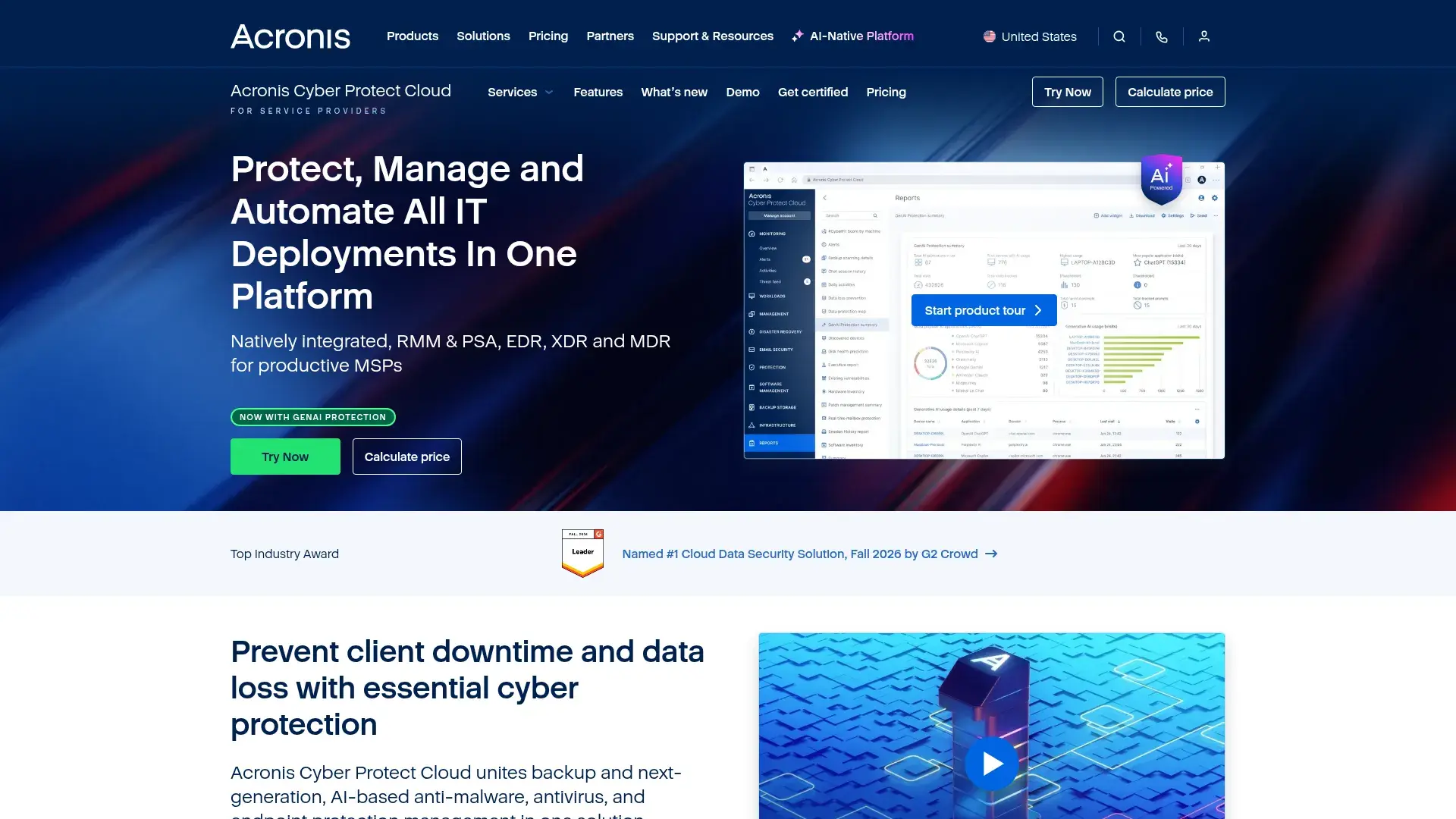
Acronis Cyber Protect Cloud is built for service providers. It natively integrates backup, disaster recovery, RMM, professional services automation (PSA), EDR, XDR, and MDR.
Best for: MSPs that want to sell backup and endpoint security from one console.
Notable feature: Backup and security share one agent and one console. Acronis takes an image backup before each patch, so a bad update can be rolled back. After an attack, it scans backup images for malware before recovery to avoid reinfection.
Limitation: EDR, XDR, and MDR are billed separately on top of any package. The price climbs as you add security layers.
Pricing: Priced per workload or per GB through service providers. Public pricing is not published.
Field Effect MDR
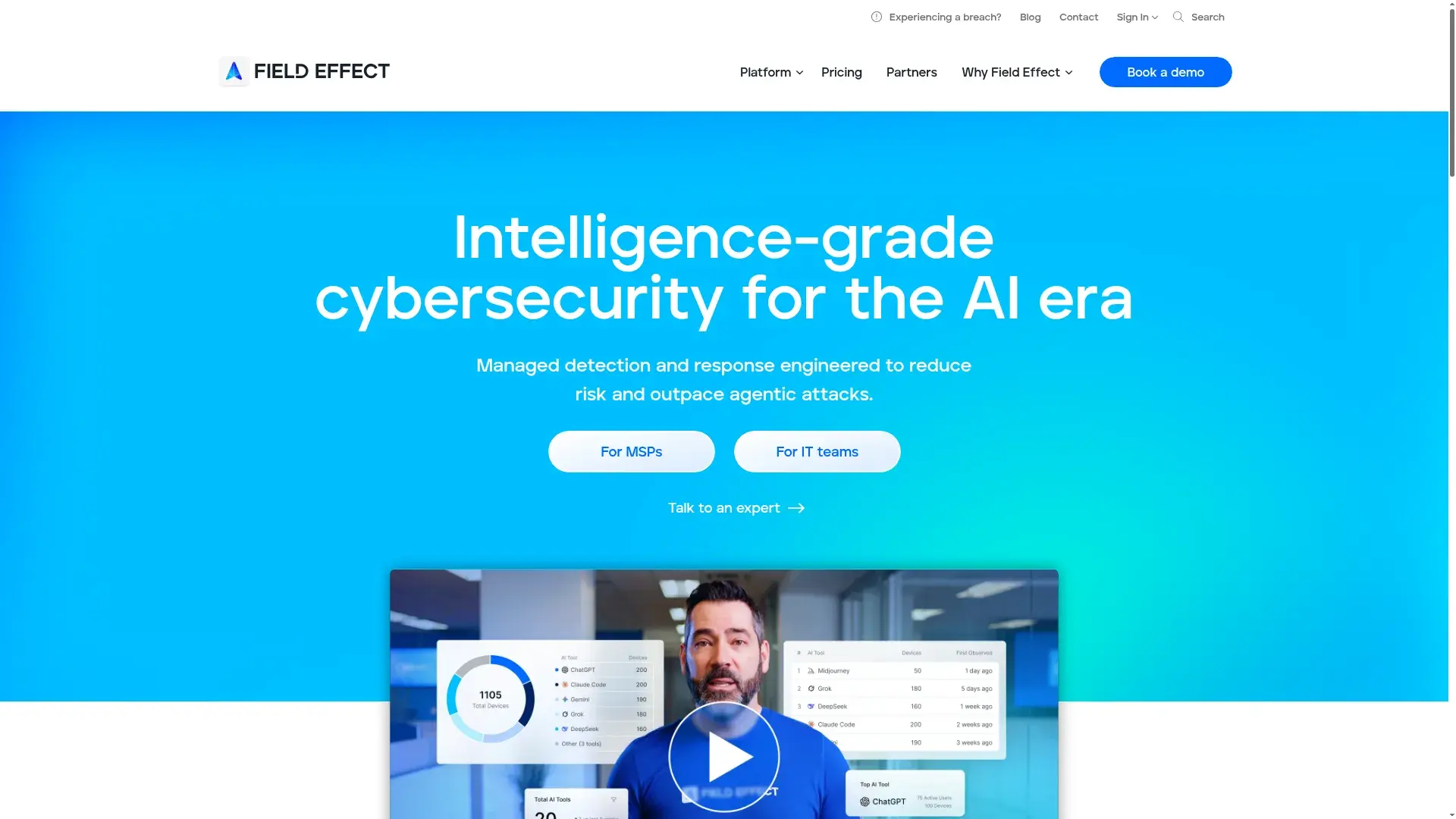
Field Effect runs a 24/7 SOC backed by its own AI detection and response. Alerts arrive as prioritized AROs (Actions, Recommendations, and Observations). Every package also includes vulnerability management.
Best for: Small and mid-sized businesses without in-house security staff.
Notable feature: Readable alerts. Melissa, a mid-market user, said that "the alerts that come through are meaningful, contextual, and actionable."
Limitation: Some alerts need more context. Noah, a small-business user, wrote that he wanted "a little bit more detail on alerts" and sometimes had to contact support.
Pricing: $5 to $25 per user per month, depending on package. There are no setup fees.
Huntress
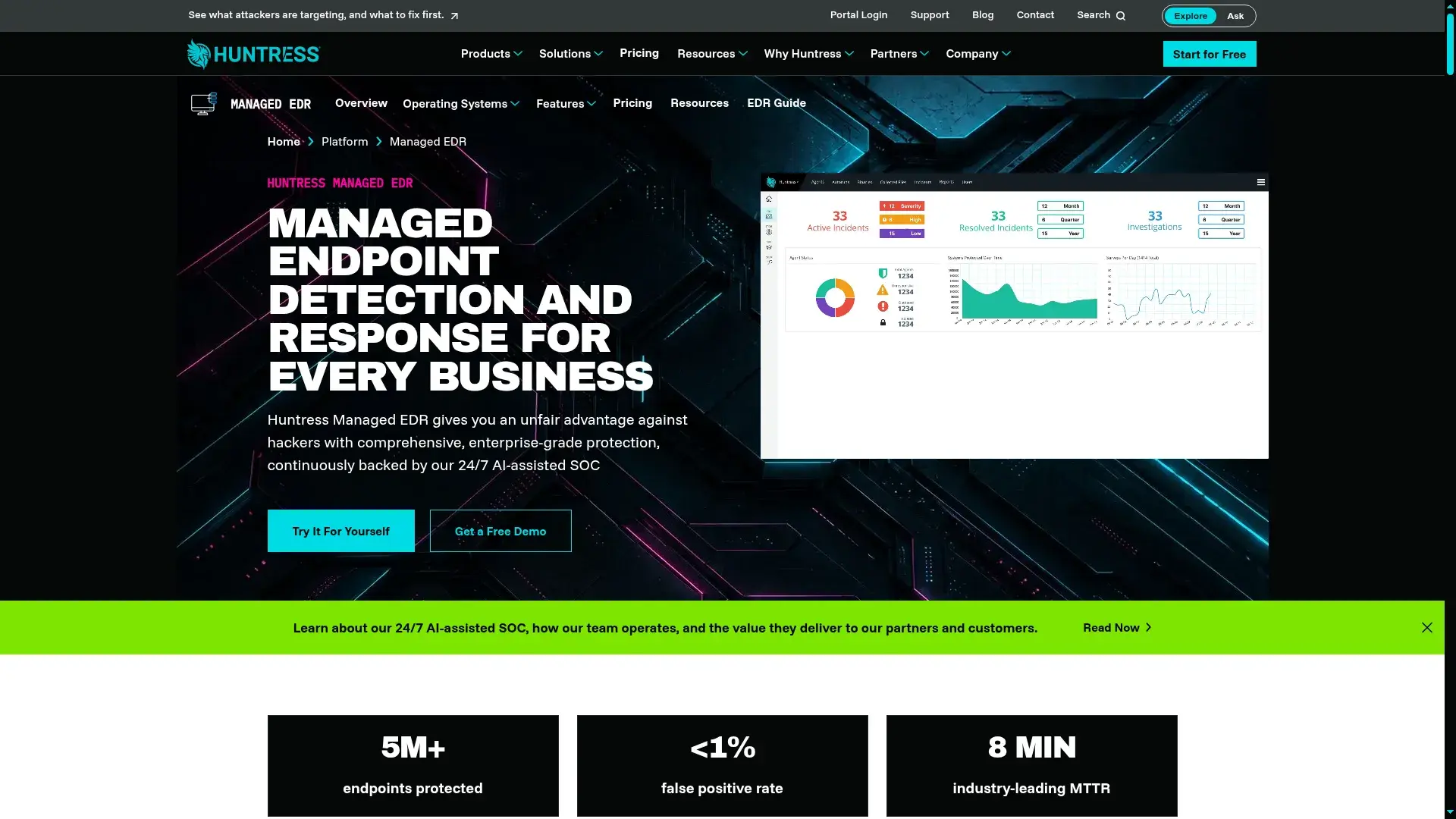
Huntress runs managed EDR on Windows, macOS, and Linux. Its 24/7 SOC investigates alerts, contains threats on the endpoint, and removes the attacker's foothold. The same platform adds identity threat detection and response (ITDR), SIEM, and security awareness training, each priced per unit with no tiers.
Best for: MSPs and small businesses.
Notable feature: SOC coverage is included in the per-endpoint price, so there is no separate MDR line item to budget for.
Limitation: It's built as a managed service, so teams used to running their own hunts in SentinelOne should check how much telemetry and self-serve hunting they'll get. Its antivirus layer is managed Microsoft Defender Antivirus instead of a proprietary engine. Direct buyers also face a 50-seat minimum per product.
Pricing: Managed EDR is $7.99 per endpoint per month at 100 endpoints. ITDR is $3.60 per identity and SIEM is $3.50 per source, per month.
Choosing The Right Alternative: A Decision Framework
Settle five questions before you book any demos. This will help cut your list to two or three options.
Team size and SOC coverage
Do you have analysts watching alerts 24/7? If not, a managed service like Huntress, Field Effect, or Cynet does more for you than a powerful console nobody has time to tune.
Budget and pricing model
Decide whether you want modular or bundled pricing. Modular platforms like SentinelOne, CrowdStrike, and Acronis let you start small, but totals get harder to forecast as you add identity, cloud, or MDR. Microsoft looks bundled, yet the E5 Security add-on and Defender Experts stack the same way.
Operating system and environment mix
Windows-heavy shops on Microsoft 365 should price Defender first. Mixed Windows, macOS, and Linux fleets need to confirm feature parity on every OS during a proof of concept.
AI agent and shadow AI exposure
Ask whether developers and staff already use AI coding assistants or agents with local access. If they do, check how each vendor sees that activity and whether it can set policy for agents as well as people.
Data retention and exit cost
Check how long each tier keeps telemetry. SentinelOne Complete keeps 14 days, and longer retention is often where costs hide.
Also price your exit. Removing an anti-tamper-protected agent takes a passphrase or token for each device. Plan that workflow before you sign.
Scenario-based picks
- Lean MSP: Huntress for simple per-endpoint pricing, or Acronis if you also sell backup.
- Small business with no security staff: Field Effect or Cynet, both of which include 24/7 monitoring.
- Microsoft E3 or E5 customer: Defender for Endpoint. You likely already pay for it.
- Enterprise with a mature SOC: CrowdStrike Falcon, Cortex XDR, or TrendAI Vision One.
- Risky human or AI-agent activity that looks legitimate: Ent. It applies one policy to people and AI agents, shows which AI tools touch sensitive data, and can stop a risky agent action before it completes.
Why More Teams Are Looking At Ent
The alternatives above are anchored on recognizing malicious artifacts and behaviors, and all of them block known threats before they run. Those tools remain strong at malware, device, and process-level protection. What they don't add is the user, application, data, agent, and intent context that shows whether a legitimate tool, used by a legitimate user or agent, is doing something it shouldn't.
Ent works at a different layer. It connects what people and AI agents do across apps, browsers, files, scripts, and AI tools into one sequence, then judges intent on the device. When that sequence points to risk, Ent can warn, require justification, constrain, or block the action before it completes.
Ent co-founder Brandon Dixon, who co-founded PassiveTotal and later helped launch Microsoft Security Copilot, sums it up this way:
"An EDR can tell you Zoom is running, but it cannot tell you that a user just handed the remote control of their machine to someone outside the business, or why."
Ent is built to answer that "why."
What Ent solves …
- AI agents as a blind spot: One policy covers people and AI agents, so agent activity isn't handled as an exception.
- Shadow AI and data leakage: Ent shows which AI tools are in use and flags sensitive content before it reaches an AI app.
- Trusted-tool attacks: Application control covers weaponized RMM tools, LOLBins, and vulnerable drivers.
- Data sovereignty: Ent can run self-hosted in your own cloud, so sensitive telemetry and processing can stay in your environment where required.
Ent fits best when AI coding assistants and agents already run with local access in your environment. It's also a strong fit when your biggest risk is insider-style activity that looks legitimate on the surface, or when you want to replace separate insider risk, UEBA, legacy DLP, and application control tools with one layer that shares the same context and enforcement.
Most teams will run Ent alongside their current EDR or MDR. Keep that tool focused on malware and response. Let Ent govern what people and agents do on the endpoint.
To see how Ent protection works as it happens on your own endpoints, book a demo with Ent.
FAQ
Is SentinelOne still a good product, and who should stick with it?
Yes. It holds 4.6 out of 5 on Gartner Peer Insights and 4.7 on G2, as of October 2026. Teams with the staff to tune it have good reason to stay. The same goes for teams that value autonomous rollback on offline endpoints.
What does SentinelOne cost compared to these alternatives, and why is pricing hard to compare?
SentinelOne lists $179.99 to $229.99 per endpoint per year for its first two tiers. CrowdStrike lists $59.99 to $184.99 per device, and Huntress lists about $95.88 per endpoint per year ($7.99 per month).
Direct comparisons are tricky. Vendors price per endpoint, per user, per workload, or through credits. Many also sell only through partners or quotes. MDR is often a separate line item.
What's the difference between EDR, XDR, and MDR, and does it matter?
Endpoint protection (EPP), also called next-gen antivirus (NGAV), is the prevention layer that blocks known and machine-learning-detected threats before they run. EDR records and investigates what gets past it. XDR correlates endpoint data with network, email, identity, and cloud signals.
MDR is a service, where an outside SOC monitors and responds for you.
The distinction matters most for staffing. EDR and XDR assume someone on your team handles alerts. MDR moves that work to the vendor.
How do these alternatives handle AI agents and shadow AI risk?
Approaches vary widely. CrowdStrike added Falcon Guardian for AI agents in September 2026. TrendAI covers AI security inside Vision One. Ent goes beyond agent security alone, because people and agents use the same applications, data, and credentials. It applies one policy to people and AI agents, shows which AI tools touch sensitive data, and can block a risky agent action before it completes.
Is switching endpoint security vendors risky, and how do teams migrate?
The main risk is a coverage gap during cutover. Most teams run the new agent alongside the old one on a pilot group first. Once detections and policies are validated, they roll out in waves and remove the old agent last.
During coexistence, set mutual exclusions so each agent ignores the other. Without them, expect CPU spikes and each tool flagging the other.
Before the old contract lapses, export or retain the historical telemetry you need for investigations or compliance. Then script the uninstall. SentinelOne's anti-tamper requires a passphrase or console approval per agent, and CrowdStrike uses a maintenance token.
Finally, keep offline and remote endpoints on a longer tail. They miss the push and need follow-up before you call the migration done.