9 Best Data Loss Prevention Tools For 2026, By Use Case

Sensitive data used to leave organizations through email, USB drives, and cloud uploads. Now, it’s just as likely to leave through a prompt pasted into ChatGPT, a coding assistant, or an agent acting with an employee’s own access credentials.
As a result, the data loss prevention (DLP) market has outgrown its original perimeter-based roots, sprouting up a collection of specialized tools tailored to specific corners of the modern tech stack. Depending on which vendor you ask, DLP could mean an endpoint agent, email gateway, or API connection into SaaS apps. But the reality? No single tool covers every channel perfectly.
We evaluated the top DLP tools available today, categorized by the channel they protect best. The list pairs established suites with newer AI-focused tools and limitations for each pick. Fortra DLP (formerly Digital Guardian), Zscaler Data Security, and Palo Alto Networks Enterprise DLP are also worth a look if you already run those vendors' platforms.
TL;DR
- DLP tools find sensitive data, watch how it moves, and enforce security policies. They come in five specializations: endpoint, network, email, cloud/SaaS, and AI.
- Most organizations need at least two deployments. An endpoint tool doesn't inspect email or SaaS sharing on its own.
- For data in use on the endpoint, including AI apps and agents, Ent is the pick. Pair it with email and SaaS DLP.
What Data Loss Prevention Tools Do, And The Five Types
DLP tools identify and classify sensitive data, then monitor how that data moves. Most organizations start their DLP journey with discovery: scanning file shares, databases, endpoints, and cloud storage for sensitive data at rest. When data moves somewhere it shouldn't, the software enforces security policies by warning the user or blocking, encrypting, or redacting the data transaction.
While finding data at rest continues to overlap and merge with data security posture management (DSPM) tools, stopping improper or risky file movements is a complex and nuanced architectural challenge. Because workflows span local devices, cloud applications, and third-party APIs, the DLP market has evolved to include five specialized deployment types.
- Endpoint DLP: Watches files, the clipboard, USB devices, printers, and apps on the user’s device but can't see data sharing inside email or SaaS apps.
- Network DLP: Inspects traffic in motion through a proxy or gateway but misses devices that bypass that path. It struggles with encrypted traffic. Apps that use certificate pinning, common in desktop AI clients and CLIs, can't be decrypted and are usually bypassed.
- Email DLP: Scans outbound mail and attachments but sees nothing outside the mail flow.
- Cloud/SaaS DLP: Scans data at rest and sharing settings inside SaaS apps, usually through APIs. However, it can't monitor what happens on the device before an upload.
- AI DLP: Inspects prompts, pastes, and uploads into AI tools, plus actions taken by AI agents.
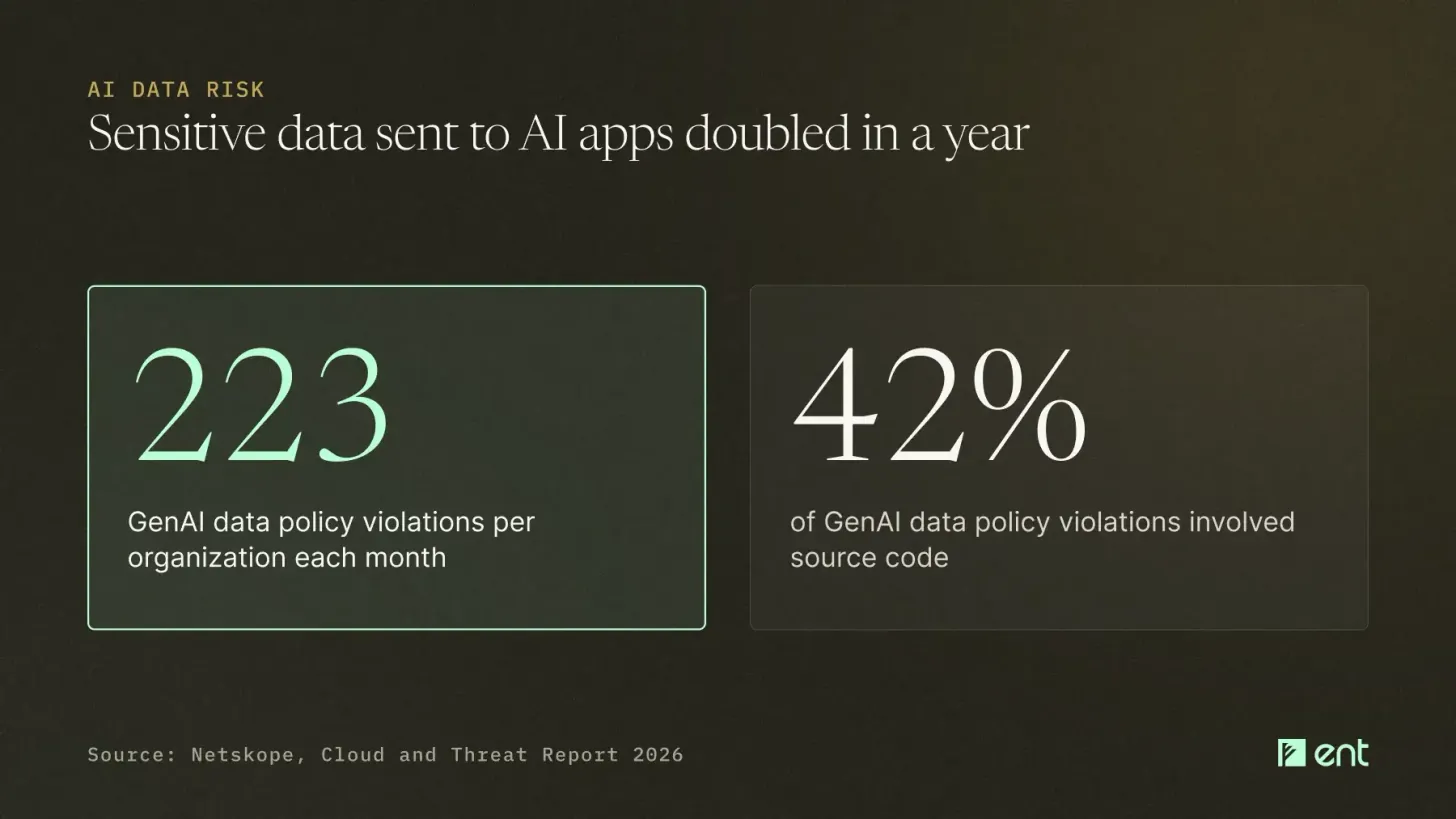
Netskope, one of the vendors below, tracks the trends and risks of increased AI usage in its Cloud and Threat Report. The 2026 research counted an average of 223 GenAI data policy violations per organization each month, with source code making up 42% of the infractions. Incidents of users sending sensitive data to AI apps doubled over the past year, and the top 25% of organizations averaged 2,100 incidents a month.
Buyers often learn the hard way that one type of DLP protection isn't enough. An endpoint tool doesn't inspect email or SaaS sharing on its own, and an email gateway can't see a paste into a chatbot.
What to look for in a DLP tool
- Channels covered: Match the tool to the exit vectors your data uses today, including AI apps and coding assistants.
- Classification accuracy: Ask how the tool handles false positives. Exact data matching and fingerprinting cut noise compared with pattern rules alone.
- Response options: Explore options that warn, require justification, or redact to keep people working when a rule misfires.
- Deployment model: SaaS, on-prem, and customer-controlled cloud are different answers for regulated data.
- Policy management overhead: Count the hours spent tuning policies on top of license cost.
The Best Data Loss Prevention Tools By Use Case
No single platform can monitor every exit point. The "best" tool is almost always determined by your primary data egress path, whether that's an employee's browser, a cloud-native SaaS app, or a developer’s local terminal.
These DLP tools represent the current leaders today, categorized by the channel they are built to protect.
Data loss prevention tools at a glance
| Tool | DLP types covered | AI app coverage | Deployment | Best for | Pricing model |
|---|---|---|---|---|---|
| Ent | Endpoint | AI apps and agents on the device | SaaS or customer-controlled (your cloud) | AI data in use on endpoints | Quote-based |
| Microsoft Purview Data Loss Prevention | Endpoint, email, cloud/SaaS | Edge, Chrome and Firefox extensions, or SASE | SaaS (Microsoft 365) | Microsoft 365 E5 shops | Per user, in E5 or E3 plus Purview Suite |
| Forcepoint DLP | Endpoint, network, email, cloud/SaaS | GenAI apps and platforms | SaaS, on-prem, or hybrid | Enterprise unified DLP | Quote-based |
| Symantec Data Loss Prevention | Endpoint, network, email, cloud/SaaS, storage | Browser-based GenAI monitoring (Windows) | On-prem, appliances, cloud, or hybrid | On-prem-heavy regulated enterprises | Quote-based, per module |
| Netskope One Data Loss Prevention | Network, email, cloud/SaaS, endpoint add-on | Inline across 1,800+ AI apps | SaaS (cloud-delivered) | Cloud and SSE | Quote-based |
| Proofpoint Enterprise DLP | Email, endpoint, cloud/SaaS | GenAI prompts and uploads | SaaS (cloud-delivered) | Email-heavy risk | Quote-based |
| Cyberhaven | Endpoint, email, cloud/SaaS | AI tools and shadow AI | Endpoint sensor plus browser extension | Lineage-based DLP and insider risk | Quote-based |
| Nightfall AI | Endpoint, email (API), cloud/SaaS | Prompts, uploads, and coding agents | SaaS plus endpoint agent | SaaS-first teams | Per user per year (quote) |
| Netwrix Endpoint Protector | Endpoint | Uploads to AI apps from the device | Virtual appliance, cloud (AWS, Azure, GCP), or SaaS | Mid-market device control | Quote-based |
The AI app coverage column reflects what each product delivers on its own, not adjacent add-ons from the same vendor.
Ent
Ent is an AI endpoint security platform for human and agentic work that acts as a lightweight agent on Windows, macOS, and Linux, plus browser extensions. A custom small language model (SLM) runs on the device to classify sensitive data at the point of use.
Ent shows security teams which AI tools are in use, including OpenAI Codex, Claude Code, GitHub Copilot, and Cursor. It also shows who uses each tool and what data goes in.
Under the hood, Ent connects user activity, agent actions, applications, data, and process execution into one sequence. Deterministic policy, behavioral intelligence, and local AI reasoning then work out what is happening, why it's happening, and whether it should continue.
The same agent handles threat-aware application control. It can allow, block, or restrict shadow AI tools, remote management tools, living-off-the-land binaries, and vulnerable drivers. When an incident needs a closer look, investigators get a natural-language timeline of what happened.
- Channels covered: Endpoint and AI apps, including browser activity and AI agents on the device.
- Best for: Security teams that need to control sensitive data flowing into AI tools and agents on managed devices.
- Notable feature: Responses go beyond blocking. Ent can warn users, require a justification, or steer them to approved AI tools.
- Limitation: Ent is endpoint-scoped, so it doesn't cover email or network DLP.
- Pricing: Not publicly listed (quote-based).
Microsoft Purview Data Loss Prevention
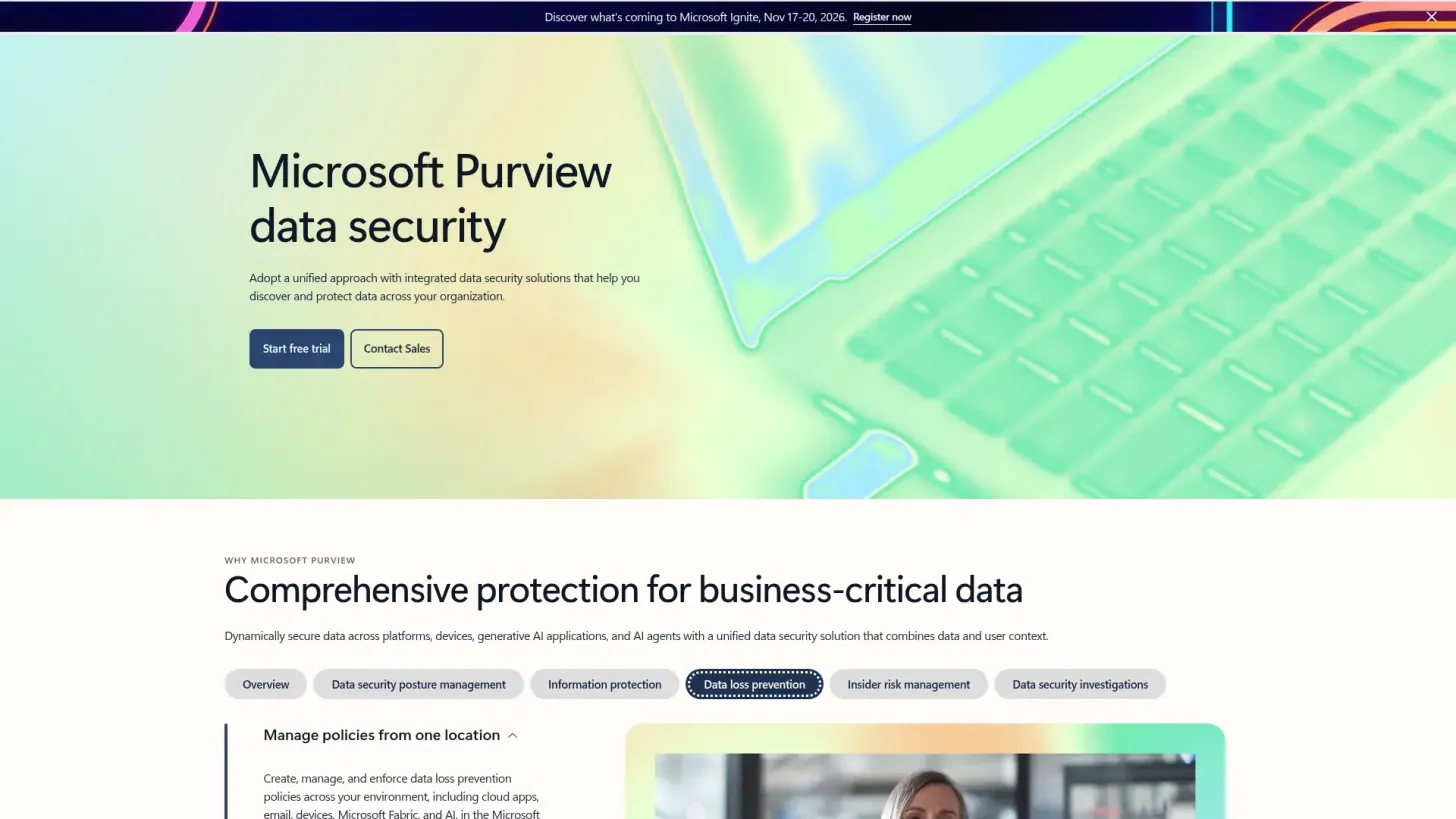
Microsoft Purview Data Loss Prevention is built into Microsoft's compliance stack. One policy engine covers Exchange, SharePoint, OneDrive, Teams, Office apps, and onboarded Windows and macOS devices.
For AI, Purview can apply inline controls to apps such as ChatGPT and Google Gemini. Those controls run through Edge for Business, the Purview browser extension for Chrome and Firefox on onboarded Windows devices, or a secure access service edge (SASE) integration.
- Channels covered: Endpoint, email, cloud/SaaS, and AI apps.
- Best for: Organizations already standardized on Microsoft 365 at the E5 level.
- Notable feature: Adaptive Protection ties DLP enforcement to each user's risk level from Purview Insider Risk Management.
- Limitation: Detection can be noisy out of the box. A director of IT on TrustRadius reported "many false positives with built-in SITs" (sensitive information types). Endpoint DLP runs on Windows and macOS only.
- Pricing: Endpoint DLP needs Microsoft 365 E5 ($60 per user per month with Teams, annual commitment). The other route is Microsoft 365 E3 plus the Microsoft Purview Suite add-on at $12 per user per month. Microsoft 365 E3 alone doesn't include endpoint DLP.
Forcepoint DLP
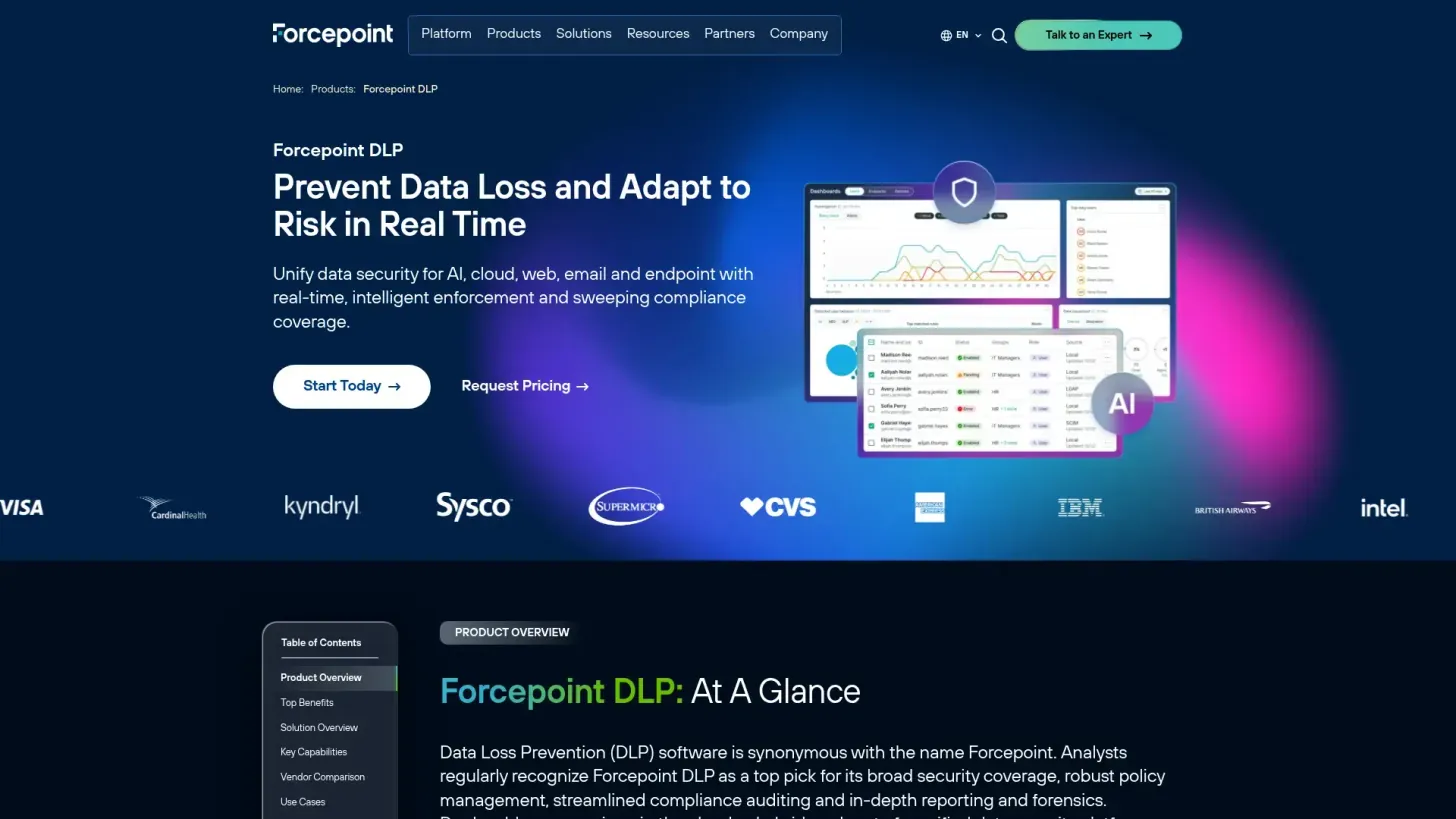
Forcepoint DLP applies one set of policies across endpoint, network, email, web, cloud apps, and generative AI tools. It ships with more than 2,000 classifiers and policy templates. ARIA, Forcepoint’s Adaptive Risk Intelligence Assistant, analyzes activity and policy coverage to recommend and deploy policies more efficiently.
- Channels covered: Endpoint, network, email, cloud/SaaS, and AI apps.
- Best for: Large enterprises that want one policy engine across every channel, deployed on-prem, in the cloud, or hybrid.
- Notable feature: Risk-Adaptive Protection scores users on 150+ behavioral indicators and tightens enforcement automatically as risk rises.
- Limitation: Expect a sizable setup project. A mid-market G2 user wrote that "initial setup and policy configuration can be complex and time-consuming."
- Pricing: Not publicly listed (quote-based).
Symantec Data Loss Prevention
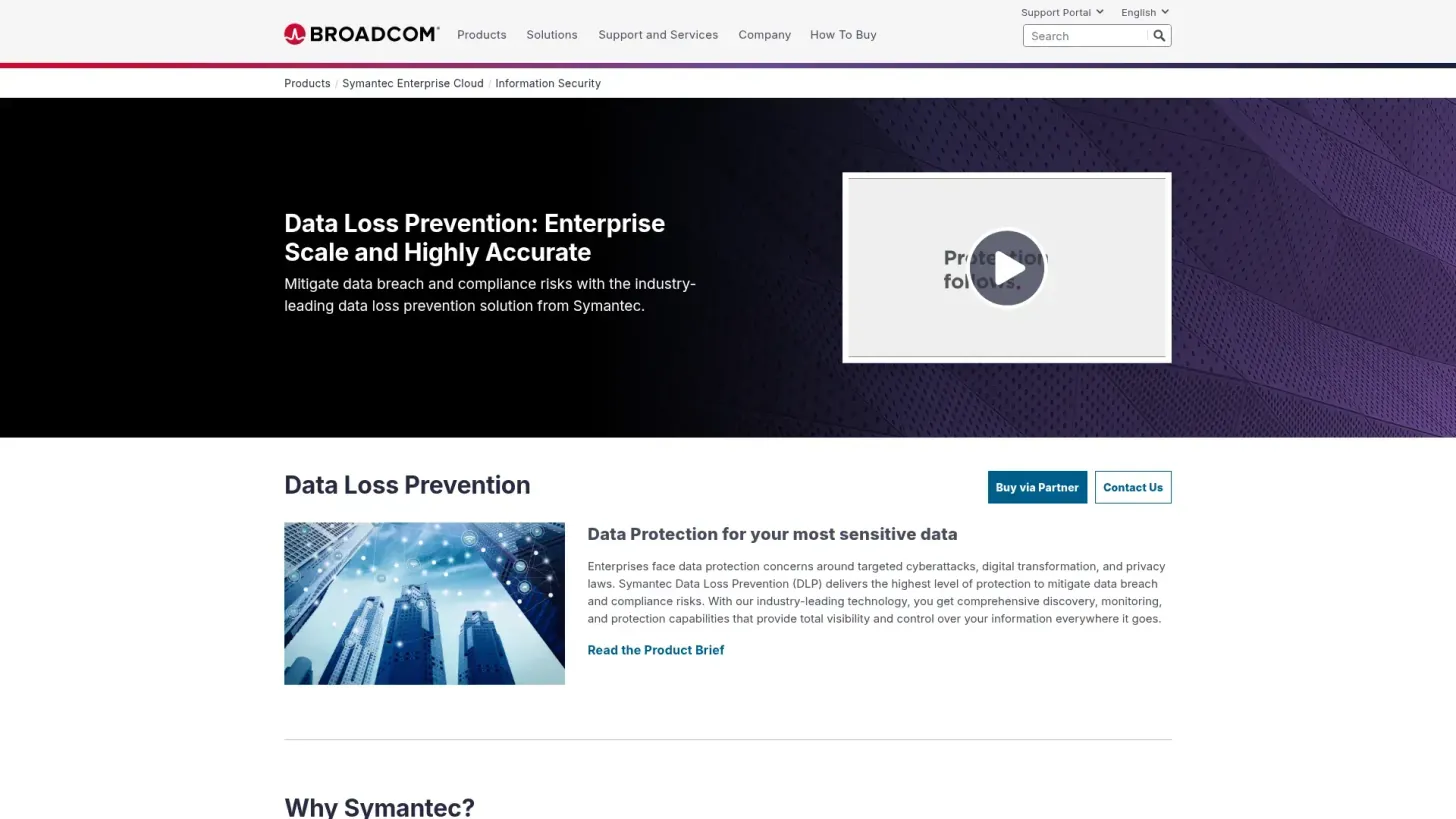
Symantec Data Loss Prevention, now owned by Broadcom, is a long-running enterprise DLP suite. It's sold as DLP Core for endpoint, network, and storage, plus DLP Cloud for cloud apps and email. In version 25.1, Broadcom added browser integration on Windows to monitor use of popular GenAI web apps.
- Channels covered: Endpoint, network, email, cloud/SaaS, and AI apps (browser-based, Windows).
- Best for: Regulated enterprises with on-prem infrastructure and a team that can run it.
- Notable feature: Detection depth. Exact data matching (EDM), indexed document matching, vector machine learning, and image OCR all run in one policy engine.
- Limitation: Deployment and policy tuning are heavy. Modules are licensed separately, so the full suite requires a high budget and a dedicated team. Broadcom also sells DLP inside larger suites, and licensing advisers report higher renewal quotes since the acquisition. Price at least one alternative alongside it.
- Pricing: Not publicly listed (custom quotes by module).
Netskope One Data Loss Prevention
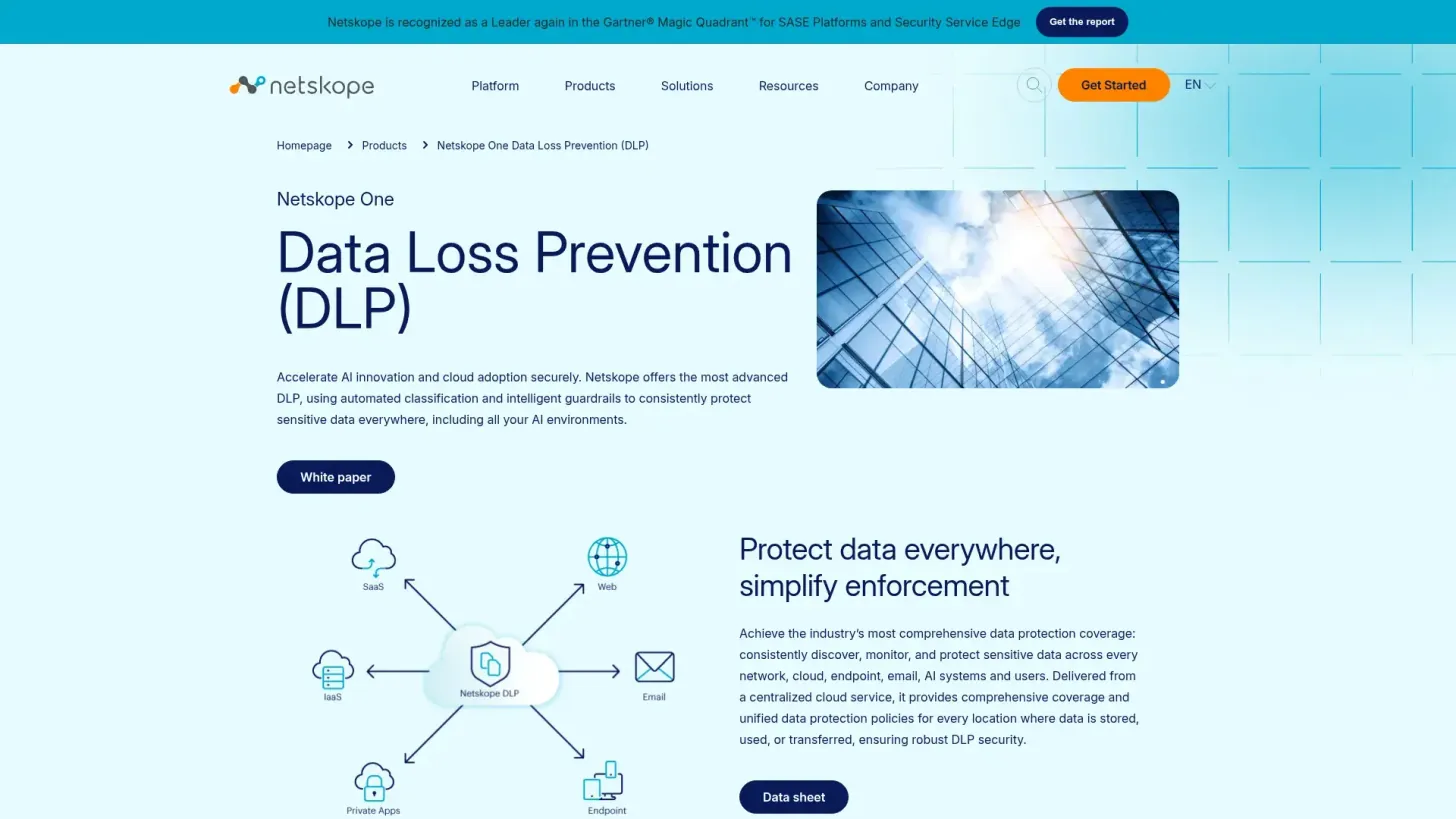
Netskope One Data Loss Prevention runs inside Netskope's security service edge (SSE) platform, enabling the tool to enforce policies before traffic hits the web or a SaaS application. A single policy framework covers web, SaaS, email, endpoints, and AI environments. Because it doesn’t have to wait for an endpoint agent, the service can catch data leaks that bypass traditional perimeter defenses.
- Channels covered: Network, email, cloud/SaaS, endpoint (add-on), and AI apps.
- Best for: Teams that already route web and SaaS traffic through Netskope, or plan to.
- Notable feature: Inline inspection across 1,800+ AI apps can redact the sensitive part of a prompt and let the task through.
- Limitation: Endpoint DLP is an add-on to the Netskope client and centers on USB storage and printers. Protection depends on traffic passing through Netskope.
- Pricing: Not publicly listed. Vendr reports a median Netskope contract of $96,815 per year across 45 purchases, for the platform as a whole.
Proofpoint Enterprise DLP
Proofpoint Enterprise DLP builds on Proofpoint's email security heritage. It protects sensitive data across email, cloud apps, endpoints, and GenAI tools, including unsanctioned ones. One user-mode endpoint agent serves both DLP and Proofpoint Insider Threat Management (ITM).
- Channels covered: Email, endpoint, cloud/SaaS, and AI apps.
- Best for: Organizations where email is the biggest exfiltration risk and Proofpoint already filters mail.
- Notable feature: ITM captures screenshots and activity context. Investigators see what happened before, during, and after an incident.
- Limitation: It's strongest where Proofpoint already handles your mail and loses much of that edge behind a different email gateway. Its user-mode agent is less likely to destabilize endpoints than a kernel-level one. It's also easier to tamper with and sees less low-level activity.
- Pricing: Not publicly listed.
Cyberhaven
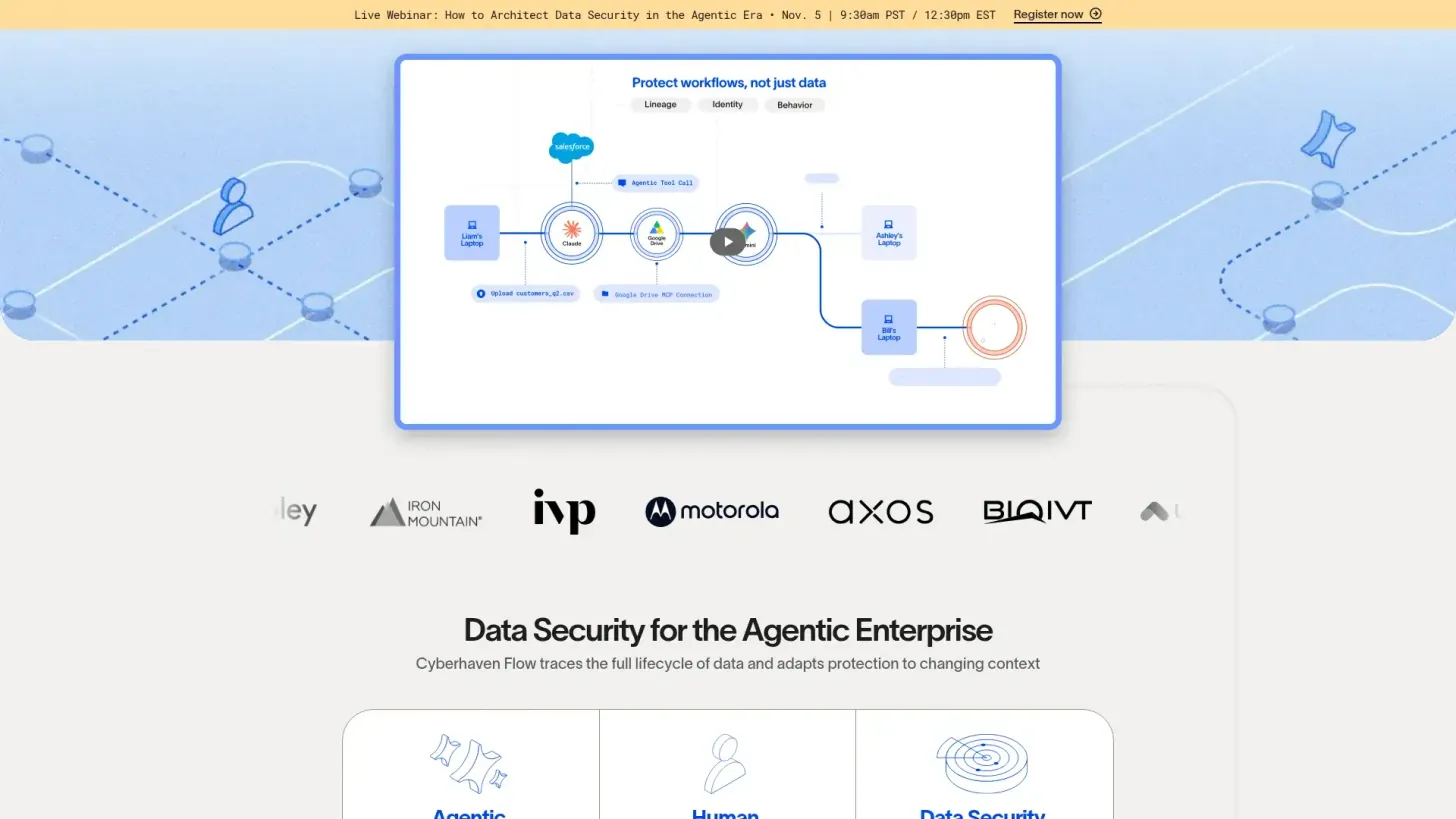
Cyberhaven is built on data lineage. It traces content from its origin through every copy, paste, and rewrite. In February 2026, it launched a unified platform combining data security posture management (DSPM), DLP, insider risk management, and AI security.
Cyberhaven and Ent overlap on endpoint DLP and insider risk, but they approach it differently. Cyberhaven's lineage shows where a piece of data came from, across endpoint, email, and cloud. Ent interprets the sequence of actions on the device and the intent behind them, then steps in before the data leaves.
- Channels covered: Endpoint, email, cloud/SaaS, and AI apps.
- Best for: Teams that want lineage-based DLP and insider risk in one product.
- Notable feature: Lineage lets a policy follow sensitive content after it's copied into a new file or pasted into an AI tool.
- Limitation: Tuning takes time. Ramyajyoti, a SoftwareReviews user, said that "initial setup requires more tuning than expected to avoid alert fatigue."
- Pricing: Not publicly listed.
Nightfall AI
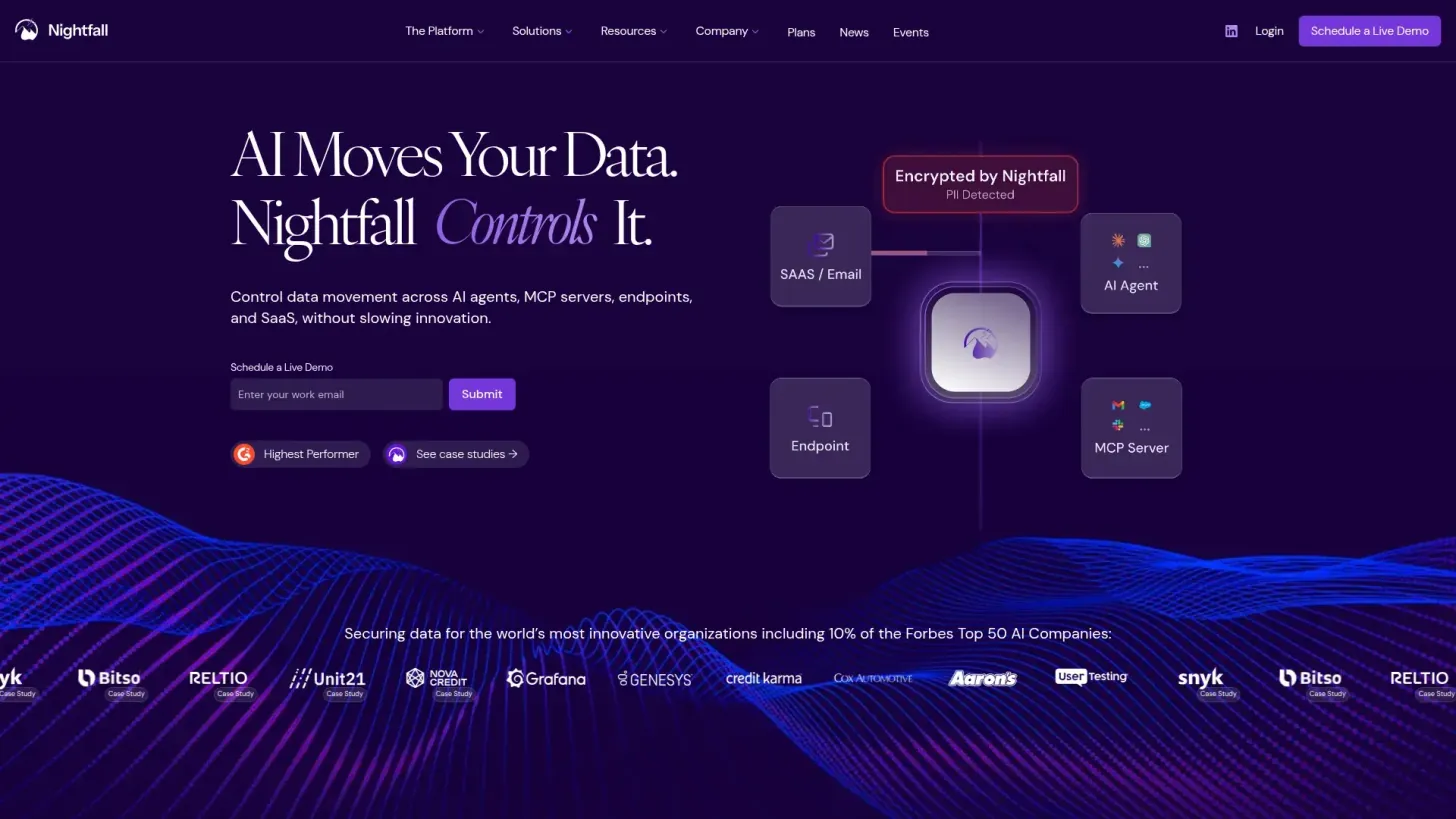
Nightfall AI uses pre-trained detectors to identify secrets, source code, and personal data instead of handwritten rules. Its SaaS DLP connects to apps such as Slack and Google Drive through APIs rather than agents to scan data at rest and in transit within cloud apps. No agent is required for that piece.
- Channels covered: Endpoint, email (Gmail and Exchange Online through APIs), cloud/SaaS, and AI apps.
- Best for: Cloud-first companies whose sensitive data lives in SaaS apps and AI coding tools.
- Notable feature: In the Premier edition, Inference Hooks inspect and block prompts, tool calls, and responses inside live AI sessions.
- Limitation: It has no network proxy. Coverage stops at the apps, browsers, and devices it integrates with.
- Pricing: Not publicly listed. Foundation and Premier editions are priced per user per year, and each user license covers two endpoint devices.
Netwrix Endpoint Protector
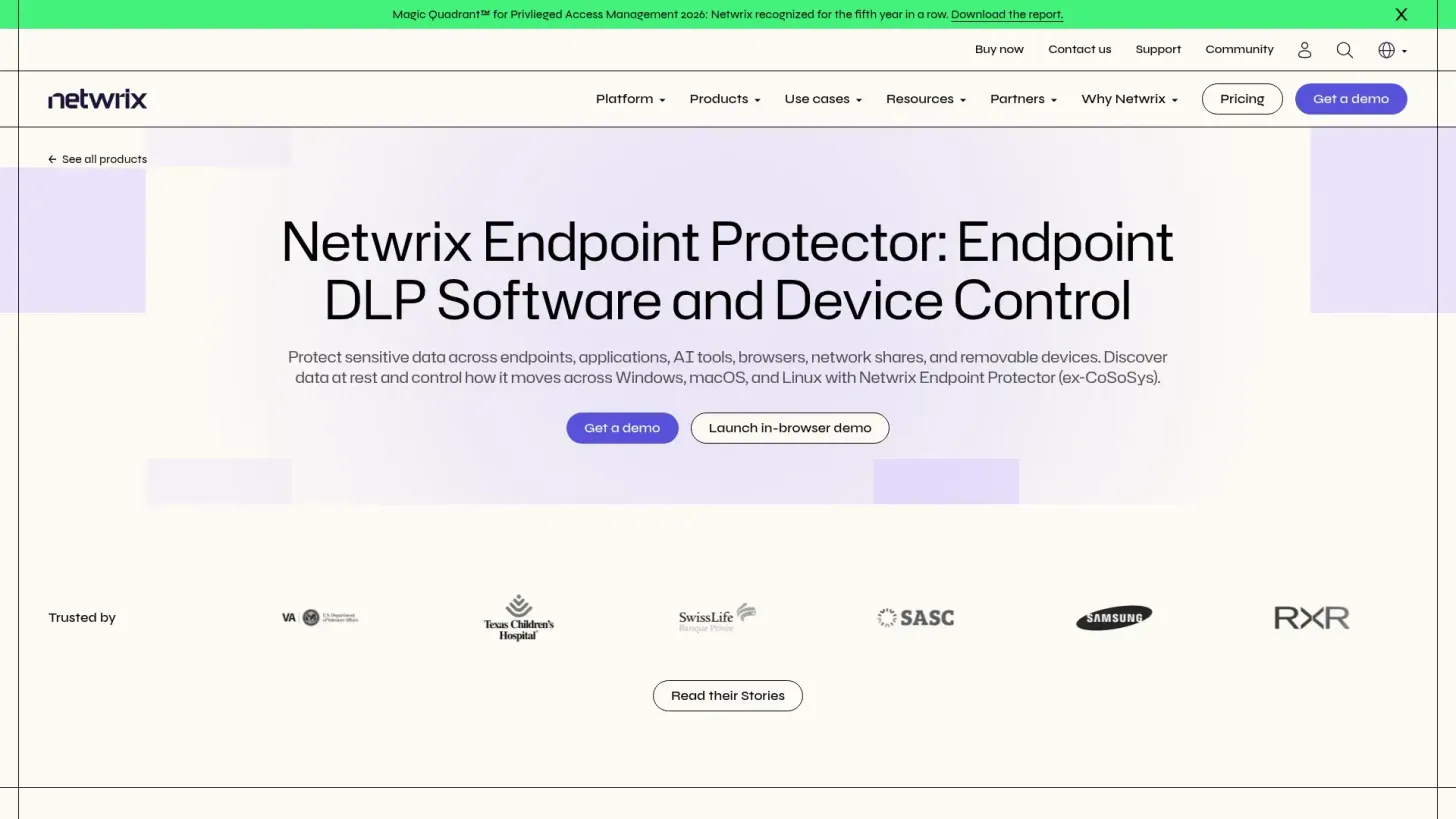
Netwrix Endpoint Protector, formerly known as Endpoint Protector by CoSoSys, prioritizes hardened data control at the endpoint. While other vendors focus on network traffic, Netwrix secures devices’ physical data exit points such as USB storage, printers, Bluetooth, and local file transfers.
Its four modules are Device Control, Content-Aware Protection, eDiscovery for data at rest, and Enforced Encryption for USB drives. It can block or restrict uploads to ChatGPT, Microsoft Copilot, and other AI apps.
- Channels covered: Endpoint and AI apps (uploads and clipboard on the device).
- Best for: Mid-market teams that need USB and device control across Windows, macOS, and Linux.
- Notable feature: Policies keep enforcing while devices are offline. It supports Windows, macOS, and Linux, though check feature parity on Linux in a pilot.
- Limitation: It's endpoint-only. There's no email gateway, SaaS API scanning, or network inspection.
- Pricing: Not publicly listed (quote-based).
Why Event-Based DLP Misses Risky Sequences
Most DLP rules evaluate events one at a time, such as a file match, an upload, or an outbound email. But risky data movement often happens as part of a series of individually normal actions instead.
Some tools already add that context. Cyberhaven's lineage tracks where data came from, while Forcepoint and Microsoft Purview adjust policies with risk-adaptive scoring based on how risky a user looks. Ent takes a different approach, interpreting the order of actions and the intent behind them in real time.
AI agents widen this visibility gap because they act with a user's own permissions, making their activity indistinguishable from the standard human workflow.
Consider these three steps an agent might run in a few seconds:
- The agent reads a .env file. Developer tools read config files all the time.
- It encodes the contents. Base64 encoding is routine in build scripts.
- It posts the result to an unfamiliar domain. Outbound requests are normal too, and the encoded payload may no longer match a secrets pattern. Many engines decode simple encodings like Base64, but chunking, compression, or encryption defeat content matching entirely.
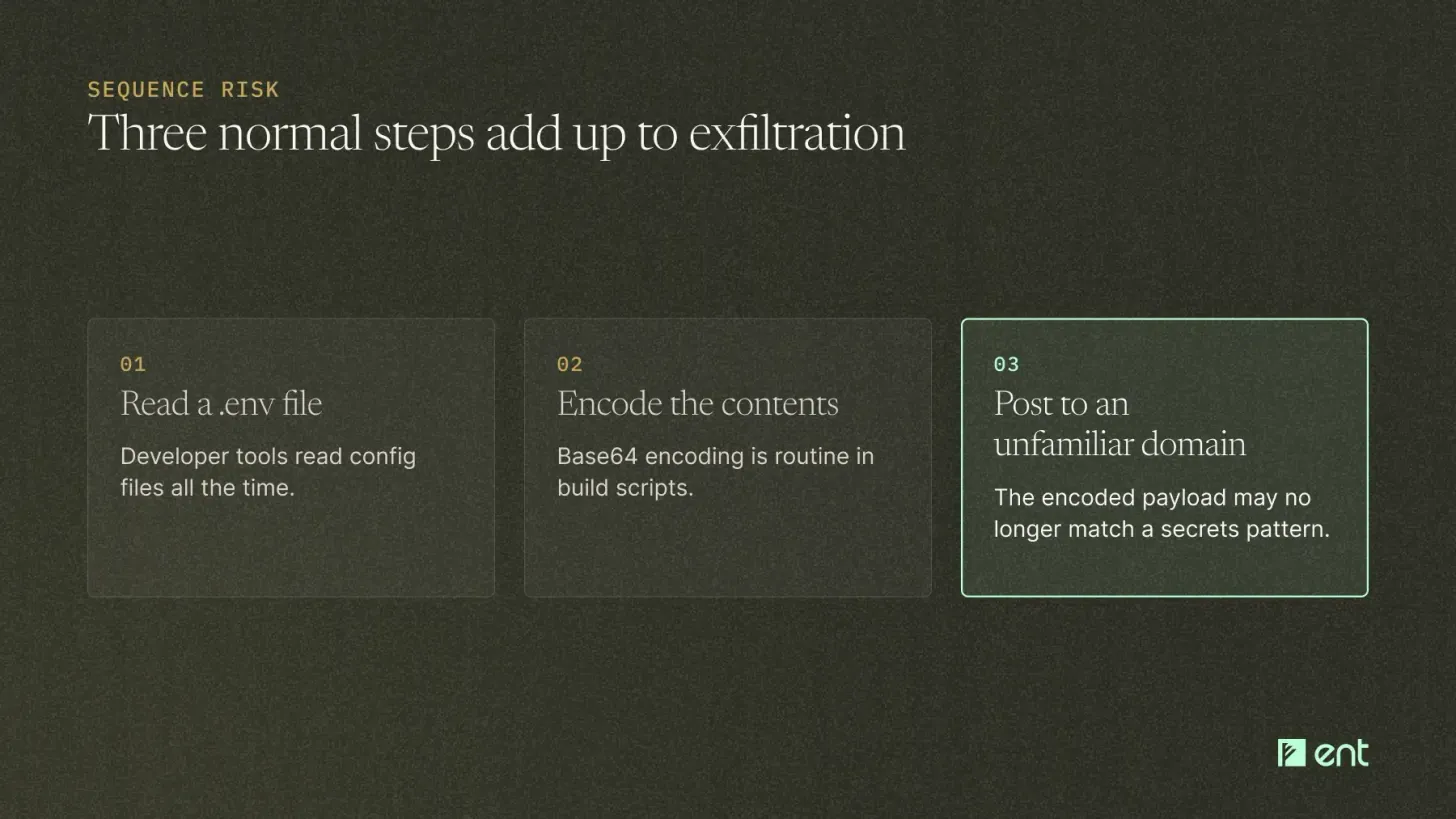
Each step is normal on its own, but the sequence results in exfiltration. A content-match rule on any single step may not fire. Brandon Dixon, co-founder of Ent, sums up the problem:
"By the time a system determines that something risky occurred, the action has often already completed."
Closing the gap means seeing actions in order, with user, application, and data context. Then the tool has to act before the final step completes. Response options matter, too. Warning a user, requiring a justification, or redacting the sensitive data cuts the friction false positives create.
Where Ent Fits: AI Endpoint Security For Data In Use
Ent brings AI to the endpoint. It understands actions in sequence and the intent behind them, then controls execution before data leaves. Its on-device SLM classifies sensitive data at the point of use and tracks it into AI apps such as Codex, Claude Code, and Cursor.
For data in AI apps, Ent can guide users and redact sensitive content. It can also warn, require a justification, escalate, or block.
The scope is specific. Ent can replace endpoint-based DLP, insider risk, and application control tools for many teams. It doesn't cover email or SaaS DLP, so it works alongside the tools you already run there.
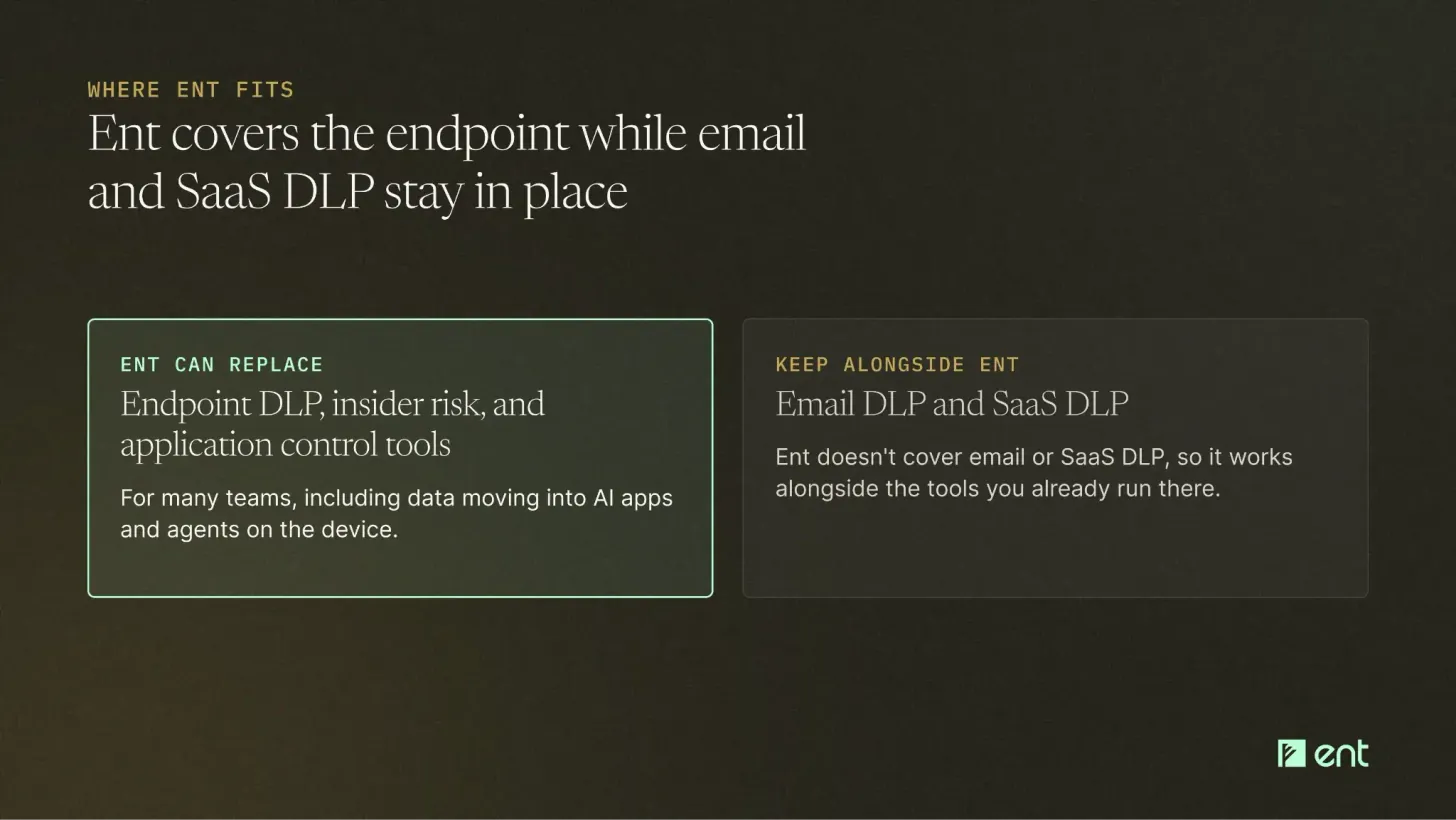
People and AI agents use the same apps, data, and credentials, and Ent applies one policy to both. It runs as SaaS or as a customer-controlled deployment in your own cloud. Sensitive telemetry can stay in your environment where required.
Andrew Cal, CISO at WestCap, describes how his team uses it:
"We use Ent to secure our workspace by understanding the intent behind what users and AI agents are doing, tracking sensitive data movement, and stepping in before the damage occurs."
Want to see how Ent handles the .env sequence above? Book a demo to watch it on your own endpoints.
FAQ
What are data loss prevention tools?
DLP tools find sensitive data, monitor how it moves, and enforce policy when it heads somewhere risky. Enforcement can mean warning, blocking, encrypting, or redacting.
What are the best DLP tools?
It depends on the channel you need to protect. Ent leads for AI app data on the endpoint, Purview for Microsoft 365 shops, and Forcepoint for enterprise-wide coverage.
What is an example of a DLP tool?
Microsoft Purview Data Loss Prevention is a common example. It applies one set of policies across Microsoft 365 apps and Windows and macOS devices.
Is DLP obsolete?
No, but rules that judge one event at a time are showing their age. AI agents create risky sequences that single-event rules miss, so newer tools add sequence context and responses like redaction.
Do I need separate DLP for email and cloud apps?
Usually, yes. An endpoint DLP tool doesn't inspect outbound email or SaaS sharing on its own.
How do DLP tools handle data pasted into AI chatbots?
Endpoint and browser-based tools inspect the paste on the device and can warn, block, or redact it. Network tools like Netskope inspect the prompt inline and strip the sensitive details.
How does DLP handle data moved by AI agents?
AI agents act with a user's own credentials and permissions, so many DLP tools can't tell an agent's actions from the person's. Single-event rules can also miss an agent that reads a file, encodes it, and sends it out within seconds.
Tools built for agentic work follow the sequence of actions and the process behind them. Ent connects agent actions, apps, data, and process execution on the device, and Nightfall's Inference Hooks inspect prompts and tool calls inside live AI sessions.
Can one DLP policy cover both human and AI agent workflows?
Yes, on the channels the tool can see. People and agents use the same apps, data, and credentials, so separate policies leave gaps when work passes from one to the other. Ent applies one policy to both on the endpoint. Email and SaaS sharing still need their own DLP coverage.