12 Best CrowdStrike Alternatives In 2026

Falcon's strengths are well documented. CrowdStrike reports 100% detection and protection with zero false positives in the 2025 MITRE ATT&CK Enterprise Evaluation. It's also building AI agent security directly into Falcon, most recently with Falcon Guardian.
Yet, the price climbs fast once Falcon Complete or add-on modules enter the deal. Some buyers are still cautious because of the July 2024 sensor outage. Others need more depth in cloud, identity, exposure management, and AI and workspace activity.
Below, you'll find 12 alternatives, what each one does best, and how to match one to your situation.
TL;DR
- Buyers tend to leave over one of five drivers: cost, update risk, coverage gaps, operating model, or AI-era risk.
- Eleven of the twelve alternatives replace the Falcon agent. They range from enterprise platforms like SentinelOne and Cortex to managed EDR built for small teams, like Huntress and ThreatDown.
- Ent is the exception. It works alongside your EDR and judges the intent behind human and AI agent actions in the workspace.
- Replacing Falcon Cloud Security or Falcon Next-Gen SIEM instead? Wiz, Orca, and Exabeam are covered in their own section.
- Compliance frameworks like NIST 800-171, CMMC, and HIPAA don't require CrowdStrike or any other named vendor.
Why Security Teams Look Beyond CrowdStrike
The reasons tend to cluster into five buckets. Which one applies to you shapes everything else in this guide.
Pricing and licensing
Falcon's self-serve tiers are public. CrowdStrike's pricing page lists Falcon Go at $59.99, Falcon Pro at $99.99, and Falcon Enterprise at $184.99 per device per year. Falcon Complete, the managed detection and response (MDR) tier, is quote-only.
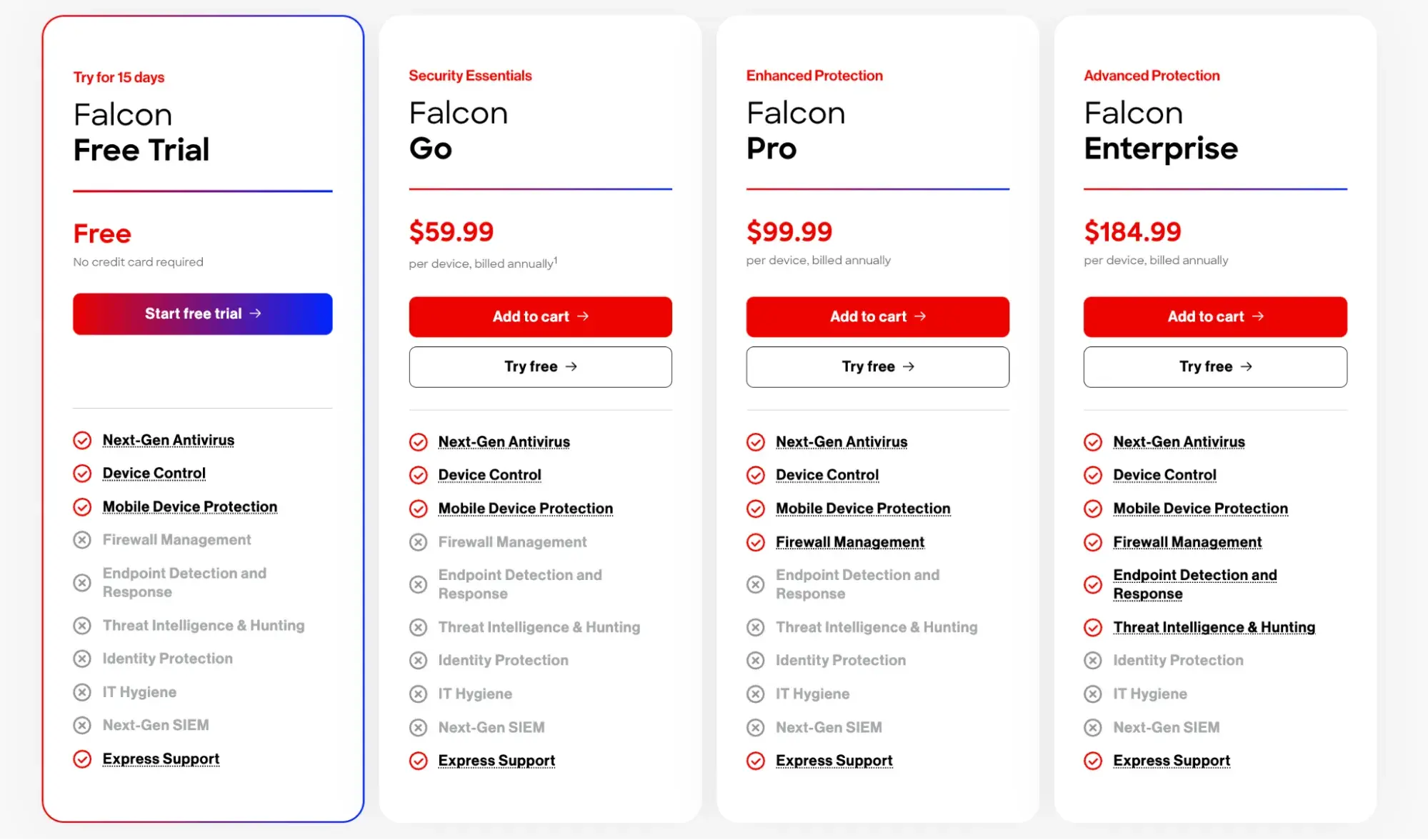
List price is rarely where enterprise deals land. Identity, cloud, next-gen SIEM, and managed services each add to the bill. Vendr's purchase data puts the median CrowdStrike contract at $55,412 a year.
Smaller teams feel the pricing complexity the most. In one G2 review, a SIEM engineer at a small business wrote that "the pricing can be relatively high for smaller organizations, especially when additional modules are required."
The July 2024 outage
On July 19, 2024, a faulty Falcon content update crashed Windows hosts running sensor 7.11 and above. The update was live for about 78 minutes before CrowdStrike reverted it. Microsoft estimated that roughly 8.5 million Windows devices went down.
CrowdStrike has since made changes. Its root cause analysis committed to staged deployment rings, customer control over Rapid Response Content, and two independent third-party code reviews.
It isn't a permanent disqualifier, but it's something to keep in mind as you evaluate solutions. Ask every potential alternative how it stages, tests, and lets you control content updates.
Coverage gaps beyond the endpoint
Falcon started as an endpoint agent. The endpoint is still where the platform is strongest.
For some buyers, the gap is cloud workload and container security. For others, it's exposure management or SIEM-style correlation across a wider log estate.
Operating model mismatch
Some teams want a self-managed platform they can tune themselves. Others want the analyst layer that Falcon Complete supplies. A mismatch shows up as alert fatigue on one side or an underused subscription on the other.
AI agent and workspace risk
AI agents now write code, move files, and call APIs on employees' behalf. IBM's 2026 Cost of a Data Breach Report found that one in four malicious breaches were AI-enabled. Those breaches cost an average of $6 million.
CrowdStrike is moving fast here. Falcon Guardian adds agent discovery, access controls, and runtime detection at the endpoint.
Endpoint-first tools still tend to read AI and human activity as file and process events. Intent is harder to see from there. This matters if you're weighing workspace-level prevention against endpoint detection.
Intent-aware security asks why an action is happening. It weighs context like who's acting, which app they're in, what data is involved, and where it's headed.
Say an AI coding agent reads a customer data file, then starts uploading it to a personal cloud drive. An endpoint tool logs a file read and a network connection. An intent-aware tool sees sensitive data leaving for an unsanctioned destination and can block the upload before it finishes.
The best alternative depends on which of these five drivers is pushing you. The rest of this guide is organized around that question.
CrowdStrike Alternatives At A Glance
Eleven of the alternatives below replace the Falcon agent. Some are enterprise platforms, and others are built for small and mid-sized teams without a full SOC. Ent sits alongside your EDR at the workspace level.
Tool Category Best For Notable Feature Pricing Model Ent Workspace/AI-era prevention Teams whose top risk is AI agents and insider-style behavior Intent-aware, just-in-time intervention for humans and AI agents Quote-only Microsoft Defender for Endpoint Direct EDR swap Organizations on Microsoft 365 E3/E5 or A5 Included in many Microsoft 365 licenses Bundled; standalone about $3 to $5.20/user/mo (third-party) SentinelOne Singularity Direct EDR swap Automated response at scale Autonomous on-agent protection and one-click rollback From $179.99/endpoint/yr (list) Palo Alto Networks Cortex Platform consolidation Unifying EDR, SIEM, and SOC tooling XSIAM combines EDR, SIEM, SOAR, and ASM Quote-only; XDR about $40 to $100/endpoint/yr (third-party) Sophos Endpoint (Intercept X) Direct EDR swap Mid-market teams that want one vendor for firewall and endpoint Coordinated response with Sophos Firewall Quote-only via partners TrendAI Vision One Platform consolidation Broad XDR across endpoint, email, cloud, network, and identity One platform with XDR, SIEM, and exposure management Quote-only; about $35 to $60/endpoint/yr (third-party) Bitdefender GravityZone Direct EDR swap Strong prevention with central management Risk analytics and PHASR attack surface reduction About $40 to $70/endpoint/yr negotiated (third-party) Trellix Endpoint Security Direct EDR swap Consolidating legacy McAfee or FireEye ePO-based central management Quote-only ESET PROTECT Direct EDR swap Lightweight protection with a cloud or on-prem console Low system footprint About $45 to $75/endpoint/yr negotiated (third-party) Huntress Managed EDR Managed EDR Small and mid-sized businesses without a SOC 24/7 human-led SOC included in the price $7.99/endpoint/mo at 100 endpoints (list) ThreatDown Managed EDR Cost-conscious businesses and MSPs Ransomware rollback in a single lightweight agent About $69 to $99/device/yr (list) Heimdal Platform consolidation Replacing stacked point tools with one agent Prevention, patching, PAM, and email in one agent Quote-only (estimate calculator)
Ent
Ent is an intent-aware endpoint platform for the workspace. A lightweight agent and browser extension watch activity across apps, browsers, files, and local AI runtimes on Windows, macOS, and Linux. On-device reasoning judges whether each action is legitimate and can step in before it completes.
Ent applies one policy to people and AI agents, including tools like OpenAI Codex, Claude Code, GitHub Copilot, and Cursor. Security teams can see who uses which AI tools and what data those tools touch. Ent can also steer people to sanctioned tools, flag sensitive content before it reaches an AI app, and block risky agent actions.
A custom small language model (SLM) classifies sensitive data at the point of use and tracks where it moves to prevent data loss. Policies can also restrict shadow AI, remote management tools, and living-off-the-land binaries. Ent runs as SaaS or self-hosted in your own cloud for full data sovereignty.
Interventions are configurable, and teams write their own policies. That lets you match the response to the risk, from steering someone to a sanctioned AI tool to restricting an action or blocking it outright. Ent also weighs behavior alongside content patterns to cut down on noisy alerts.
- Best for: Teams whose biggest emerging risk is AI agents activity, insider-style behavior and data movement that looks legitimate on the surface.
- Notable feature: Inline prevention and execution control that redirect, restrict, or block a human or AI agent action before it finishes.
- Limitation: It isn't built as a sole replacement for antivirus-layer prevention.
- Pricing: Quote-only. Ent doesn't publish pricing, so schedule a demo to get a quote.
Microsoft Defender for Endpoint
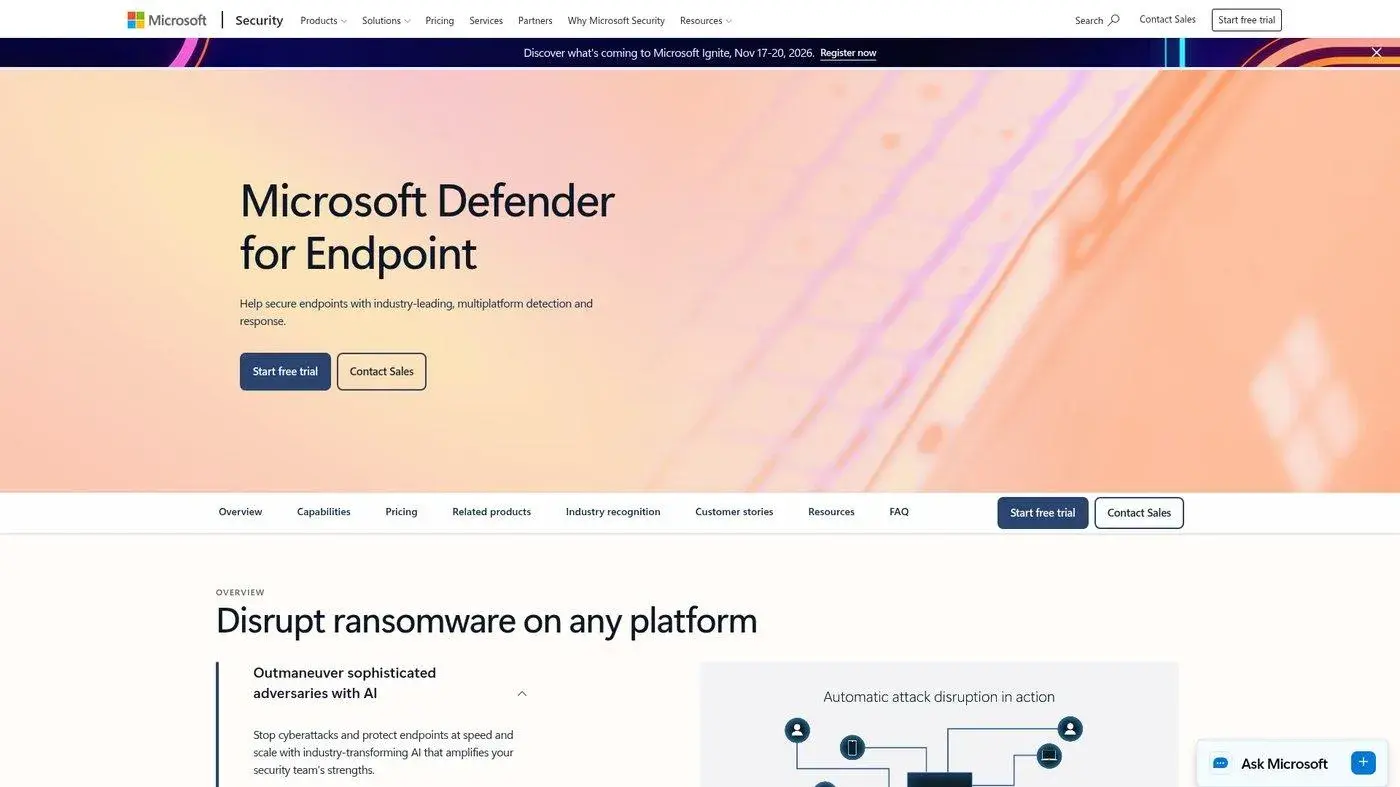
Microsoft Defender for Endpoint is the EDR many organizations already own. Plan 1 is included in Microsoft 365 E3 and A3. Plan 2 comes with E5 and A5, per Microsoft's licensing guide.
Deployment friction is low for Windows-heavy shops. The endpoint sensor is built into Windows 10 and 11, so onboarding is mostly a policy and licensing exercise. E3 customers can add the Microsoft Defender Suite for $12 per user per month to extend coverage to email, identity, and SaaS apps.
- Best for: Organizations already licensed for Microsoft 365 E3/E5 or A5.
- Notable feature: Endpoint signals feed the same Defender XDR console as email and identity.
- Limitation: Management is split across several Microsoft portals. Depending on the setting, endpoint policy may live in Defender, Intune, or Entra. Finding the right place can take time, so budget for admin training or a partner who knows the stack.
- Pricing: Included in E3/A3 (Plan 1) and E5/A5 (Plan 2). Standalone, CostBench reports about $3 for Plan 1 and $5.20 for Plan 2 per user per month (third-party). Defender for Business lists at $3 per user per month for up to 300 users.
SentinelOne Singularity
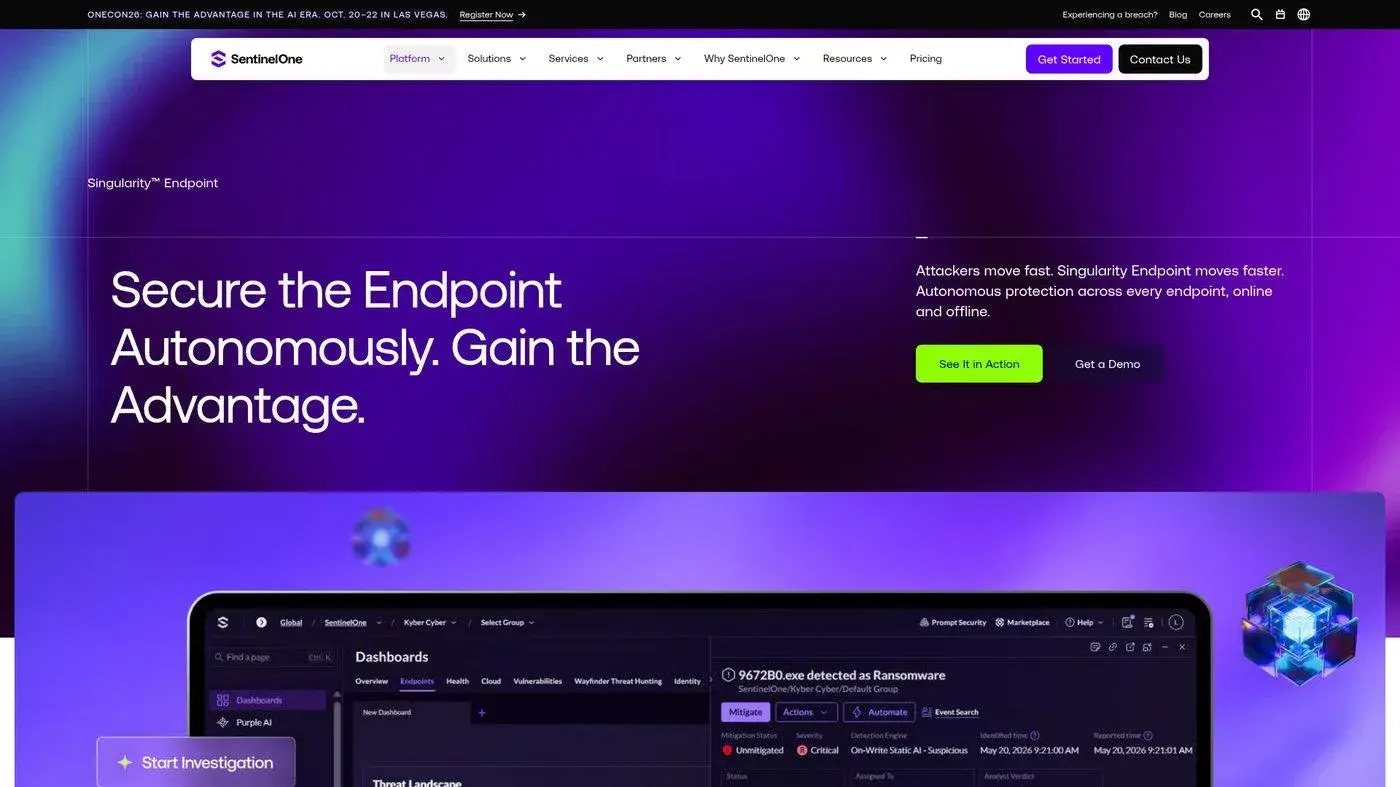
SentinelOne Singularity is the closest architectural match to Falcon. Both rely on a single agent and behavioral detection. The difference is where decisions happen.
SentinelOne's agent detects and mitigates on the device itself. That keeps protection running online and offline, including in air-gapped environments. The same agent covers Windows, macOS, Linux, and cloud workloads.
- Best for: Teams comparing cost at scale that want an EDR architecture similar to Falcon's.
- Notable feature: One-click rollback and remediation that returns an endpoint to a trusted state.
- Limitation: Singularity Complete lists at $179.99 per endpoint per year, versus $184.99 for Falcon Enterprise. SentinelOne also sat out the 2025 MITRE evaluation, so plan your own proof-of-concept testing.
- Pricing: Singularity Complete is $179.99 and Singularity Commercial is $229.99 per endpoint per year (list, for 5 to 100 workstations). Enterprise is quote-only.
Palo Alto Networks Cortex (XDR/XSIAM)

Palo Alto Networks Cortex is a platform play more than an endpoint swap. Its flagship, Cortex XSIAM, is an AI-driven SOC platform with EDR and XDR built in. It also folds in SIEM, SOAR, attack surface management (ASM), behavior analytics, and threat intelligence.
XSIAM uses the Cortex XDR agent on endpoints. Palo Alto also sells Cortex XDR on its own for teams that only need endpoint detection and response.
Treat it as a consolidation decision. XSIAM can replace Falcon on the endpoint and your SIEM in the same move. The value case rests on retiring several SOC tools at once.
- Best for: Teams consolidating EDR, SIEM, and exposure management onto one platform.
- Notable feature: XSIAM combines EDR, SIEM, SOAR, and ASM on one data platform.
- Limitation: The payoff depends on committing to the broader platform. Buying Cortex XDR alone leaves most of the consolidation value on the table. Alert tuning also comes with a steep learning curve.
- Pricing: Quote-only. Vendr reports Cortex XDR at roughly $40 to $100 per endpoint per year, depending on tier (third-party).
Sophos Endpoint (Intercept X)
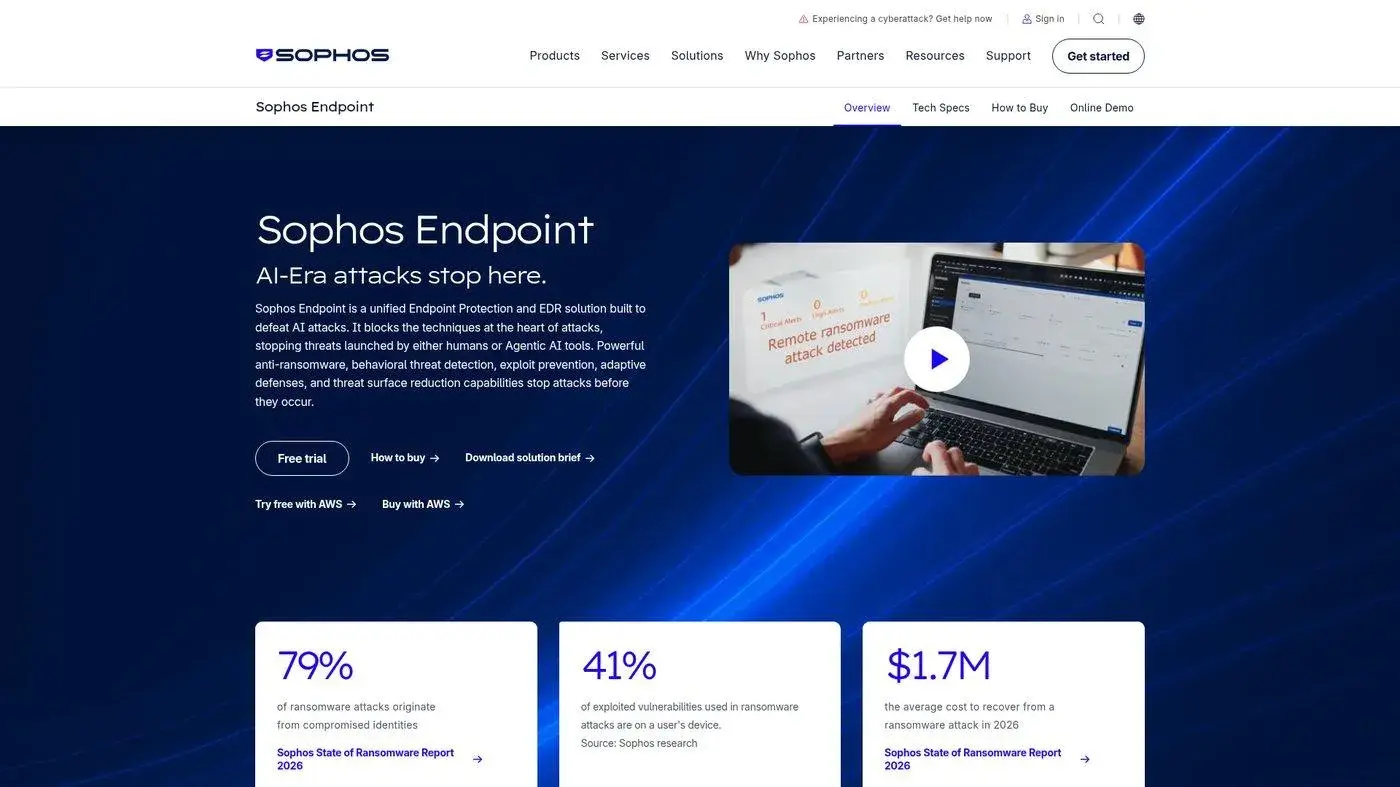
Sophos Endpoint, still widely known as Intercept X, leans prevention-first. It turns on 60+ exploit mitigations by default. Its CryptoGuard feature reverts files that ransomware has encrypted.
The main draw is its tie-in with Sophos Firewall. The two products share signals and coordinate a response when either one spots an attack. Teams without analysts can add Sophos MDR for 24/7 monitoring.
- Best for: Mid-market teams that want one vendor for firewall and endpoint.
- Notable feature: Synchronized response between Sophos Endpoint and Sophos Firewall, managed from one console.
- Limitation: Agent overhead is the main drawback. It can spike CPU and memory during scans, updates, and telemetry uploads. Pilot it on your oldest laptops and busiest servers before a full rollout.
- Pricing: Quote-only through partners. Vendr reports Intercept X Advanced at roughly $50 to $70 per user per year for smaller deployments (third-party).
TrendAI Vision One
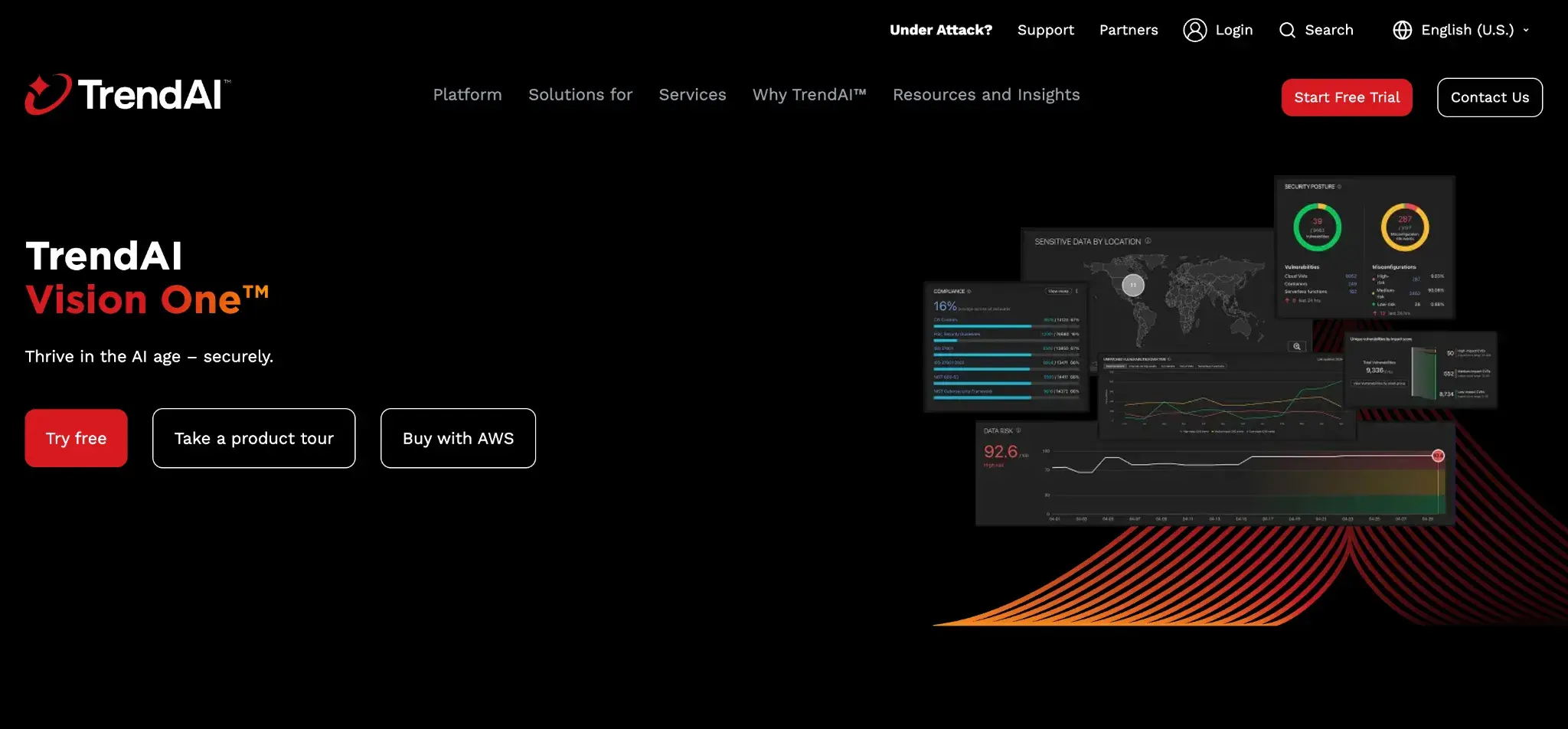
TrendAI Vision One is the enterprise platform formerly sold under the Trend Micro name. Trend Micro rebranded its enterprise business as TrendAI in March 2026. The platform covers endpoints, email, cloud, network, identity, and data from one console.
On top of that coverage sit XDR, an agentic SIEM, SOAR, and cyber risk exposure management. That lets you replace Falcon on the endpoint and consolidate email and network security in the same purchase.
- Best for: Organizations that want broad XDR coverage across endpoint, email, cloud, network, and identity.
- Notable feature: Endpoint protection, XDR, SIEM, and exposure management on one platform.
- Limitation: The rebrand is recent, so product names in older contracts, docs, and partner quotes may still say Trend Micro. Confirm exactly which modules a quote includes before comparing it to Falcon.
- Pricing: Quote-only. Vendr reports Vision One bundles at roughly $35 to $60 per endpoint per year (third-party). The median Trend Micro contract on Vendr is $43,277 a year.
Bitdefender GravityZone
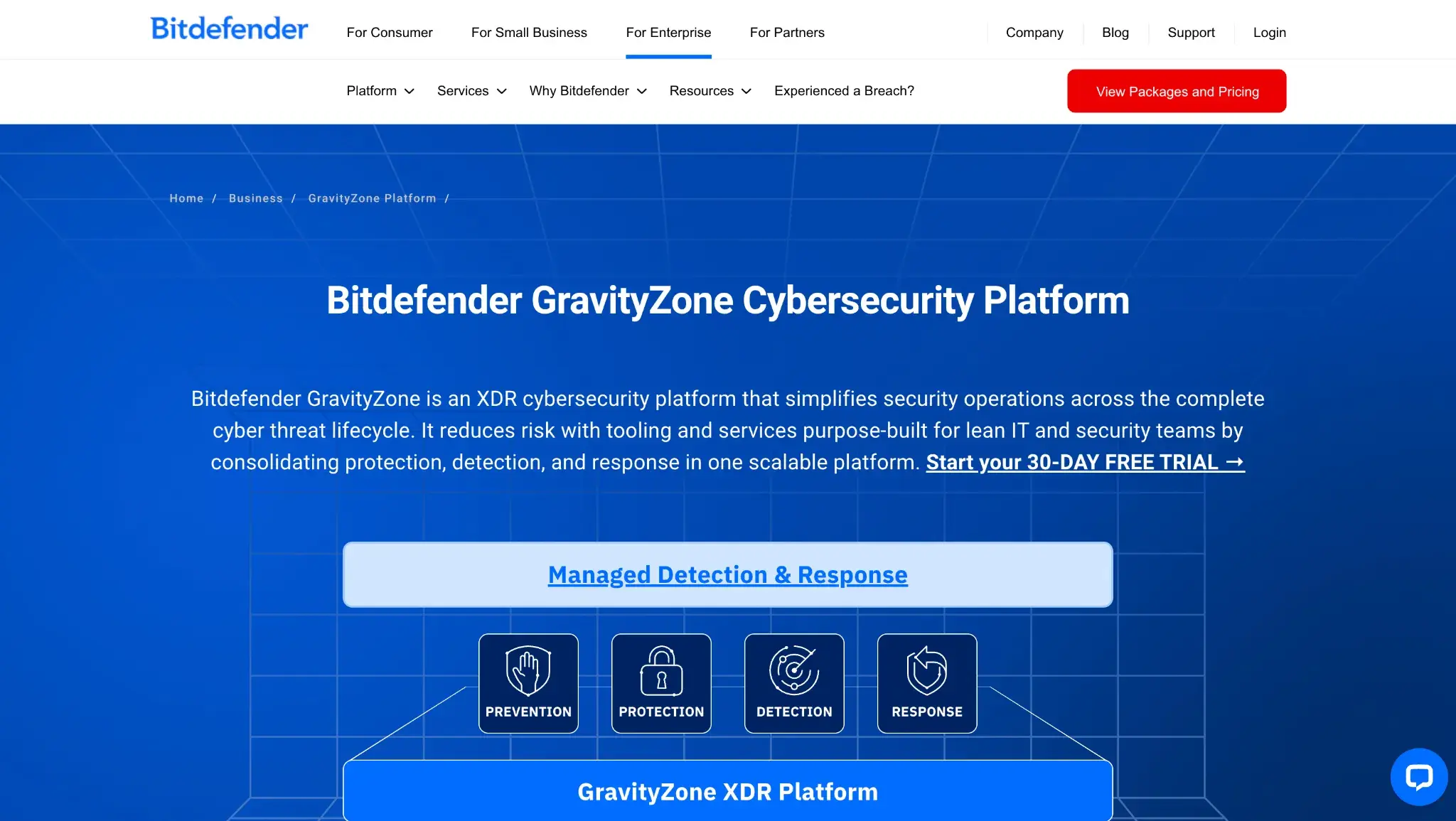
Bitdefender GravityZone unifies endpoint protection, EDR, and XDR under one console. Its risk analytics give each organization a risk score and track how it improves over time. PHASR, its attack surface reduction feature, tightens endpoint controls based on user behavior and active threats.
GravityZone offers both cloud-hosted and on-premises consoles. Patch management, email security, and full-disk encryption are available as add-ons.
- Best for: Teams that want strong prevention and central management without an enterprise price tag.
- Notable feature: PHASR hardens each endpoint based on how it's used.
- Limitation: Renewals can cost much more than year one. CostBench reports buyers seeing renewal prices 50% to 80% above new-customer pricing, so negotiate multi-year terms up front.
- Pricing: Quote-only through partners. Vendr reports buyers paying about $40 to $70 per endpoint per year after negotiation, with a median contract of $8,121 a year (third-party). CostBench lists starting prices from about $57 to $95.89 per device per year, depending on tier.
Trellix Endpoint Security
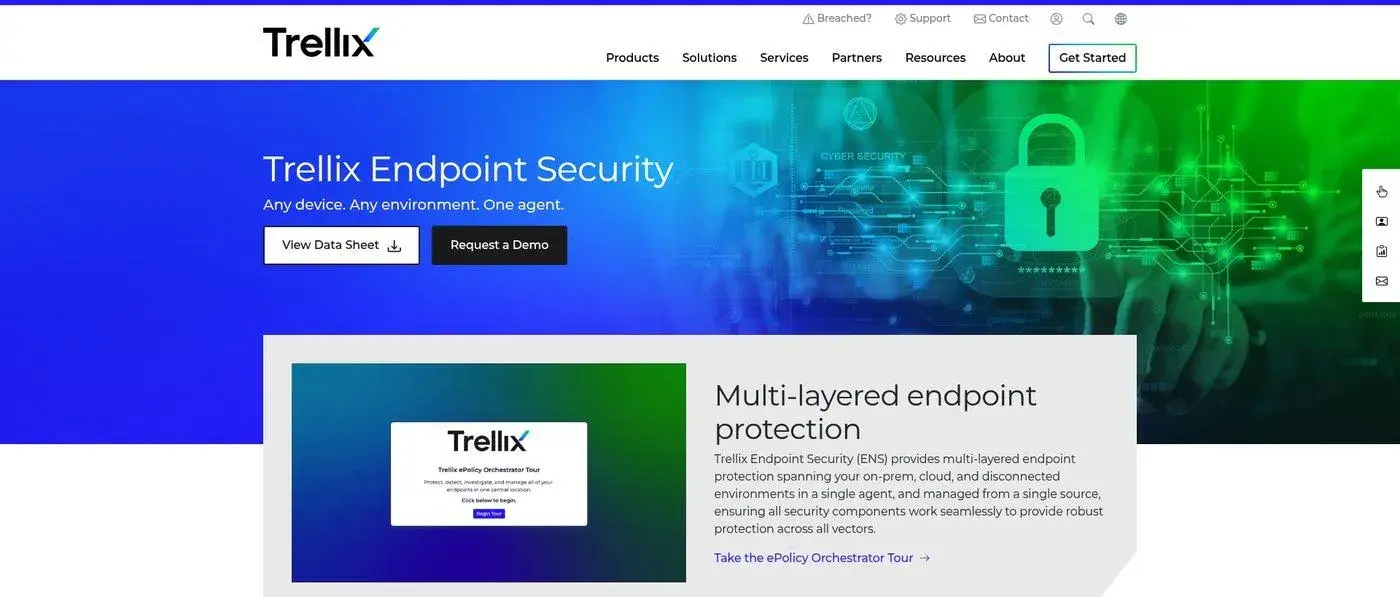
Trellix formed in January 2022 when McAfee Enterprise and FireEye combined. Its endpoint suite runs under ePolicy Orchestrator (ePO), the console many McAfee shops already know. For McAfee shops, that continuity is often the strongest reason to shortlist it.
- Best for: Organizations consolidating legacy McAfee or FireEye deployments.
- Notable feature: ePO-based central management across endpoint and EDR policy.
- Limitation: CPU and memory use can run high at system startup, so test on older endpoints first. The case for Trellix also weakens quickly if you aren't already running McAfee or FireEye.
- Pricing: Quote-only. Trellix doesn't publish endpoint pricing.
ESET PROTECT
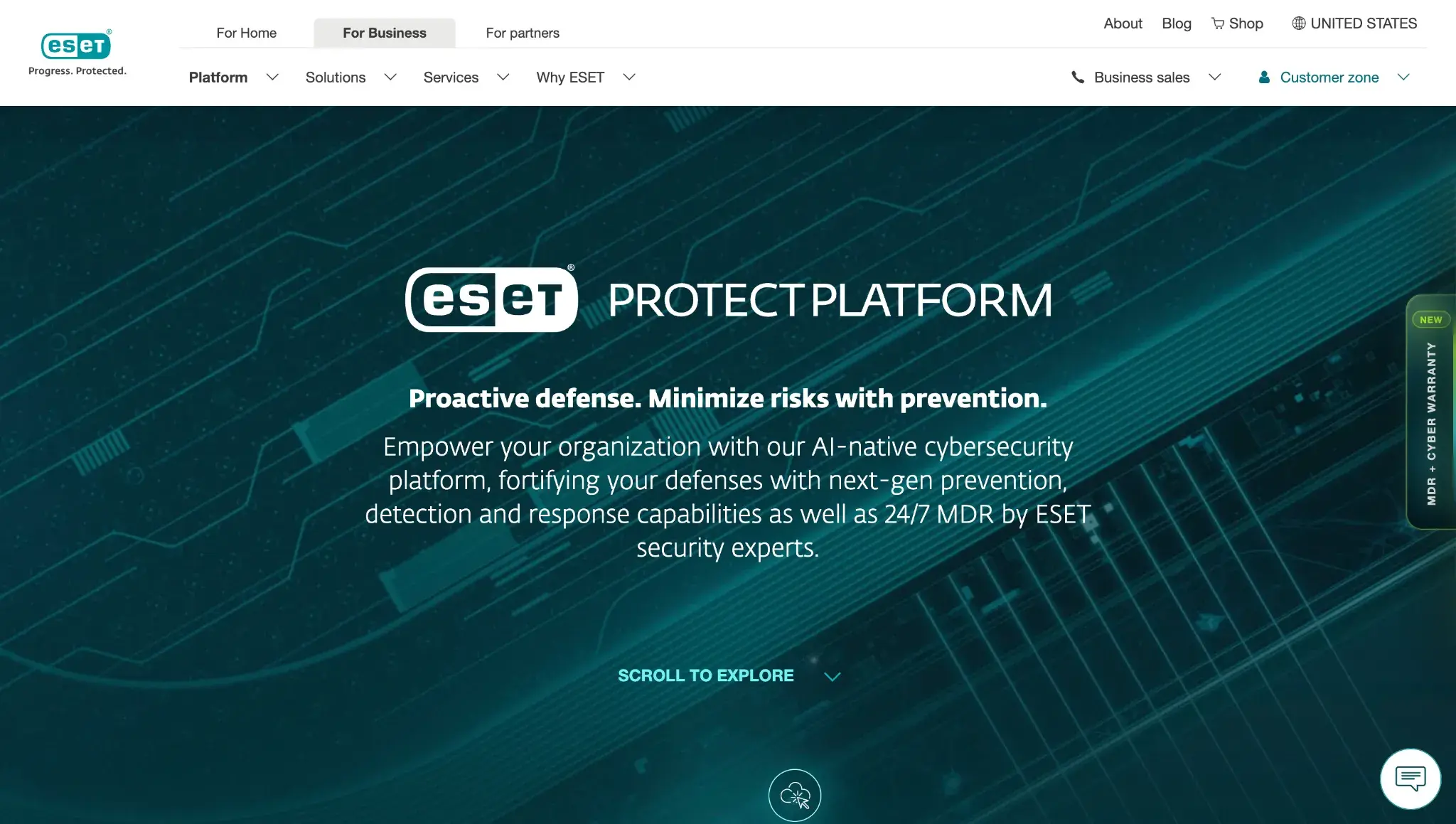
ESET PROTECT is built around a light footprint. ESET says its agent has extremely low impact on device performance. It protects computers, servers, mobile devices, and cloud workloads.
ESET offers a full on-premises console alongside its cloud console. Higher tiers add ESET Inspect for XDR and 24/7 MDR.
- Best for: Teams that want lightweight protection and the choice of a cloud or on-premises console.
- Notable feature: Low system overhead that suits older laptops and busy servers.
- Limitation: The entry tier is next-gen antivirus only. EDR and MDR come with the higher tiers, so compare like for like when you price it against Falcon.
- Pricing: Quote-only through partners. Vendr reports list pricing of about $60 to $100 per endpoint per year and negotiated pricing of $45 to $75 (third-party). The median contract is $13,182 a year. ESET's current tiers are Core, Premium, and Ultimate, so confirm which one a quote covers.
Huntress Managed EDR
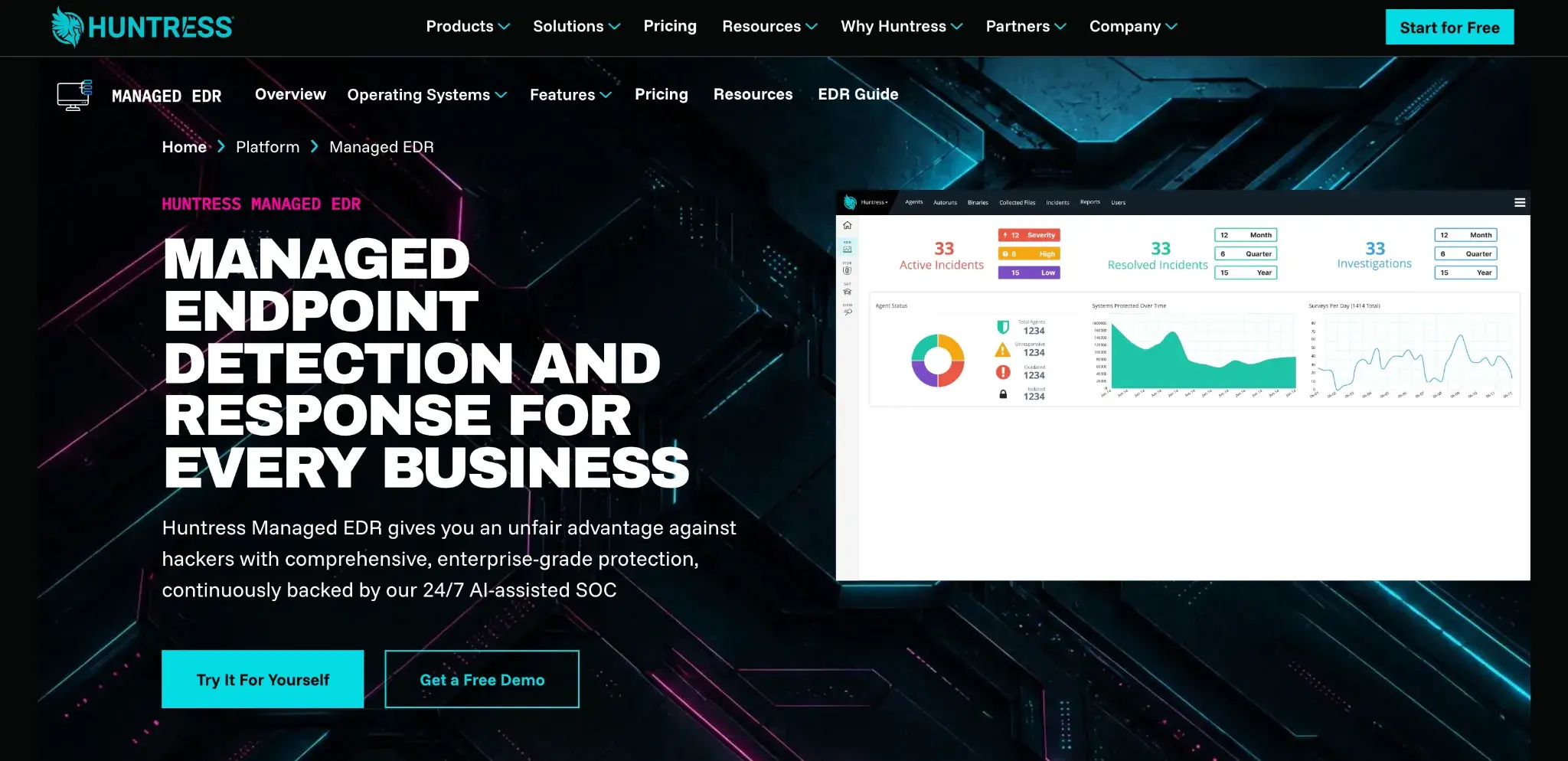
Huntress pairs EDR with a 24/7 human-led SOC that's included in the price. Its analysts investigate threats, contain them, and send a remediation plan in plain English. One agent covers Windows, macOS, and Linux.
Huntress also manages Microsoft Defender Antivirus at no extra cost. That makes it a natural fit for small teams already on Microsoft 365 that need someone watching the console.
- Best for: Small and mid-sized businesses without a dedicated SOC.
- Notable feature: Human-led SOC included at no additional cost. Analysts send remediation plans instead of raw alerts.
- Limitation: Huntress is channel-first. Buying direct requires a 50-seat minimum, so most customers buy through an MSP or reseller.
- Pricing: $7.99 per endpoint per month at 100 endpoints (list). Rates drop at higher volumes. Vendr reports a median contract of $11,000 a year (third-party).
ThreatDown
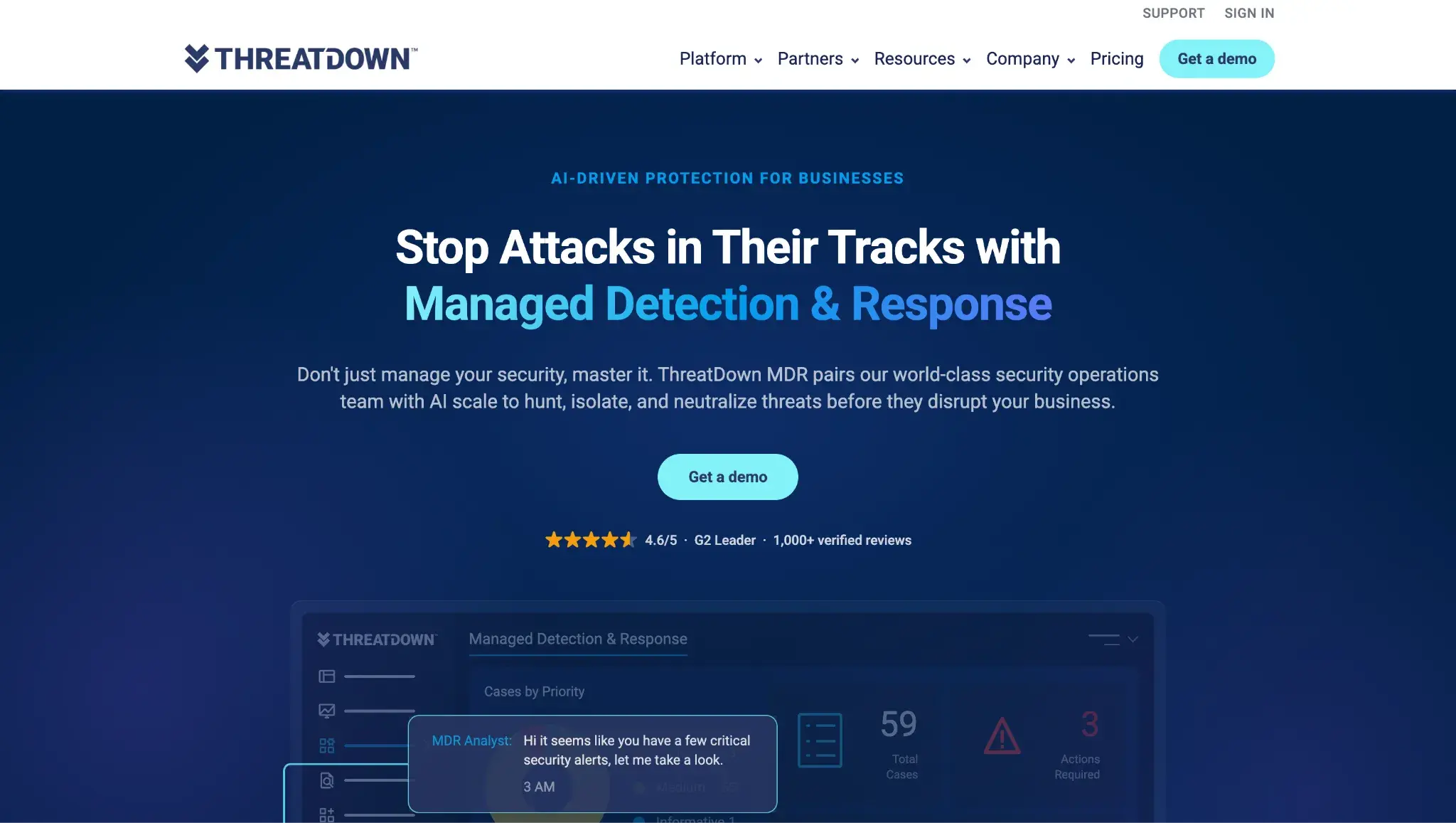
ThreatDown is Malwarebytes' business division. It runs one lightweight agent that combines next-gen antivirus, EDR, and ransomware rollback. Its Elite MDR tier adds 24/7 human-led threat monitoring and response.
ThreatDown targets small businesses, mid-market teams, and MSPs. Its pricing is published. That makes it one of the easiest alternatives here to budget for.
- Best for: Cost-conscious businesses and MSPs that want EDR or MDR at a predictable price.
- Notable feature: Ransomware rollback that restores affected files after an attack.
- Limitation: Identity threat detection and premium support sit in the top Ultimate MDR Plus tier. That tier is quote-only.
- Pricing: ThreatDown lists Core at $345, Advanced EDR at $395, and Elite MDR at $495 per year for 5 devices. That works out to about $69 to $99 per device per year. Three-year terms get 20% off. Vendr reports EDR deals at about $70 to $100 per endpoint per year, with a median contract of $7,380 (third-party).
Heimdal
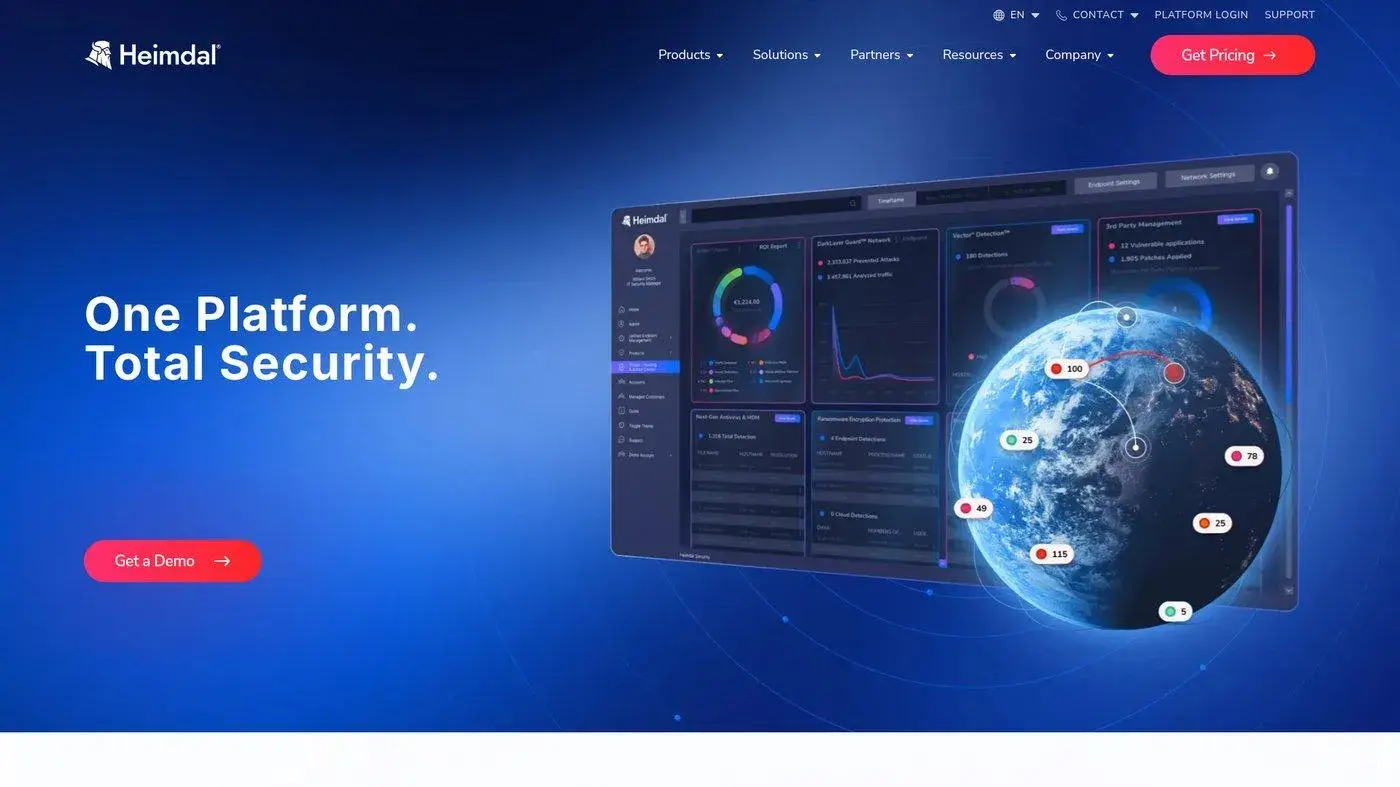
Heimdal bundles prevention, patching, and access control into one agent and console. Modules include DNS security, next-gen antivirus, patch and asset management, privileged access management (PAM), email security, and EDR/XDR. A managed XDR service adds a 24/7 SOC.
- Best for: Teams that want prevention, patching, identity, and email in one agent instead of stacked point tools.
- Notable feature: Patch and asset management inside the same agent as endpoint protection.
- Limitation: The admin experience lags the feature list. The portal can be hard to navigate, and integration with professional services automation (PSA) tools is limited. That matters most for managed service providers (MSPs) and IT teams that run ticketing through a PSA.
- Pricing: Quote-only. Heimdal offers an online estimate calculator, and sales sets final pricing.
Decision Framework: Matching An Alternative To Your Situation
Feature lists matter less than a few blunt questions. Answer these before you book demos.
Question Why it matters Where it points Are you replacing the endpoint agent, or filling a gap around it? These tools cover different layers. Most swap out Falcon's agent. Others add workspace, cloud, or SIEM coverage alongside it. Replacing the agent: any of the 11 EDR picks above. Filling a gap: Ent, or the cloud and SIEM tools in the next section. How big is your team, and is anyone dedicated to watching a console? Console-heavy platforms need analyst time for tuning and triage. Lean teams get more from managed options. Lean teams: Huntress, ThreatDown Elite MDR, Sophos with MDR, or Heimdal with MXDR. Staffed SOCs: Cortex, SentinelOne, or TrendAI Vision One. Is your budget grant-funded capex or recurring opex? Smaller institutions often can't absorb costs that grow year over year. Renewal jumps and module add-ons are harder to forecast. Published per-endpoint pricing: Huntress, ThreatDown, SentinelOne, or Defender bundled with Microsoft 365. Lock in multi-year terms with Bitdefender. Which compliance frameworks apply, such as NIST 800-171/CMMC or HIPAA? None of these frameworks names a vendor. Auditors look for deployed, current, monitored protection with evidence. Any of the EDR picks can meet malicious-code controls. Weigh reporting and log retention over brand name. How much of your estate is Linux servers and compute versus Windows office endpoints? Cloud workloads and servers need different coverage than employee laptops. Compute-heavy: SentinelOne, Cortex, or TrendAI Vision One, plus a cloud tool from the next section. Windows-heavy: Defender, Huntress, or Sophos. Is AI and workspace activity part of the risk you need to cover, beyond endpoint file events? Endpoint tools record files and processes. Judging the intent behind human and AI agent actions takes app- and browser-level context. Ent. It judges the intent behind human and AI agent actions and can step in before they complete.
Once you have answers, match them to the scenarios below.
- Your risk is AI agents and human behavior and activity: Ent fits best here. It judges intent across apps, AI tools, and browsers. It can also stop an action before it completes, control exection, and protect data from exposure.
- You're comparing cost at scale on a similar architecture: SentinelOne is the closest one-for-one swap for Falcon's agent model. Its public list pricing gives you a clean benchmark.
- You already license Microsoft 365 E3/E5 or A5: Start with Microsoft Defender for Endpoint. You may already be paying for it.
- You're a small team with no one watching a console: Shortlist Huntress and ThreatDown. Both bundle a 24/7 SOC at a published price.
- You need an on-premises console: ESET PROTECT and Bitdefender GravityZone both offer one alongside their cloud consoles.
- You want EDR, SIEM, and SOC tooling on one platform: Palo Alto Networks Cortex is designed for that consolidation. XSIAM combines EDR, SIEM, SOAR, and ASM on one platform.
Replacing Other Falcon Products
Falcon is a platform, and some buyers are replacing more than the agent. The tools below don't replace endpoint protection. They're alternatives to Falcon Cloud Security and Falcon Next-Gen SIEM.
Falcon Cloud Security alternatives
If you need visibility into cloud and containerized environments, the shortlist changes. Some endpoint vendors cover both, while dedicated cloud platforms go deeper on the cloud side.
- SentinelOne Singularity Cloud Security: Combines posture management, workload protection, and runtime defense for containers, VMs, and AI workloads. It correlates cloud, endpoint, and identity telemetry. That mirrors how Falcon pairs its cloud and endpoint data.
- Palo Alto Networks Cortex Cloud: Palo Alto folded Prisma Cloud into Cortex Cloud in 2025. XSIAM customers can add its cloud capabilities natively, so cloud and endpoint data land on one platform.
- Microsoft Defender for Cloud: A CNAPP that covers Azure, AWS, and Google Cloud. Defender for Containers adds Kubernetes runtime protection. It's strongest in Azure-heavy environments.
- TrendAI Vision One: Cloud security runs on the same platform as its endpoint, email, and network coverage.
- Wiz: Wiz maps risk across code, cloud, and runtime with a security graph. Wiz Defend adds a lightweight runtime sensor for detection and response inside cloud workloads. Google completed its $32 billion acquisition of Wiz in March 2026, and Vendr reports a median contract of about $154,400 a year.
- Orca Security: Orca scans cloud workloads without agents using its patented SideScanning. An optional runtime sensor adds live protection. Vendr reports a median contract of about $95,600 a year.
Falcon Next-Gen SIEM alternative
Exabeam is a SIEM and user and entity behavior analytics (UEBA) platform that merged with LogRhythm in 2024. It baselines normal activity across a broad log estate, and its Agent Behavior Analytics extends that to AI agents. It runs cloud-native or self-hosted, and Vendr reports a median contract of about $210,000 a year.
Cortex XSIAM and TrendAI Vision One also include SIEM capabilities. If you're choosing one of them for the endpoint, check whether its SIEM covers your log sources before buying a separate one.
Where Ent Fits
Most of the tools above are highly effective at stopping malicious activity. They block malware, exploits, and suspicious behavior in real time. Legitimate actions performed with valid tools and identities are harder to judge without more context.
AI agents widen that gap. An agent with valid credentials and a sanctioned tool can still send sensitive data somewhere it shouldn't go.
Ent's difference is architectural. It evaluates the intent behind a human or AI agent action, using on-device reasoning across the endpoint and browser. It can then intervene before the action completes.
It applies one policy to human and AI agent behavior. Agent activity isn't handled as an exception case. For teams where data sovereignty is a hard requirement, Ent can run self-hosted in your own cloud.
Be clear-eyed about fit. Ent is built for teams whose biggest emerging risk is AI agents and insider-style behavior that looks legitimate on the surface. Most teams will likely run it alongside an existing endpoint or cloud stack. Keep your EDR on the endpoint. Let Ent govern what people and agents do in the workspace.
To see intent-aware prevention on your own endpoints, book a demo with Ent.
Frequently Asked Questions
What does CrowdStrike cost, and why do quotes vary so much?
Falcon Go, Pro, and Enterprise list at $59.99, $99.99, and $184.99 per device per year. Falcon Complete is quote-only. Endpoint count, modules, term length, and managed services all move the final number.
That spread is visible in purchase data. Vendr reports CrowdStrike contracts ranging from about $12,700 to $337,000 a year.
How do these alternatives differ at a category level?
Direct EDR swaps like SentinelOne, Defender, and ESET replace the Falcon agent. Managed EDR options like Huntress and ThreatDown add a 24/7 SOC for teams without analysts. Platforms like Cortex, TrendAI Vision One, and Heimdal consolidate EDR with other tools.
Ent sits at the workspace level and judges the intent of human and AI agent actions. Wiz, Orca, and Exabeam replace Falcon's cloud and SIEM products. They don't replace the agent.
Can you run these alongside CrowdStrike instead of replacing it?
Yes. Ent, Wiz, Orca, and Exabeam can all run alongside Falcon.
The EDR picks are different. Running two full EDR agents on one device usually only makes sense during a migration window.
Does compliance require CrowdStrike specifically?
No. NIST SP 800-171 Rev. 3 names no vendor products, and CMMC Level 2 aligns to the 110 requirements of Rev. 2.
HIPAA asks for procedures for guarding against malicious software. What auditors want to see is deployed, current, monitored protection, backed by evidence.