13 Best AI Governance Tools For 2026, By Use Case

- Governing the AI you build or buy: An inventory of AI systems, risk assessments, and evidence for frameworks like the EU AI Act and NIST AI RMF.
- Governing how AI gets used: Controlling how employees and agents use AI tools on their own machines every day.
To govern the AI your company builds or buys, you need a system of record. To govern the AI your employees actually use, you need real-time enforcement.
For security teams, the more pressing problem is usually the second one. Think shadow AI, coding assistants like Cursor and Claude Code, agents that act with a user's own credentials, and agents that connect to tools and data through the Model Context Protocol (MCP).
No single platform does both perfectly. Our guide covers your blind spots by breaking down the best AI governance tools today, categorizing them by the specific real-time security or big-picture governance, risk, and compliance (GRC) needs they actually solve.
TL;DR
AI governance splits into two jobs, and most teams need a tool for each. Here are the best picks.
- Best for workforce AI usage and agent control: Ent governs what people and AI agents do on the endpoint with one policy.
- Best for Microsoft 365 shops: Microsoft Purview DSPM covers Copilot and AI app data risk inside an existing E5 estate.
- Best for model, risk, and compliance governance: Credo AI offers policy packs and an agent registry built for governance, risk, and compliance (GRC) teams.
- Best for enterprises standardized on IBM or OpenPages: IBM watsonx.governance ties lifecycle monitoring to a risk console.
What AI Governance Tools Do And How To Evaluate Them
AI governance tools help an organization find, control, and prove how it uses AI. Most cover some mix of these five functions:
- Discover AI systems. Find the models, apps, agents, and AI tools in use, including the unapproved ones.
- Assess risk. Score each use case by data sensitivity, impact, and regulatory exposure.
- Enforce policy. Turn rules into controls that warn, block, or redact.
- Monitor behavior. Watch models and AI usage over time for drift, misuse, or leaks.
- Produce audit evidence. Generate the records an auditor or regulator will ask for.
Two categories with different owners
Model, risk, and compliance governance tools serve GRC, legal, and data science teams by tracking AI systems as corporate assets. Workforce AI usage and agent control tools serve security teams by stepping in when employee AI use gets risky.
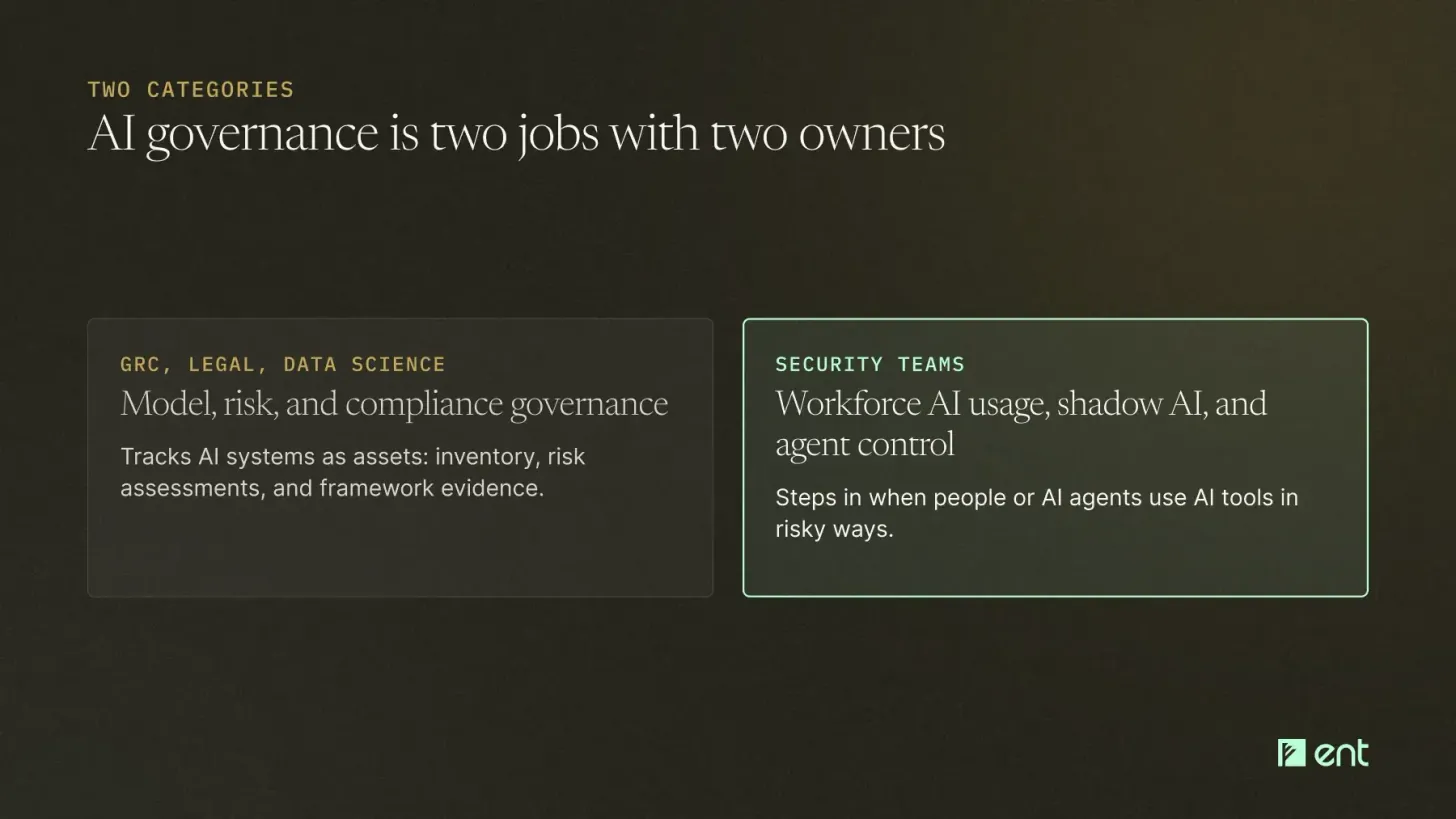
Many organizations need one of each, but the two sides overlap around shadow AI and agent governance. For example, OneTrust and Credo AI now offer agent registries and MCP policy controls alongside their regulatory templates.
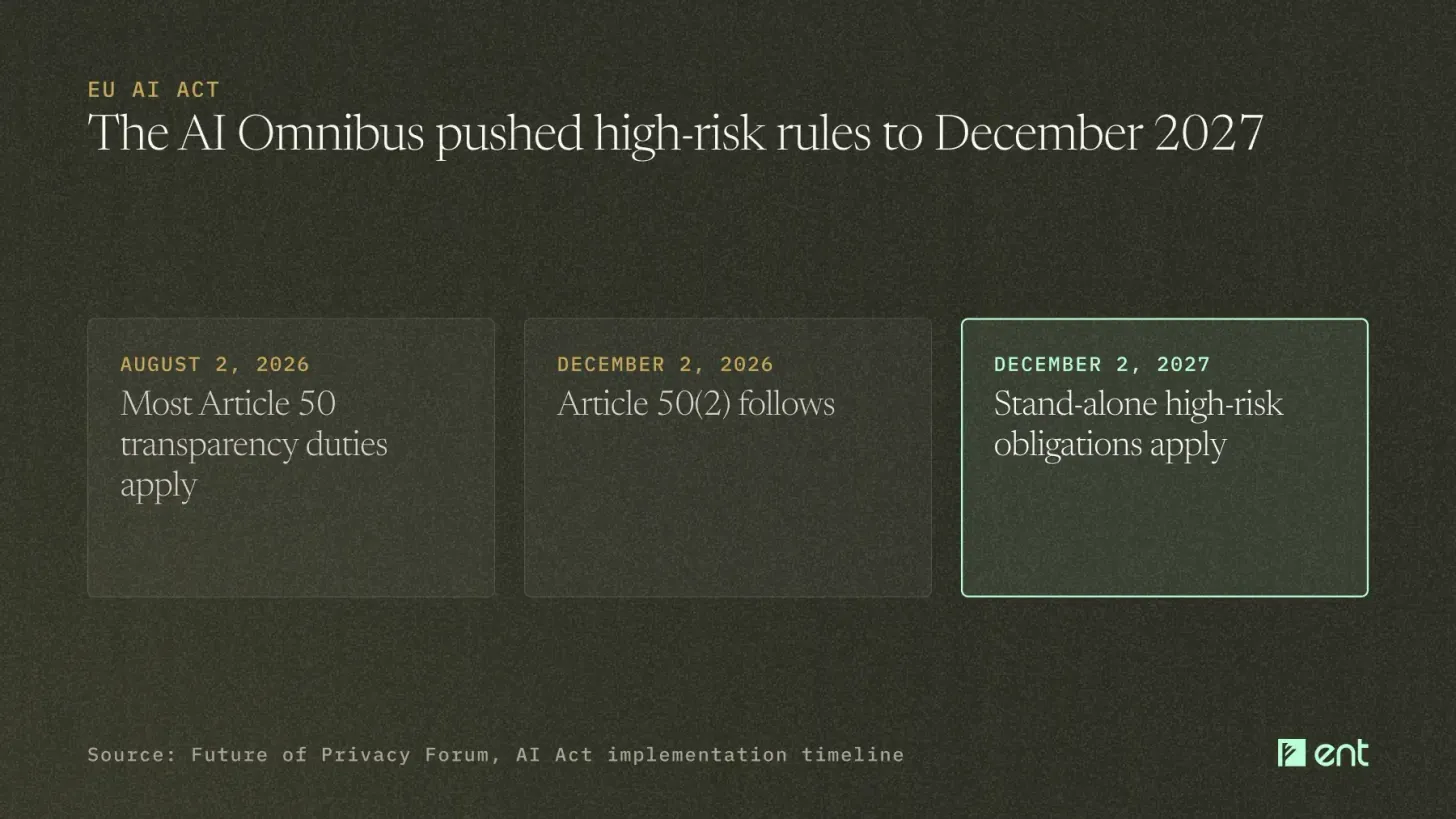
Regulation drives much of the compliance side of the industry. The rollout of the EU AI Act has been a moving target; the AI Omnibus provided some breathing room by pushing back enforcement of high-risk use cases like hiring, credit scoring, and education to late 2027, but most transparency mandates started hitting organizations in August 2026.
Because the legal landscape is shifting so fast, GRC teams rely on compliance governance tools to map their AI architecture against policies like the NIST AI Risk Management Framework and ISO/IEC 42001 to protect themselves in the meantime.
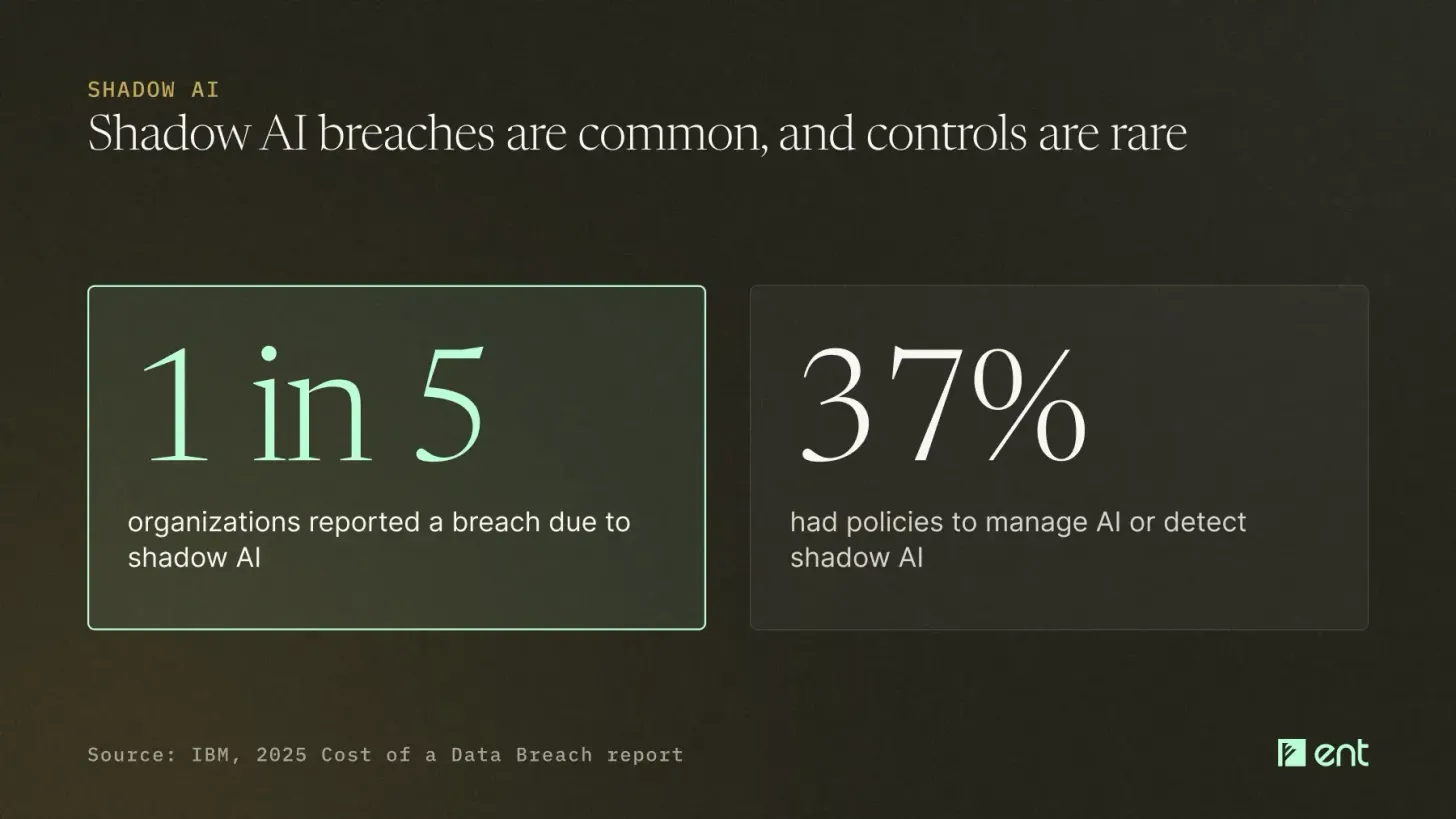
The security side of the market, however, responds to the immediate threats facing organizations from unknown or unmoderated employee AI usage or unregulated agents. According to IBM's 2025 Cost of a Data Breach report, one in five organizations reported a breach from shadow AI. Only 37% had policies to manage AI usage or detect shadow AI.
What to look for in compliance governance
| Capability | What to look for |
|---|---|
| AI inventory and ownership | A single registry of models, apps, agents, and vendors, each with a named owner. |
| Framework mapping and evidence | Templates for the EU AI Act, NIST AI RMF, and ISO/IEC 42001 that produce audit-ready records. |
| Risk assessment workflows | Intake forms and risk tiering that route each use case to the right reviewers. |
| Model monitoring integrations | Connections to the platforms where models run, so drift and bias results feed back into the record. |
What to look for in usage and agent control
| Capability | What to look for |
|---|---|
| Coverage | Which AI tools and agents it can see, from chat apps to coding assistants and autonomous agents. |
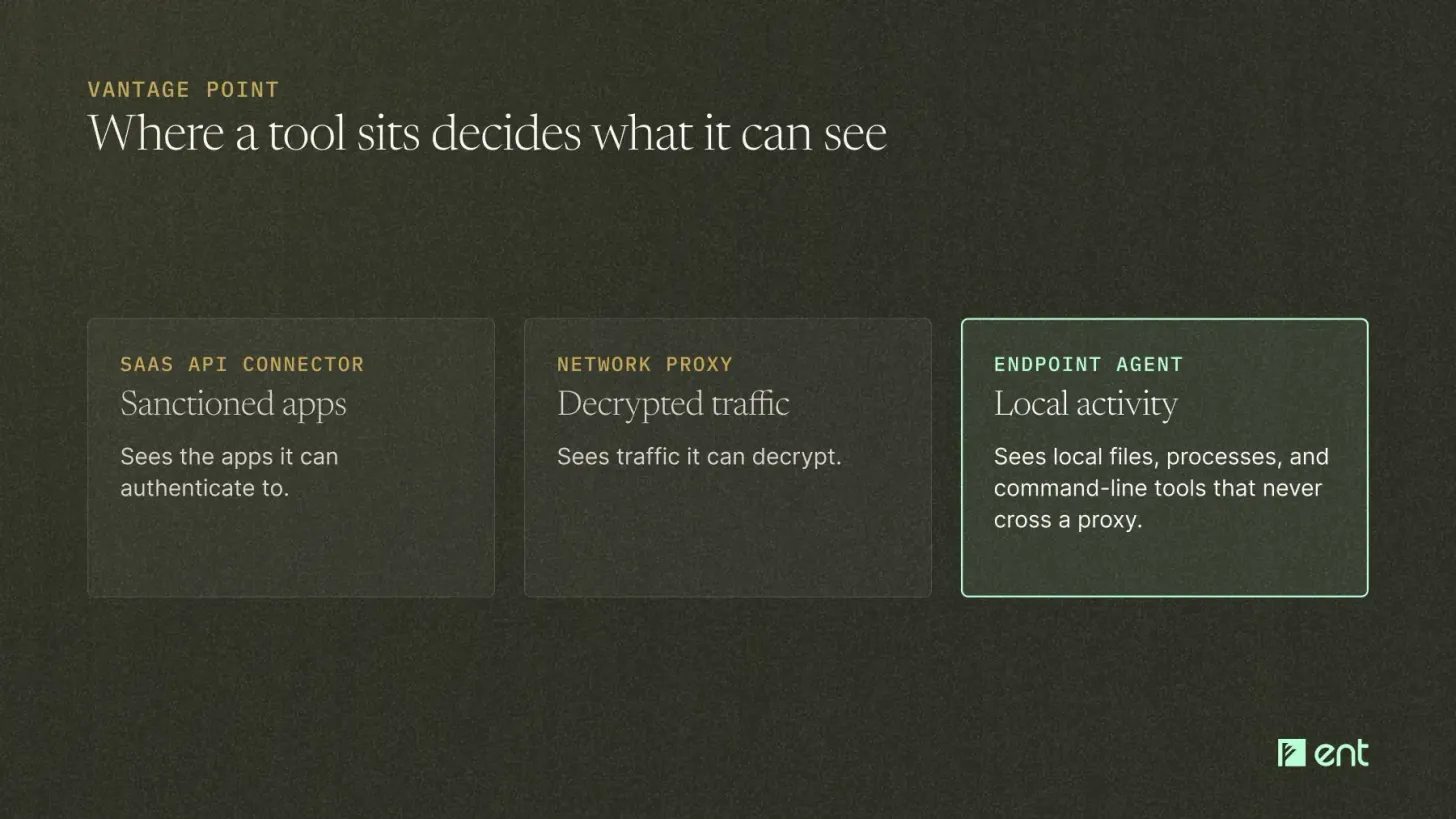
| Vantage point | Where it sees activity, whether through a SaaS API, a network or security service edge (SSE) proxy, a browser extension, or an endpoint agent. |
| Response options | Whether it only alerts, or can also warn, block, or redact in the moment. |
| Prompt data handling | How it spots sensitive data in prompts and uploads, and what happens next. |
Of the four capabilities above, vantage point matters most because it decides what the tool can see. A SaaS API connector sees sanctioned apps, while a network proxy sees traffic it can decrypt. An endpoint agent sees local files, processes, and command-line tools that never cross a proxy.
Each vantage point has its own blind spot, though. An endpoint agent only covers managed devices, while a SaaS API connector also sees activity from unmanaged and personal devices.
Practical buying questions
Most vendors in both categories are quote-only, so ask early about deployment and setup time. Check that findings flow into your existing data-loss protection (DLP), security information and event management (SIEM), and identity tools.
For any endpoint agent or browser extension, also ask about CPU and battery cost, offline behavior, and tamper protection.
The 13 Best AI Governance Tools, By Use Case
The list starts with workforce AI usage and agent control, led by Ent. Model, risk, and compliance governance follows, led by Credo AI with IBM watsonx.governance as a runner-up.
| Tool | Category | What it governs | Where it enforces | Response options | Pricing model |
|---|---|---|---|---|---|
| Ent | AI endpoint security | AI tool and agent activity by people and agents | Endpoint agent and browser extensions | Warn, require justification, constrain, escalate, block, guide, redact | Quote-only |
| Microsoft Purview DSPM (formerly DSPM for AI) | Data security posture management | Copilot, agents, and third-party AI app data risk | Microsoft 365, onboarded devices, browser extension | Audit, warn, block, label-based DLP | Microsoft 365 E5 licensing plus pay-as-you-go |
| Reco | SaaS and AI agent security | SaaS-connected AI agents and integrations | SaaS APIs and OAuth, plus browser and runtime controls | Alert, revoke, disable, block, redact (runtime controls new in 2026) | Quote-only |
| Harmonic Security | AI usage control | Employee AI prompts and AI app use | Browser extension, endpoint, MCP Gateway | Log, coach, warn, block | Quote-only |
| Netskope One (Skylight) | SSE | AI app traffic and prompts | Network proxy and SaaS APIs | Coach, block, redact | Quote-only |
| Credo AI | AI governance platform | AI inventory, risk, and framework evidence | Governance workflows, agent registry | Policy checks, alerts, guardrails | Quote-only, per use case |
| IBM watsonx.governance | AI lifecycle governance | Model risk, monitoring, and compliance | Model platforms and risk console | Evaluations, alerts, workflows | Published tiers from $3,500/month |
| OneTrust AI Governance | AI governance platform | AI inventory, risk tiering, agents | Governance workflows, SDK in apps | Allow, redact, block via SDK | Quote-only |
| Holistic AI | AI governance and risk testing | AI registry, testing, and frameworks | Cloud, code, and SaaS connectors | Alerts, inline agent controls | Quote-only |
| ModelOp Center | AI lifecycle governance | Model lifecycle and audit evidence | Deployment pipeline | Block deployment, open change requests | Quote-only (non-prod from $25,000/month) |
| Monitaur | Model risk governance | Model risk policies and evidence | Governance workflows | Validation, alerts | Govern $500,000, Automate $100,000 per 36 months (AWS) |
| Fiddler AI | AI observability and guardrails | Model and agent behavior in production | Inline guardrails in the AI app | Detect, redact, block | Free, $0.002 per trace, custom |
| Securiti | Data security and AI governance | Sensitive data feeding AI, AI models, agents | Data platform and LLM firewalls | Classify, block, sanitize | Quote-only |
Workforce AI usage, shadow AI, and agent control tools
These tools govern what people and AI agents do with AI tools day to day. Where each one sits decides what it can see and stop.
We chose the five picks below to cover each vantage point, from the endpoint and browser to SaaS APIs and the network. Other tools worth a look include Prompt Security (now part of SentinelOne), Palo Alto Networks AI Access Security, Zscaler's generative AI controls, and Cisco AI Defense.
1. Ent
Ent is intent-aware AI endpoint security for human and agentic work that provides live visibility into AI tools such as OpenAI Codex, Claude Code, Claude Cowork, GitHub Copilot, and Cursor. It shows who uses the platforms, what data goes in, and whether that fits each person's role.
One policy covers both people and AI agents. Both use the same applications, data, and credentials, so Ent is broader than agent security alone. A custom small language model runs on the device and classifies sensitive data at the point of use.
Best for: Security teams that need to control how employees and AI agents use AI on endpoints.
Notable feature: Sequence-level context. Ent connects user activity, agent actions, applications, data, scripts, tools, and process execution into one sequence, then can warn, require justification, constrain, escalate, or block the activity. It also controls shadow AI apps, remote management tools, and living-off-the-land binaries (LOLBins).
Limitation: Ent isn't a model inventory or compliance documentation platform. Pair it with a tool from the model, risk, and compliance group if you need EU AI Act compliance.
Pricing: Not publicly listed.
2. Microsoft Purview DSPM (formerly DSPM for AI)
Microsoft Purview Data Security Posture Management (DSPM) has absorbed and replaced the standalone DSPM for AI product. The admin portal now labels the legacy interface "DSPM for AI (classic)."
It covers Copilot, agents, and third-party AI apps with an AI observability view that inventories AI apps and agents for recent activity, prompts, and responses that contain sensitive data.
Best for: Microsoft 365 organizations managing Copilot and AI app data risk.
Notable feature: Native Copilot controls. A DLP policy can stop Microsoft 365 Copilot and agents from summarizing files with selected sensitivity labels.
Limitation: Visibility into non-Microsoft AI apps needs pay-as-you-go billing and device onboarding. It also needs the Purview browser extension for Chrome or a configuration policy for Edge, and a secure access service edge (SASE) or SSE integration can add network detection. Unmanaged devices and unsupported browsers fall outside endpoint DLP.
Pricing: Microsoft Learn lists a Microsoft 365 Copilot license for Copilot and agents, plus pay-as-you-go billing for other AI apps. The Purview service description doesn't spell out DSPM entitlements, so confirm E5 or E5 Compliance coverage with Microsoft. Microsoft 365 E5 lists at $60 per user per month with Teams ($51.45 without).
3. Reco
Reco discovers AI tools and agents from the SaaS and identity layer by analyzing OAuth permissions and API calls. It finds AI features and agents across platforms like Copilot, ChatGPT, Claude, Agentforce, and n8n and can then revoke excessive permissions or disable unauthorized agents.
Best for: Teams that need to find and clean up AI agents and integrations connected to their SaaS apps.
Notable feature: Reco Graph maps agents, identities, applications, permissions, and data together. You can see which embedded agent holds which OAuth scopes.
Limitation: Reco's traditional strength is API-based posture and detection. The company recently expanded into runtime controls, launching Browser Guard and runtime prompt analysis shortly after. Because these are new features, be sure to confirm their general availability and thoroughly test them during a proof of concept.
Pricing: Not publicly listed. While pricing is based on a per-user model, third-party buyer data from Vendr indicates a median annual cost of around $12,000.
4. Harmonic Security
Harmonic Security governs how employees use AI tools. It runs as a browser extension and adds endpoint coverage for desktop apps, integrated development environments (IDEs), and copilots, plus an MCP Gateway for agent traffic. Small language models read each prompt and classify it in less than 200 milliseconds, according to the vendor.
Best for: Security teams that want to coach employees toward approved AI tools without routing traffic through a proxy.
Notable feature: Prompt-level classification by use case. Harmonic can coach, warn, or block, and can redirect users to an approved enterprise assistant.
Limitation: Harmonic doesn't advertise redaction of sensitive data inside prompts. Coverage also depends on the extension and endpoint components being deployed on managed devices.
Pricing: Not publicly listed. Its pricing page shows three tiers (Explore, Guide, and Command) without prices.
5. Netskope One (Skylight)
Netskope governs AI use through its foundational Netskope One SSE platform, with its specialized AI security suite Netskope Skylight layered on top. It inspects prompts and responses inline and through APIs, and it tells corporate AI accounts apart from personal logins.
Best for: Organizations that already route traffic through an SSE.
Notable feature: Inline redaction. A DLP match can redact the sensitive detail and let the task continue.
Limitation: Inline controls only see traffic steered through Netskope's client, tunnels, or proxy, and API connectors cover sanctioned apps. Given that architecture, an agent's local file reads and command-line actions won't show up unless they create steered traffic. Netskope’s new Skylight Agent Action Control also works on inspected network traffic.
Pricing: Not publicly listed. Vendr reports a median of about $96,815 a year for the whole Netskope One platform (not AI controls alone), based on 45 purchases.
Model, risk, and compliance governance tools
While the previous tools protect and track endpoints, these platforms sit at the organizational level and treat AI as a trackable corporate asset. Model, risk, and governance compliance systems help GRC, legal, and data science teams inventory AI systems, assess risk, and prove compliance.
6. Credo AI
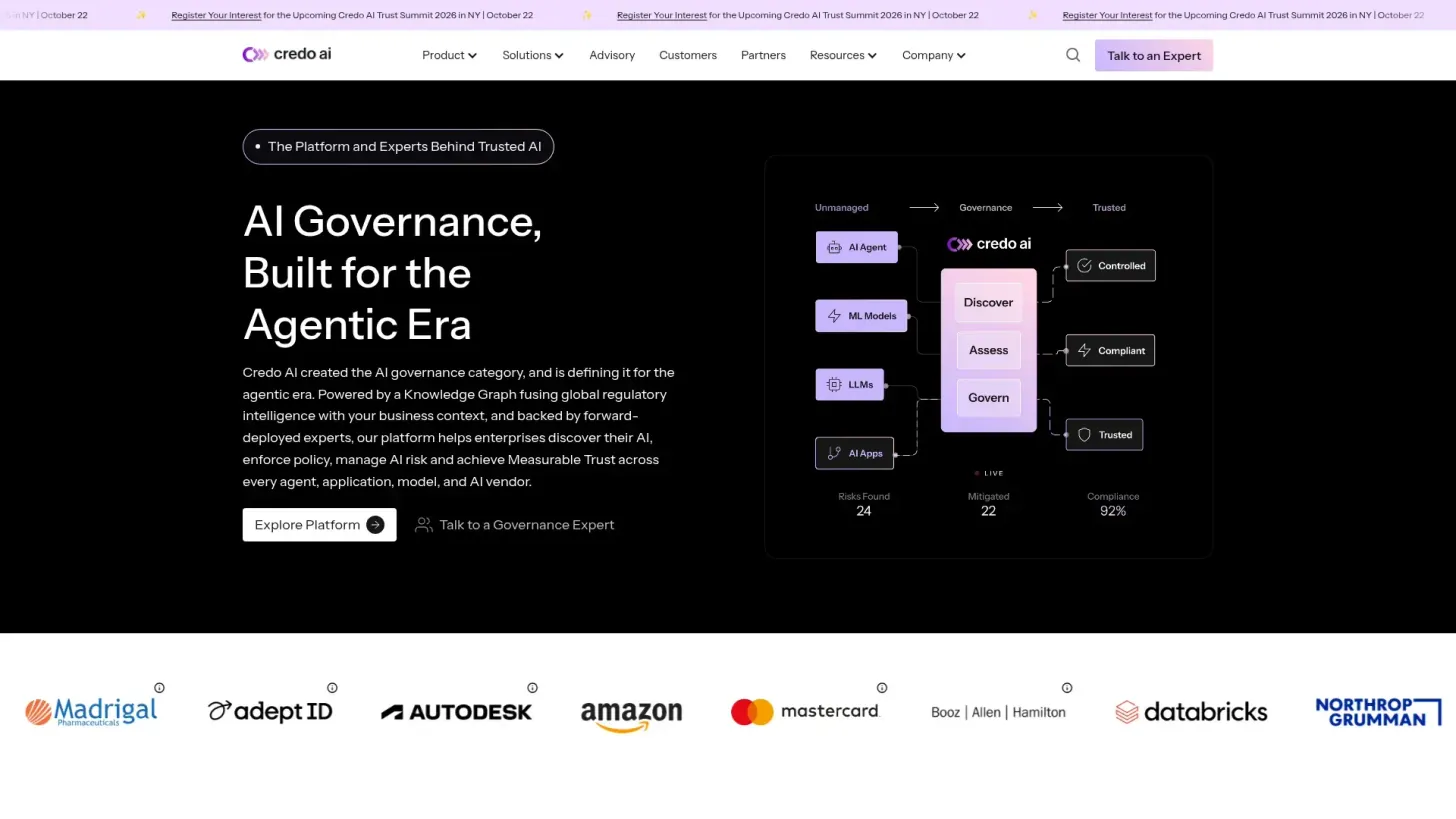
Credo AI is a governance platform built for compliance and risk teams that keeps a central inventory of AI systems, including agents, models, apps, and shadow AI. Pre-built policy packs cover the EU AI Act, NIST AI RMF, ISO/IEC 42001, and SOC 2.
Best for: GRC teams that need framework-ready evidence and want agents tracked in the same inventory as models.
Notable feature: An agent registry with "agent cards" that record each agent's purpose, tools, data sources, and guardrails. It also governs MCP servers.
Limitation: Enforcement depends on integrations with the platforms where models and agents run, so it isn't built to watch or stop employee AI use on devices.
Pricing: Not publicly listed. The AWS Marketplace listing prices an annual plan by the number of AI use cases through a private offer.
7. IBM watsonx.governance
IBM watsonx.governance pairs model evaluation and monitoring with a risk console built on IBM OpenPages. It tracks AI risk across the lifecycle and includes a catalog for registering and evaluating agents.
Best for: Large enterprises already using IBM or OpenPages for model risk management.
Notable feature: Cross-vendor monitoring. Ashish, a senior consultant, wrote on G2 that he appreciates it "isn't limited to just IBM's AI; it can monitor AI from other companies."
Limitation: Packaging is complex. The risk and compliance tiers are priced per instance, per module, and per concurrent user.
Pricing: IBM's pricing page lists Risk and Compliance Basic from $3,500 a month and Advanced from $6,450 a month. Each includes one instance, one module, and one concurrent user. An AWS plan costs $42,000 a year for 5 AI use cases and 25 concurrent users.
8. OneTrust AI Governance
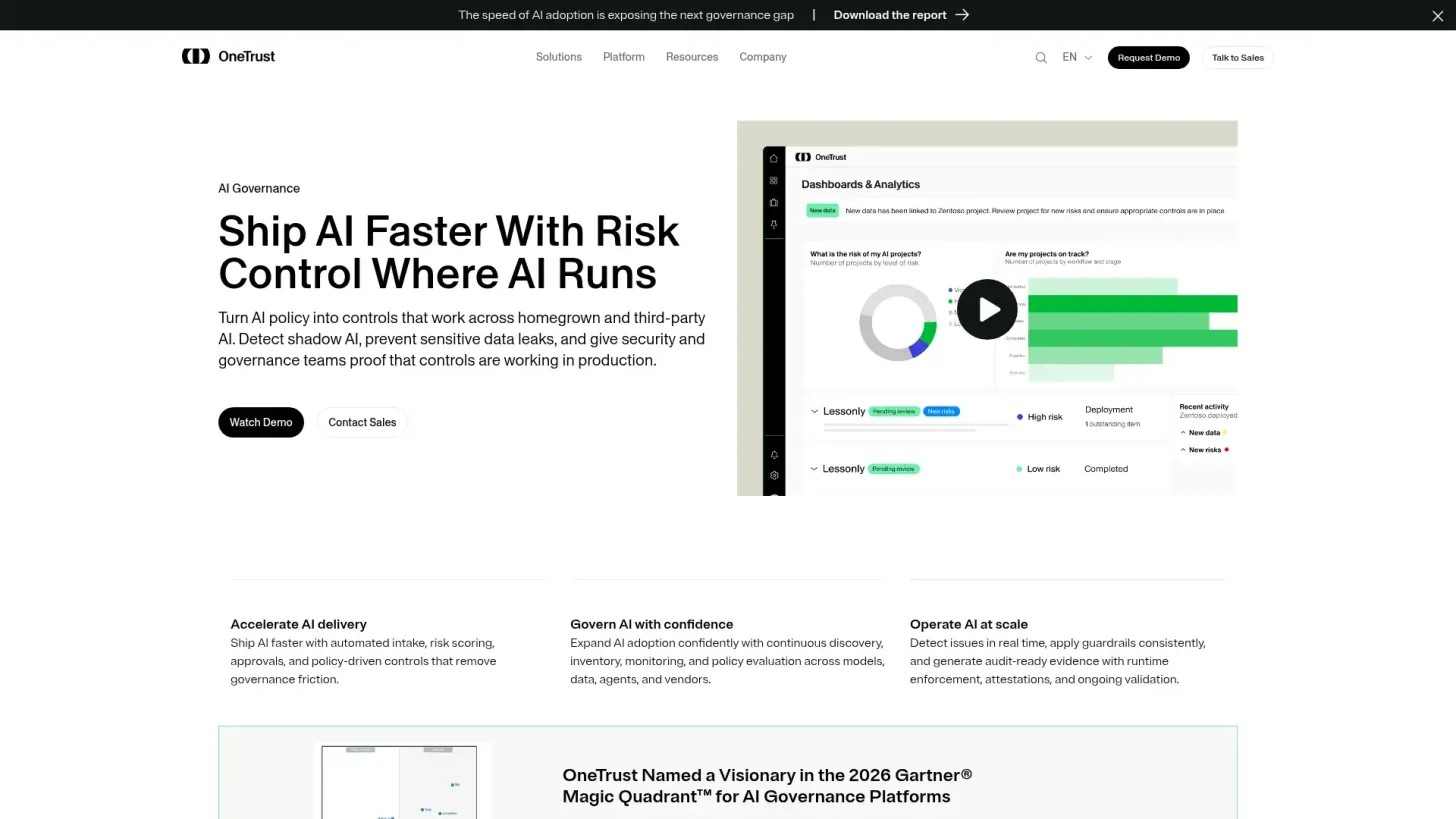
OneTrust AI Governance inventories AI systems, models, agents, datasets, and vendors, then applies EU AI Act, NIST AI RMF, and ISO/IEC 42001 templates. It automates risk tiering by use case, data sensitivity, and deployment context. The tool has also expanded into runtime protections through agent registration and MCP policy enforcement.
Best for: Privacy and GRC teams that already run OneTrust and want AI governance in the same platform.
Notable feature: An AI Policy Engine that turns written policies into machine-readable rules. An SDK can then allow, redact, or block sensitive data in prompts and outputs.
Limitation: Runtime enforcement relies on the SDK, so engineering teams must instrument each app. OneTrust's pages don't describe how its shadow AI detection sees employee use of outside AI tools.
Pricing: Not publicly listed. OneTrust's enterprise pricing page says pricing is based on admin users and AI inventory.
9. Holistic AI
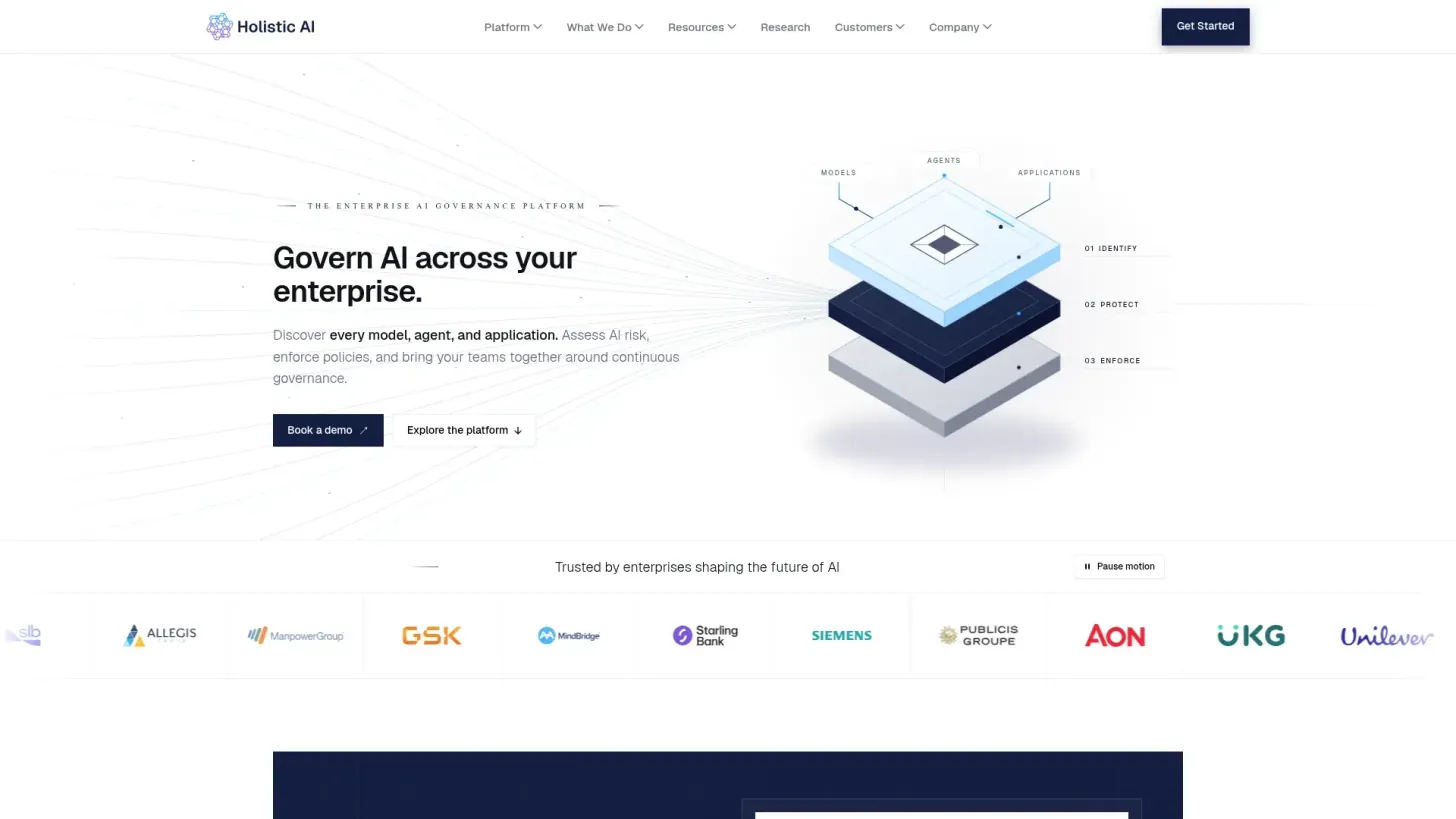
Holistic AI keeps a live registry of models, agents, datasets, and endpoints, then scans cloud, code, and SaaS to identify ungoverned AI. Framework assessments cover the EU AI Act, NIST AI RMF, ISO/IEC 42001, and New York City's Local Law 144.
Best for: Teams that need bias testing and agent red teaming alongside compliance tracking.
Notable feature: Built-in testing covers bias, robustness, privacy, and jailbreaks. Runtime agents can monitor for prompt injection and data leakage.
Limitation: Its public pages don't describe deployment options, and little public user feedback exists.
Pricing: Not publicly listed.
10. ModelOp Center
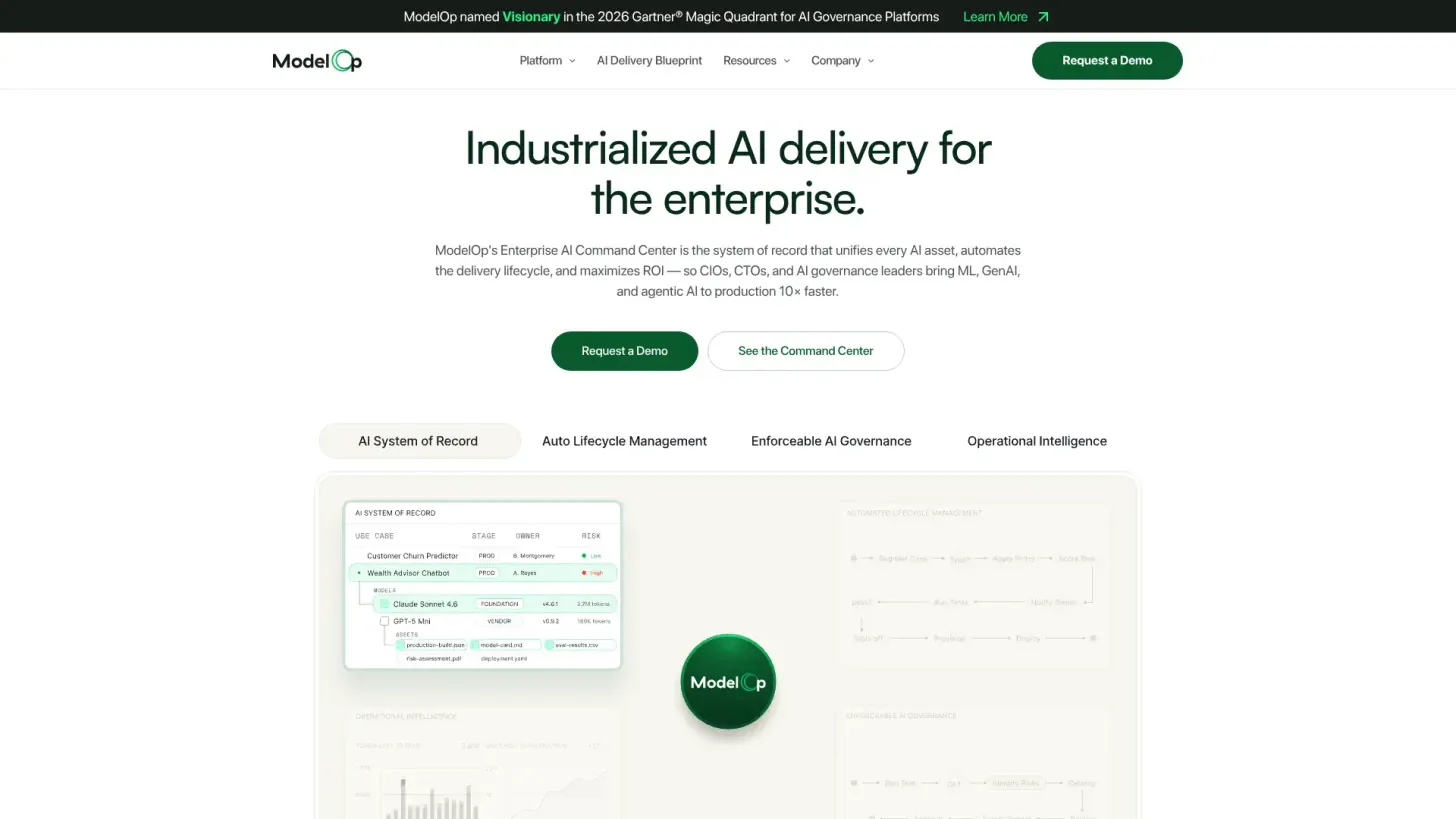
ModelOp acts as a system of record for machine learning (ML), generative AI, agents, and vendor AI. It runs lifecycle workflows from intake to retirement and auto-generates a risk tier for each use case. Automated tests for bias, drift, and performance feed audit evidence.
Best for: Enterprises that need governance enforced at deployment time.
Notable feature: Enforcement in the pipeline. ModelOp can block a drifting model from deploying and open a ServiceNow change request automatically.
Limitation: It's a heavy enterprise lift. Public pricing covers only a non-production instance.
Pricing: The AWS Marketplace listing shows a non-production instance at $25,000 a month. Production pricing comes through a private offer.
11. Monitaur
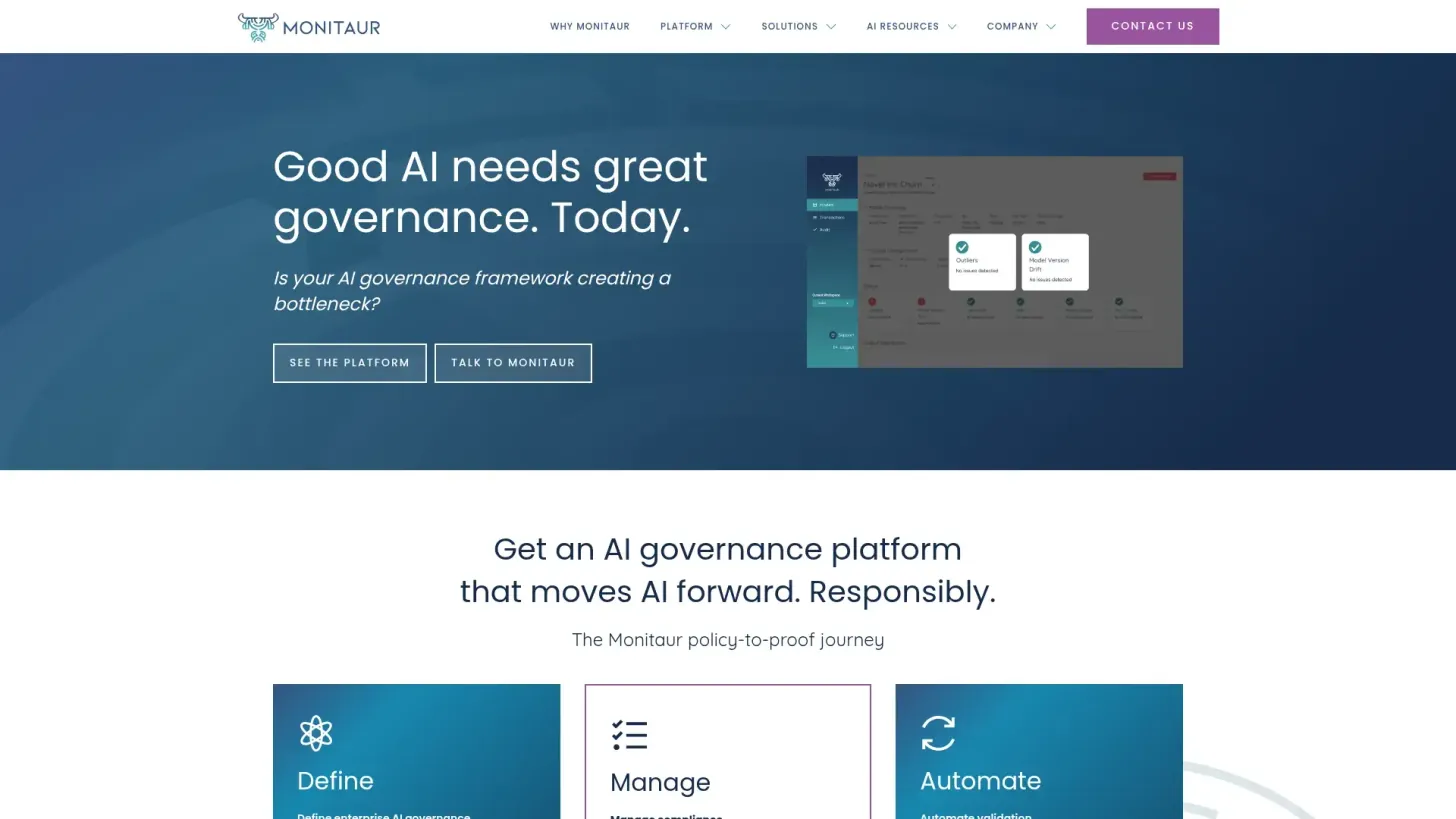
Monitaur takes a "policy-to-proof" approach across the AI lifecycle. It maps evidence from existing systems to a common controls library aligned with NIST AI RMF, ISO/IEC 42001, and the EU AI Act, along with running pre-deployment evaluations and continuous drift and bias checks.
Best for: Insurers and financial services firms with formal model risk management programs.
Notable feature: Deep focus on insurance model governance. Vendor governance comes with controls pre-mapped for generative and agentic AI vendors.
Limitation: It's priced for large programs. Its public pages also don't describe deployment beyond SaaS on AWS.
Pricing: The AWS Marketplace listing prices Monitaur Govern at $500,000 and Monitaur Automate at $100,000, each on a 36-month contract.
12. Fiddler AI
Fiddler AI is an observability and runtime control platform for ML models and AI agents by combining evaluation, drift and explainability monitoring, and inline guardrails. The guardrails detect or redact personally identifiable information (PII), protected health information (PHI), and secrets, along with flagging prompt injection and jailbreaks.
In November 2026, CrowdStrike agreed to acquire Fiddler and plans to sell it as Falcon Observe on its Falcon platform. The deal is expected to close by the end of January 2027.
Best for: ML and platform teams monitoring the models and agents they build.
Notable feature: Explainability. A developer at ADP said on PeerSpot that "Fiddler AI shows both the change and the reason behind it."
Limitation: Fiddler is observability-first. Its pages don't describe use-case intake, risk tiering, or framework control mapping.
Pricing: Fiddler's pricing page lists a free tier with real-time guardrails and a Developer tier at $0.002 per trace. Enterprise pricing is custom and adds virtual private cloud (VPC) and on-prem deployment.
13. Securiti
Veeam acquired Securiti in December 2025. Securiti ties AI governance to the data that feeds it. Its platform maps data, identities, AI models, and agents on one graph and adds prompt, retrieval, and response firewalls for generative AI apps.
Best for: Data and privacy teams that want AI governance tied to sensitive data discovery and classification.
Notable feature: Agent Commander, announced in February 2026, aims to detect risky agent behavior and undo unwanted agent actions using Veeam recovery.
Limitation: AI governance is one module in a broad data platform. Its public pages don't describe model risk tiering the way dedicated model governance tools do.
Pricing: Not publicly listed. Vendr reports a median annual contract of about $49,841 based on buyer data.
The Gap Most AI Governance Tools Miss: What Happens On The Device
Inventories, policy documents, and SaaS or network monitoring leave a blind spot: AI agents and coding assistants act on the endpoint using a user's own files, credentials, and authorized tools. Harmonic and Purview see on-device events like prompts and file uploads, but few tools connect file reads, process execution, and network activity into one sequence.
Traditional security tools look for malicious behavior and known attack patterns, and they're good at identifying it. An AI agent doing something harmful through its normal, authorized actions, however, doesn't look malicious at the process level.
Consider a coding agent that connects to an unvetted MCP server. It reads a customer CSV from the repo, then sends the rows to a third-party tool through that server. Each step is normal on its own, but the sequence results in exfiltration.
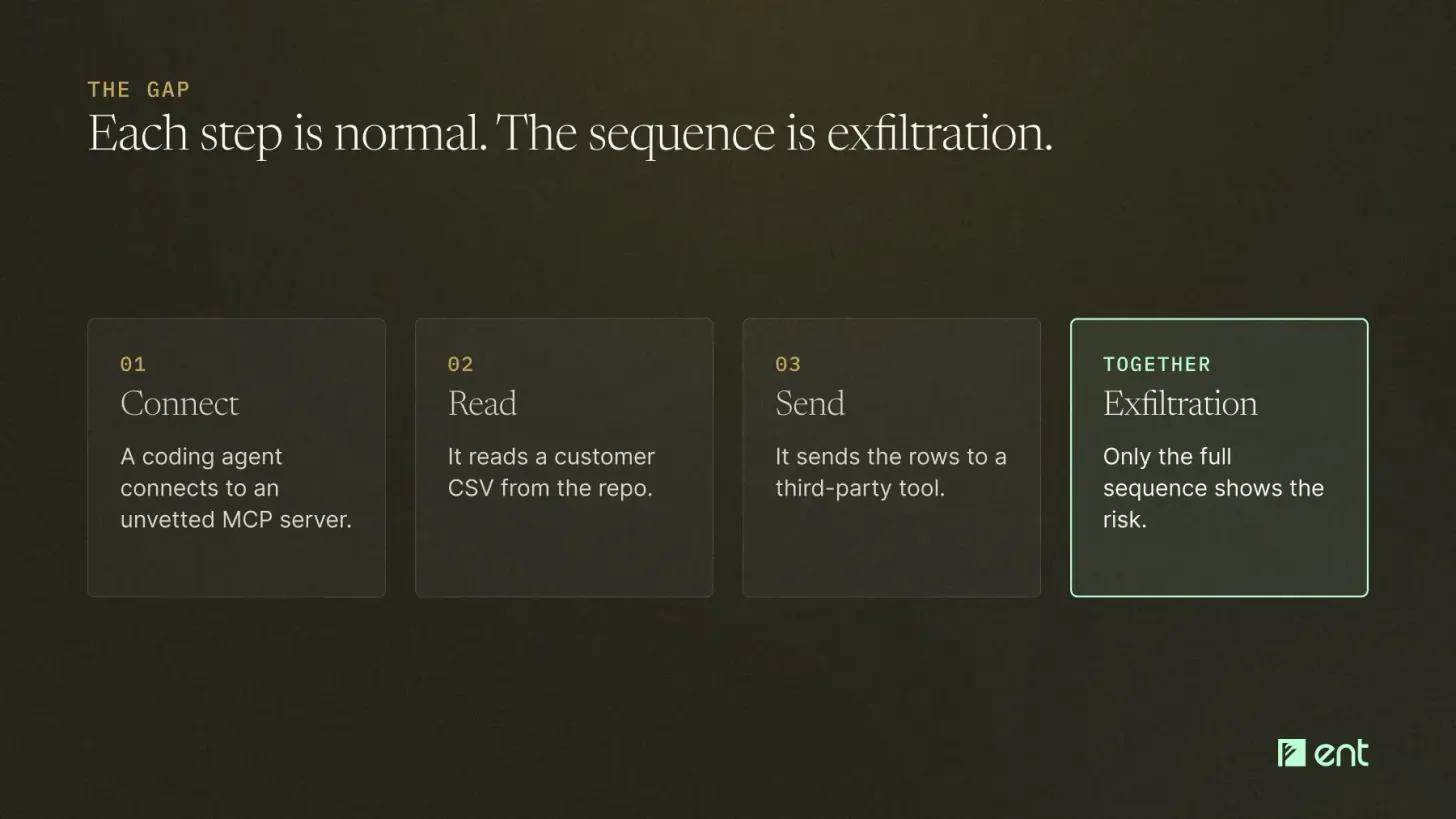
A compliance registry won't flag it if the agent was approved and the MCP server was added on the developer's machine. A SaaS API connector never sees it. A network proxy may see the outbound request but not the file read that came first.
This is why a program’s vantage point sits at the top of our evaluation list. Brandon Dixon, co-founder of Ent, sums up the problem:
"Logs are summaries. They describe fragments of what happened, but rarely the full story."
The pressure is growing. IBM's newest Cost of a Data Breach report found AI systems enabled one in four malicious breaches, a 56% increase over last year. AI is already part of how attacks happen, and agents with legitimate access add more activity that looks normal in isolation.
How Ent Approaches AI Governance For People And Agents
Ent brings AI to the endpoint to understand actions in sequence and the intent behind them. Deterministic policy, behavioral intelligence, and local AI reasoning answer three questions:
- What is happening? The full sequence of user, agent, application, and data activity.
- Why is it happening? The intent Ent interprets behind that sequence.
- Should it continue? The policy decision to allow, warn, constrain, escalate, or block.
For data in AI apps, Ent can also guide the user or redact sensitive content.
Ent complements your existing endpoint detection and response (EDR) or extended detection and response (XDR). Those tools stay strong at malware, device, and process-level protection, but Ent adds user, application, data, agent, and intent context, and pairs with a platform from the model, risk, and compliance group.
Deployment is flexible. Ent runs as SaaS or as a customer-controlled deployment in your own cloud. That lets sensitive telemetry and processing stay in your environment where required.
Elias Manousos, CEO and co-founder of Ent, explains why Ent works at the endpoint:
"Prevention needs context from browsers, applications, and files so it can distinguish legitimate work from a hijacked user or rogue AI agent."
Want to see how Ent governs AI tools and agents on your own endpoints? Book a demo to walk through it with your team.
FAQ
What is the best tool for AI governance?
It depends on the job. For governing how people and AI agents use AI tools on their devices, Ent is the strongest fit. For model inventory, risk assessments, and regulatory evidence, look at Credo AI, IBM watsonx.governance, or OneTrust AI Governance.
What are examples of AI governance?
Examples include keeping an inventory of AI models and agents, running risk assessments before deployment, and producing EU AI Act documentation. Blocking sensitive data from an unapproved chatbot or restricting a coding agent’s functionality also counts.
What are the six pillars of AI governance?
Although several experts list six components of AI governance, NIST's AI Risk Management Framework names seven characteristics of trustworthy AI: valid and reliable; safe; secure and resilient; accountable and transparent; explainable and interpretable; privacy-enhanced; and fair with harmful bias managed. The NIST AI RMF defines each one in detail.
What is the difference between AI governance and data governance?
Data governance controls how data is collected, stored, and accessed. AI governance controls how AI systems and tools are built, bought, and used. The two overlap wherever sensitive data flows into a model, a prompt, or an agent.
Do I need an AI governance tool if I already have a GRC platform or EDR?
Usually, yes, because a GRC platform rarely discovers AI usage or enforces controls in real time. EDR is strong at malware and known attack patterns. It isn't built to tell when an authorized agent's normal actions add up to a risky sequence.
How do you govern AI coding assistants and agents on employee devices?
Start with visibility into which assistants and agents run on each device, and what data and tools they touch. Then set one policy for both people and agents. Endpoint-based tools like Ent work here because the agent's actions happen on the device itself.